
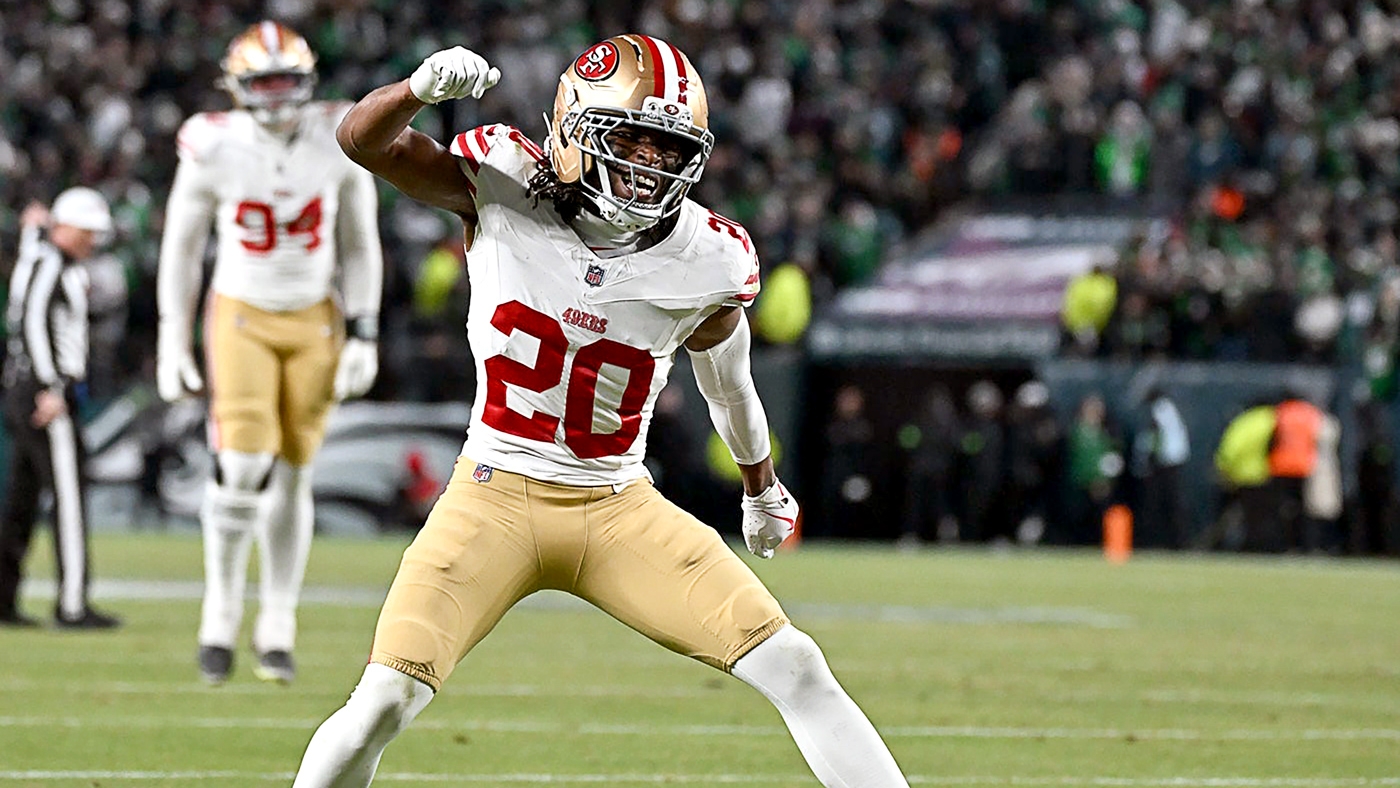

The transition from college football to the NFL is rarely seamless, particularly for defensive backs tasked with handling some of the league’s most dynamic route-runners who generally operate from the slot. For San Francisco 49ers rookie cornerback Upton Stout, that reality became evident during his first season.
Despite earning the starting slot corner role out of training camp, Stout was recently ranked among the lowest-graded slot defenders in football by Pro Football Focus (PFF), highlighting some of the challenges he faced throughout the year.
Stout, 23, entered the season with significant expectations after being a third-round draft selection, No. 100 overall, and that only intensified after winning the starting nickel job in the preseason. Slot corner is one of the most demanding positions on the field, requiring not only quick processing, disciplined footwork, and elite-level agility but also the ability to defend both the pass and the run. While flashes of promise were present, consistency proved elusive as opposing offenses frequently targeted Stout on third down and in critical situations.
Statistically, Stout’s season was a mixed bag. Appearing in 16 games, he finished with 82 combined tackles, five passes defended, one forced fumble, and one sack. The tackle total highlights his willingness to contribute in run support and his availability on a snap-to-snap basis, particularly in underneath coverage.
49ers Upton Stout faces growing pains after difficult rookie season
His 65.6 PFF defense grade when lined up in the slot ranked 20th among 36 NFL defensive backs with at least 270 slot-defender snaps. Stout’s qualifying 77.8 PFF run-defense grade ranked 11th, and his qualifying 77.6 PFF pass-rush grade ranked seventh. Stout’s reliable run defense and blitz-viability give him a chance to retain the starting role in 2026, potentially preserving his status as a slot defensive back to target in wide receiver matchups.
In addition, Stout’s overall coverage grade of 60.6 ranked 26th of 36. His targeted rate of 20.9% ranked 34th of 36, and his open-target rate of 67.1% ranked 32nd of 36. If that doesn’t seem bad enough, Stout’s 532 receiving yards allowed ranked 36 of 36, last among corners that meet the criteria above.
NFL Slot DB Coverage
Upton Stout
PFF Coverage Grade
60.6 (No. 26)
Targeted Rate
20.9% (No. 34)
Open-Target Rate
67.1% (No. 32)
Receiving Yards Allowed
532 (No. 36)
Catch Rate Allowed
72.7% (No. 23)
Forced Incompletion Rate
9.2% (No. 15)
Yards Allowed Per Coverage Snap
1.46 (No. 31)
Explosive Pass Plays Allowed
12 (T-No. 34)
Explosive Pass Plays Allowed Rate
3.3% (T-No. 33)
These struggles are not uncommon for rookie defensive backs, especially those thrust into full-time roles early in their careers. The speed of NFL route concepts, combined with the physicality of professional receivers, often exposes technical flaws that were less apparent in lower levels. For Stout, those growing pains were magnified by the responsibility of anchoring the slot, where mistakes are quickly exploited.
Plus, let’s not discount the fact that the 49ers had one of the worst pass-rushes in the league when superstar Nick Bosa went down in the third game of the season with a torn ACL. Not having a pass-rush will leave a team’s secondary on an island, which happened to the 49ers.
Even the best corners on the planet are not going to be able to cover NFL wide-outs for five, six, and seven seconds, let alone over and over again. The 49ers ranked 29th in the league, according to ESPN, with a pass-rush win rate of just 29%.
Still, the season was not without value for the 49ers or for Stout’s development. Logging a full year of starting experience is worth noting. With an offseason to refine technique, improve anticipation, and better understand route combinations, Stout will have an opportunity to address the shortcomings that contributed to his low ranking.
Although the data above is a bit depressing, look on the bright side of things: Stout gained that invaluable experience and will have an opportunity to grow and improve.