
HONOLULU (HawaiiNewsNow) – Medical experts are warning Hawaii patients to take a closer look at their medical bills. Hawaii’s general excise tax can be misapplied, potentially leading to overcharges and frustration for providers navigating the complex calculations.
How the tax is supposed to work
Most medical providers set prices for their services, but insurance companies typically pay them less than the listed price.
Under Hawaii law, the excise tax is supposed to be calculated based on what the provider is actually paid by both the insurance company and the patient, not on the original price the provider intended to charge.
Dr. Kelley Withy, a medical school professor who advises doctors on how to charge Hawaii’s 4 percent or 4.5 percent excise tax, said patients should not rush to pay after a visit.
“I always tell whoever’s trying to charge me the full amount, I say, ‘I’m going to see how much my insurance pays first, because that’s the number that I’m going to have to pay of what’s left,’” Withy said.
She said the tax adds a layer of confusion because it is a charge that other states do not have.
A real-world example of overcharging
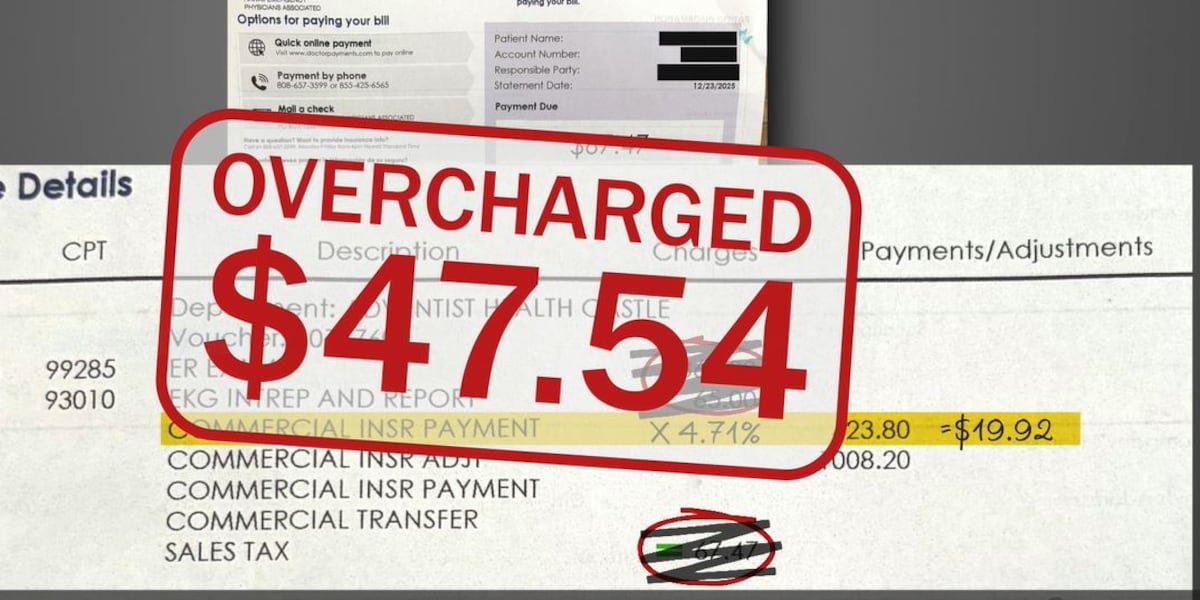
HNN Investigates obtained a bill from a viewer who was overcharged on taxes following an emergency room exam and electrocardiogram.
The provider’s listed price totaled just over $1,400.
The bill applied 4.71 percent, Oahu’s 4.5 percent excise tax plus a small amount to cover tax on the tax, to that full amount, producing a tax charge of $67.47.
But the excise tax should have been applied only to what the provider was actually paid, which was just over $400 from the insurance company.
The correct tax on that amount would have been $19.92, meaning the patient was overcharged by more than $47.
It took the patient and the doctor’s office three months to resolve the correct charge.
Why errors happen
Dr. Scott Miscovich, owner of Premier Medical Group, an independent provider, said the miscalculation is a systemic problem.
“This is impossible for a doctor’s office to be able to solve that because a lot of it is basically determined by the insurance company,” she said.
Dr. Miscovich said offices often do not know what an insurer will pay until a statement arrives weeks later.
“Well, a doctor’s office has no idea what the insurance company is going to pay them or not pay them until they just get this a month later, some kind of statement in the mail that goes into our billing systems and our billing companies,” Dr. Miscovich said.
Independent doctors take on burden
Most large providers, such as hospitals, are nonprofit organizations and are not required to pay the general excise tax.
That means the compliance burden falls most heavily on independent doctors.
The delayed insurance payments can also generate small follow-up bills months after a visit, sometimes for just a few dollars, that still cost providers money to send.
Dr. Miscovich said she receives many bills totaling just $2 or $3.
“We pay through the nose for the billing systems and companies,” Miscovich said. “You have to pay $1.50 for every letter that goes out to the patient.”
She added, “It almost seems like it’s just another push to hurt the private practice communities, and boy, is it hurting the people of Hawaii because we are so short of all types of doctors and especially the high-end specialists, and primary care is hard to find,” Miscovich said.
What patients can do
Anyone who suspects they have been overcharged is asked to contact the provider or billing company directly.
Providers in the cases reviewed by HNN Investigates were apologetic and seemed to appreciate having the error pointed out and either waived the charge or issued a refund.
Providers who fail to correct improper charges could face scrutiny from the state tax department.
Copyright 2026 Hawaii News Now. All rights reserved.