
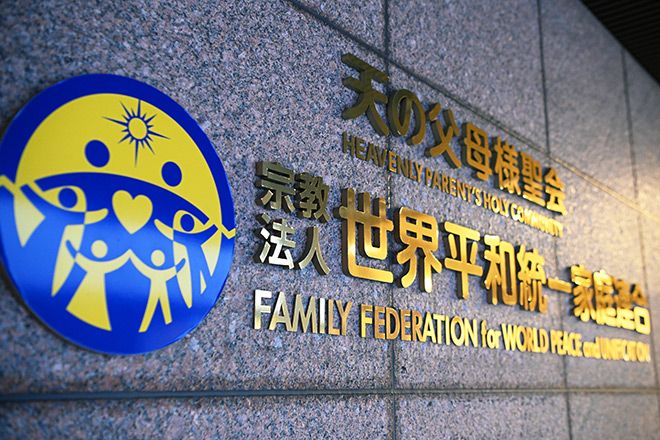
The Tokyo High Court on March 4 upheld a lower court’s order for the former Unification Church to dissolve, agreeing that the organization’s solicitation for large donations has continued to harm society.
Although the organization, now officially called the Family Federation for World Peace and Unification, intends to file a special appeal with the Supreme Court, the high court’s decision means liquidation proceedings can begin under the Religious Corporations Law.
The “liquidator,” an attorney to be appointed by the Tokyo District Court, will administer the church’s assets and arrange compensation payments to victims of its donation solicitations and other practices.
Nobuya Fukumoto, an attorney for the organization, expressed anger over the decision.
“This is unbelievable,” he told reporters. “How can something like this be permitted in a nation governed by the rule of law?”
However, he said the church would “cooperate” with liquidation procedures while it appeals to the top court.
The Ministry of Education, Culture, Sports, Science and Technology, which has jurisdiction over religious organizations, asked the Tokyo District Court to order the dissolution of the church over its shady financial practices.
The court in March last year issued the order, saying the church’s “solicitation for donations and other practices had caused enormous harm, which continues at a degree that cannot be overlooked.”
The church filed an appeal with the high court, but Presiding Judge Motoko Miki sided with the district court’s decision.
The Christian-based Unification Church was founded in South Korea in 1954 and certified as a religious corporation in Japan in 1964.
In the 1980s, the church’s “spiritual sales” became a social problem in Japan.
Under this scheme, believers of the organization preyed on the anxieties of others facing various difficulties, telling them that “your unhappiness stems from ancestral karma, and you must purchase a vase or a signature stamp to dispel it.” To regain “happiness,” the victims gave large monetary donations to the church.
In July 2022, former Prime Minister Shinzo Abe was shot and killed while delivering a campaign speech in Nara during the Upper House election.
The assassin, Tetsuya Yamagami, 45, said his mother, a church follower, had donated large sums that financially ruined his family. He said he targeted Abe because of his close connections to the religious organization.
The killing rekindled public attention on the organization’s donation practices and its ties to politicians.
The Ministry of Education, Culture, Sports, Science and Technology and the Cultural Affairs Agency began efforts to ascertain the circumstances surrounding the church.
They checked past civil court judgments ordering the organization to pay damages and held hearings with more than 170 victims.
They confirmed that, since the 1980s, more than 1,500 individuals had suffered a total of about 20.4 billion yen ($130 million) in damages through large-sum donations and related practices.
Under the Religious Corporations Law, a court may order the dissolution of a religious corporation “found to have violated laws and regulations and to have clearly caused serious harm to public welfare.”
After determining that the Family Federation for World Peace and Unification met these statutory requirements, the ministry filed a petition for a dissolution order in 2023.
In the high court proceedings, the central issue was whether “harm” had continued after the organization issued a 2009 legal compliance declaration, which aimed to implement structural reforms within the organization.
The organization also criticized the district court for including settlement cases that never went to trial as “harm,” arguing that those settlements had not been examined through formal fact‑finding by a court.
It further contended that the dissolution order was unnecessary because the church is currently addressing restitution to victims through such measures as establishing a compensation committee.
In response to the high court’s decision, the organization issued a statement that said the dissolution order fulfills Yamagami’s wish “to resent the Family Federation and harm it.”
“It can be said that this amounts to the entire nation carrying out the wishes of the perpetrator and terrorist who killed former Prime Minister Abe,” the statement said. “This decision is an unjust determination that is baseless, goes against the principle of evidence‑based adjudication, and renders a preconceived conclusion.”
The organization said it will continue to “fight to protect freedom of religion, including filing a special appeal to the Supreme Court.”