
Your support helps us to tell the story
From reproductive rights to climate change to Big Tech, The Independent is on the ground when the story is developing. Whether it’s investigating the financials of Elon Musk’s pro-Trump PAC or producing our latest documentary, ‘The A Word’, which shines a light on the American women fighting for reproductive rights, we know how important it is to parse out the facts from the messaging.
At such a critical moment in US history, we need reporters on the ground. Your donation allows us to keep sending journalists to speak to both sides of the story.
The Independent is trusted by Americans across the entire political spectrum. And unlike many other quality news outlets, we choose not to lock Americans out of our reporting and analysis with paywalls. We believe quality journalism should be available to everyone, paid for by those who can afford it.
Your support makes all the difference.Read more
An “intense” Saharan dust plume is to sweep into Europe this week as sand from North Africa is blown into the Iberian peninsula and western Mediterranean.
Colourful sunrises and sunsets, hazy skies, and occasional deposits of dust if it rains, could be observed in some areas, according to the EU’s Copernicus Atmosphere Monitoring Service (CAMS).
Spain, Portugal and parts of France will be especially affected around Friday before the plume moves into the North Sea and Scandinavia. Sand could reach Britain too, but the effects will be far more marginal.
Rainfall could bring the dust down to the surface because of what experts call a high likelihood of a “wet deposition”. This would increase the potential impacts on visibility and air quality. In the past, air travel has been disrupted due to low visibility.
While the transport of dust in this manner is “fairly common” this time of year, according to Mark Parrington, a senior scientist at Copernicus, the current transition marks a particularly “remarkable” episode.
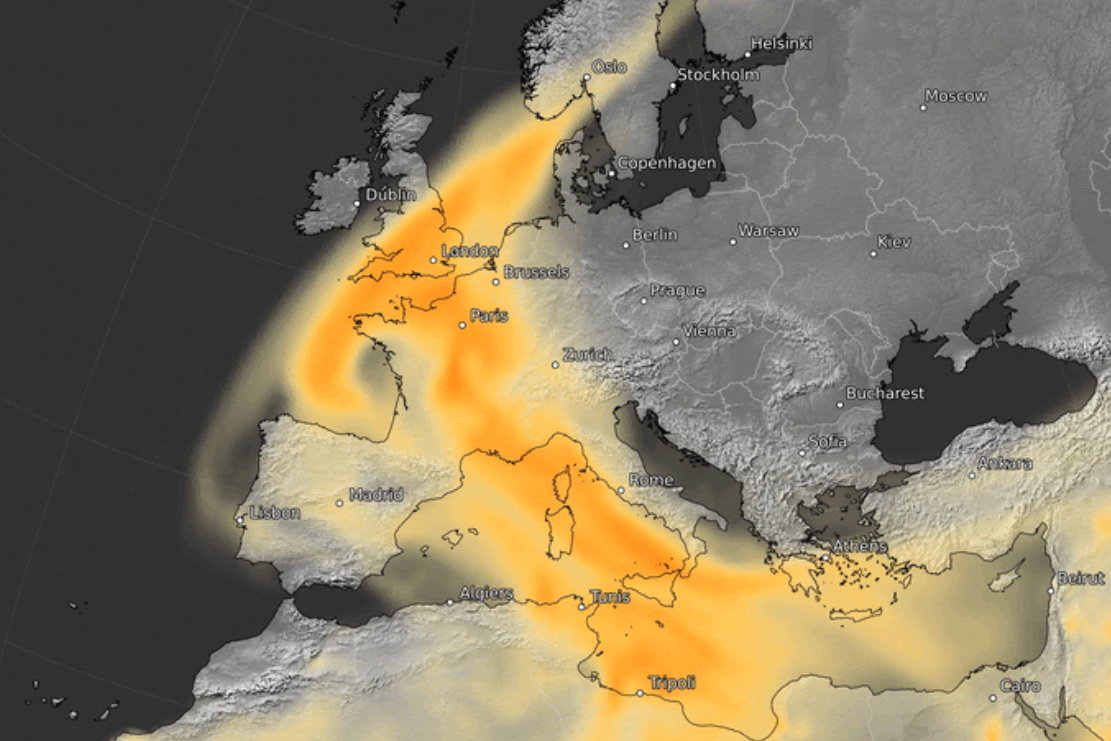
open image in gallery
(Copernicus)
The plume is being driven by a low-pressure system, dubbed Storm Regina by Portugal’s weather service. This system is transporting dust directly from North Africa into Europe.
A previous event, taking place between 20 and 25 February last month, was linked to “Calima” winds, which blew dust from the Saharan desert out to the North Atlantic. But this time the effects are expected to be more intense.
“It is going to be visible more at times of sunrise or sunset, deeper orangey colors,” Mr Parrington told The Independent. “But by the time it reaches the UK, the surface impacts are are are probably not noticeable. But in Spain and southern France the impact from this dust transport will be increased because it’s much closer to the source region as well.”
Mr Parrington says the plume will “be more intense across the Iberian Peninsula compared to the event observed from 20–25 February.”
“It is also expected to be more direct, driven by Borrasca-type winds transporting dust straight into the western Mediterranean region,” he explained.
“Noticeable surface air quality impacts are forecast across parts of Spain, Portugal and France. At higher altitudes, the plume is expected to reach the North Sea and Scandinavia.
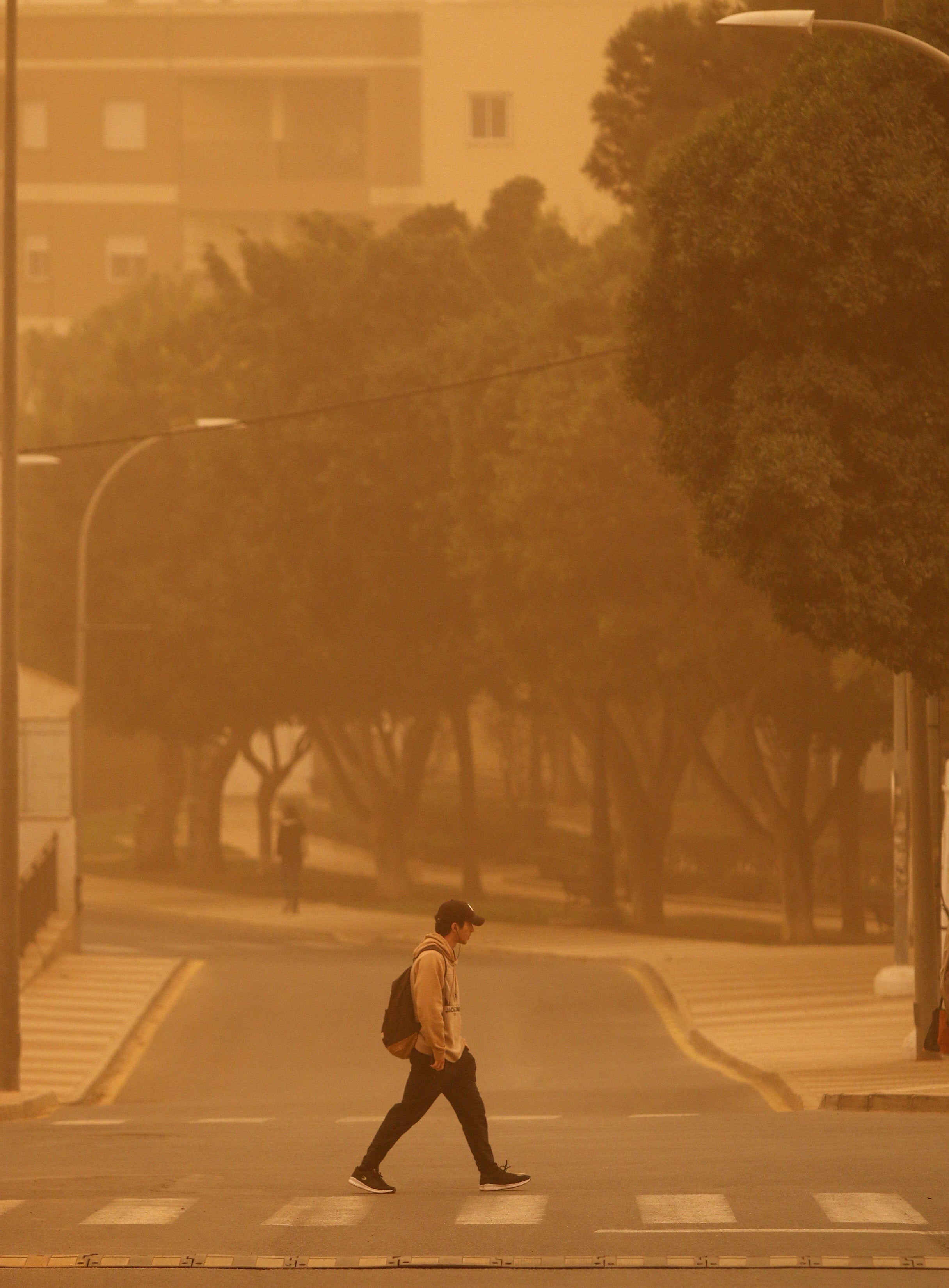
open image in gallery
A man crosses a road as dust from the Sahara desert blankets the coastal city of Roquetas de Mar, Spain, 15 March 2022. A wave of airborne dust from the Sahara moved through southern and central Spain propelled by storm Celia. (EPA)
“This type of transport is fairly common at this time of year, with some occasional remarkable episodes, such as the current. Our monitoring is particularly suitable for these transboundary transport situations.”
How severely people are affected will depend on whether there is rainfall alongside the dust.
“The way that it could reach the ground level is if it mixes with any rain,” Mr Parrington continued. “Then the dust can get absorbed by the rain and then when it falls to the ground it might leave a dusty residue on the car or on windows.
“It can also impact air quality and pollution and in the Western Mediterranean and visibility too. There have been cases in the past where civil aviation is protect impacted by this due to reducing visibility and making it more difficult to operate.”
In March 2024, a Saharan dust cloud blanketed much of southern Europe, causing air pollution across the region. Holiday hotspots were left with air pollution up to 10 times the recommended levels. Children and the elderly were ordered by Crete authorities to stay indoors. Orange skies were seen over London in 2022, when a similar movement reached the shores of Britain.