
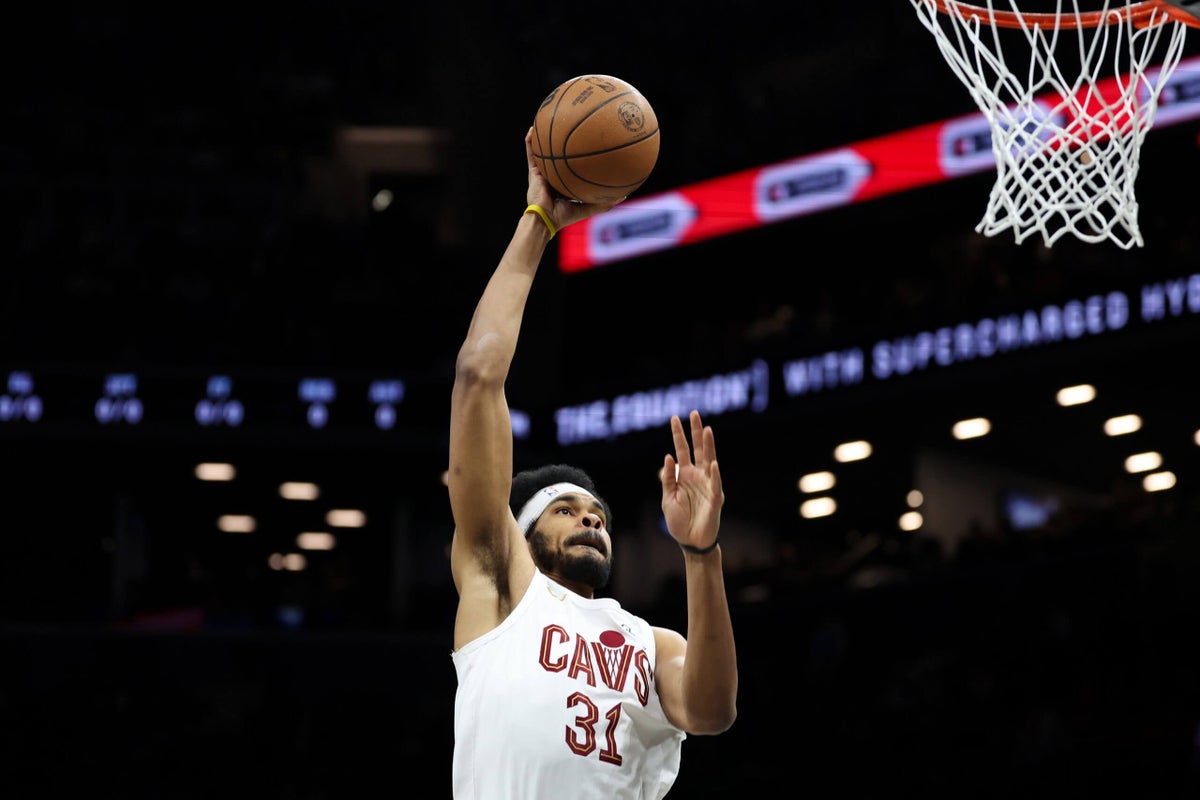
CLEVELAND — The Cleveland Cavaliers’ most consistent player over the last month has not been Donovan Mitchell. It has been Jarrett Allen.
The two of them together represent the trickiness of managing a roster at this time of the year for a team preparing for the playoffs. Mitchell has missed the last four games with a right groin strain, which coach Kenny Atkinson clarified Tuesday night is not a serious, concerning injury. If Mitchell returns for Cleveland’s next game, which isn’t until Sunday, he will have had 11 days off.
In the meantime, Allen was on the court for each of Cleveland’s eight games in the previous 13 days, including a gritty 113-109 win over the Detroit Pistons on Tuesday. And in game No. 8, on Day 13 of this grueling stretch, Allen went down with an injury — he banged knees with a Pistons player, left in the third quarter and did not return.
It’s a stroke of bad luck. Atkinson could’ve given Allen the night off, then had the same thing happen to Allen on another fluke play in the next game. Or, Mitchell could have played in any of the four games he has missed and suffered a more serious tissue injury that puts him in jeopardy for the start of the playoffs.
Bubble wrap isn’t really an option for any player. However, this is one of the key challenges for any playoff coach whose team isn’t playing for much between now and mid-April. Cleveland, now 39-24, isn’t catching first-place Detroit (45-15). The Cavs, meanwhile, are three games ahead of the Toronto Raptors for fourth place in the East (which means home-court advantage in the first round) and 5 1/2 games ahead of the seventh-place Orlando Magic.
Therefore, the Cavs are not at risk of falling into the Play-In Tournament, which means they must balance rest and rust until April 12. Making sure the players spend enough time on the court together — this is a new team with recent additions James Harden, Dennis Schröder and Keon Ellis — while also doing whatever possible to ensure they’re upright when the playoffs arrive.
“That’s part of this job, figuring out when you can get a guy a game and you can look at the schedule — we try to do that the best we can,” Atkinson said. “You always look back on it like, ‘Man, should we have (given a player more rest)?’ This is more of a contact thing (with Allen). The soft tissue is one of the ones where you’re like, ‘That’s overuse.’”
Allen loves to play in the regular season — he didn’t miss a single game last year — and has no interest in sitting out now, especially after injuries to his fingers forced him out during the early months. Still, he seemed to be toughing out a difficult night Tuesday, battling not only behemoth center Jaren Duren but also backup big man Isaiah Stewart, who returned from his seven-game suspension for fighting with the Charlotte Hornets.
Allen, who was averaging 22.1 points and 11.1 rebounds while shooting an NBA-best 73 percent from the field over the previous 12 games, finished Tuesday’s win with just 8 points and three rebounds in 21 minutes.
Mitchell, meanwhile, hasn’t played since he scored 23 points on 5-of-18 shooting in a win over the New York Knicks on Feb. 24.
Of Mitchell’s injury and prognosis, Atkinson said: “(He is) trending better. You know our schedule. I know you guys don’t like this, but (if the game were) a playoff game, he plays. We don’t want this thing nagging him.”
“I was part of the push,” Atkinson continued. “We all collaborated on the conversation and got to this decision. It’s the smart one. Don’t want this thing nagging him going into crunch time.”
Mitchell had missed just four games this season before his recent string of absences and was cruising toward his first 72-plus games in a regular season since 2019. He is averaging a career-high 28.5 points, which has dropped a touch since Allen turned into Wilt Chamberlain and Harden joined him at the trade deadline.
Yet, Mitchell has also dealt with injuries in each of the last two playoff runs. He couldn’t finish the series against the Boston Celtics in the second round two years ago, and he was playing with a calf issue toward the end of the Indiana Pacers series in the second round last season. He also appeared in 71 regular-season games for Cleveland leading into last year’s playoffs.
Injuries have been a recurring theme in Cleveland’s recent playoff runs, and they’ve been prevalent for too many series. At some point, the team needs to either find a way to be healthy at the right time or play through the pain.
Even so, there is little to be gained by overdoing it now. The Cavs host Boston for a 1 p.m. game Sunday on ESPN and the No. 6-seed Philadelphia 76ers on Monday, then travel to Orlando to play the No. 7 Magic. After those three games, only five of Cleveland’s remaining 16 contests are against teams with winning records.
There isn’t enough time left to chase the Pistons in the standings. The Cavs could climb to the second or third seed, but staying at fourth would mean avoiding Boston and New York until at least the conference finals.
Cleveland typically doesn’t play well against the more physical teams, and a rugged defense is Detroit’s calling card. Nonetheless, the Cavs’ backcourt size, notable defensive presence on the wing with Jaylon Tyson and Dean Wade (who didn’t play Tuesday either), and two key additions to the bench in Schröder and Ellis, give Cleveland more functional depth than it’s had in years.
With Wade out (ankle sprain), the Cavs used Tyson on Pistons star and Eastern Conference player of the month Cade Cunningham, wearing him down with defense all over the court. Cunningham finished 4-of-16 shooting, and as an aside, Tyson was also Cleveland’s leading scorer with 22 points and five 3s. During a playoff series, Cleveland’s defense would be shaped to stop Cunningham, whether it’s Wade or Tyson starting on him.
The Cavs need to get there first, however, by managing the age-old NBA dilemma of rest versus rust as best as they can.