
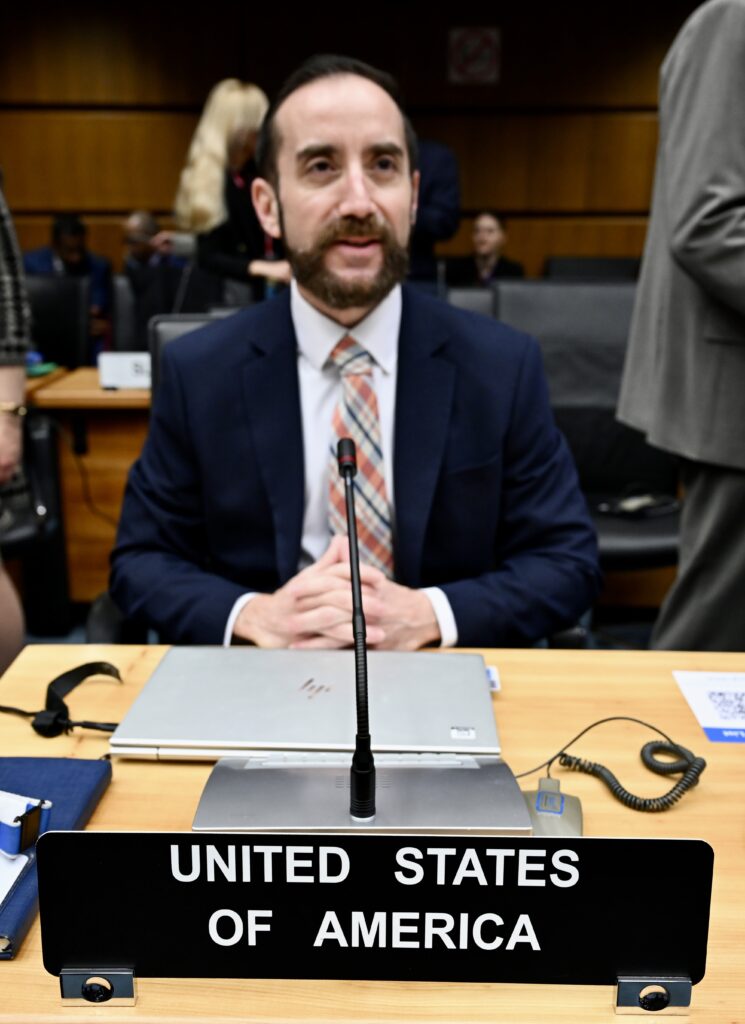
U.S. Statement – As Delivered by U.S. Representative John Krohn – Agenda Item 4 – Strengthening the Agency’s activities related to nuclear science, technology, and applications: Nuclear Technology Review 2026
Vienna, Austria, March 3, 2026
Chair,
The United States appreciates the Secretariat’s efforts in preparing Nuclear Technology Review (NTR). We commend the IAEA’s emphasis on innovation in the nuclear power industry to meet tomorrow’s needs for safe, secure, and reliable energy. This includes the increasing energy demands for data centers and artificial intelligence. However, while the United States continues to support the IAEA’s mandate-focused work, we are compelled to remind the IAEA that the United States strongly opposes the politicization of the IAEA’s work. Specifically, we remain concerned about the IAEA’s work on politically driven agendas, such as climate change. While the United States recognizes specific environmental threats, we encourage practical protections, such as disaster planning, rather than focusing on politically motivated climate agendas.
Chair,
The United States continues its leading role in unleashing advanced peaceful nuclear technologies to ensure that American nuclear technologies that meet the highest standards of safety, security, and safeguards are available to advance our shared security and usher in a new age of global prosperity. Continued growth and innovation in nuclear power will decrease dependence on unreliable foreign sources of energy, reduce costs for consumers, and increase opportunities for all Member States.
Over the course of the past year, the United States has made tremendous progress in deploying advanced peaceful nuclear technologies. Some recent examples include: U.S. Nuclear Regulatory Commission’s approval of NuScale’s 77 Mega Watt small modular reactor design; also GE Vernova submitting an application to the U.S. Nuclear Regulatory Commission (NRC) to build its BWRX-300 small modular reactor in Tennessee; HOLTEC submitted a partial construction permit to the NRC for its SMR-300 at a nuclear site in Michigan; construction proceeding on the Kairos HERMES demonstration reactor in Tennessee; Oklo commencing non-nuclear construction on its Aurora reactor in Ohio. In addition, the U.S. Department of Energy pushes forwards on reaching criticality for three advanced reactor concepts at the Idaho National Laboratory by July 4th of this year, our nation’s 250th birthday.
Chair,
The United States applauds the significant progress in fusion energy development, which holds the promise for providing limitless energy for our global needs. We take note of the significant private investment in this sector, much of which is occurring in the United States, and the progress shown at the ITER global research facility. The United States appreciates the NTR’s reference to the U.S. National Ignition Facility achieving a record fusion yield in 2025. We also continue to advance commercial fusion technologies as evidenced by the Commonwealth Fusion Systems SPARC demonstration facility partnering with Google for their first ARC fusion power plant and Helion partnering with Microsoft on its Polaris plant. We continue to call on IAEA to ensure close coordination between its Department of Nuclear Applications and the Department of Nuclear Energy under Major Programme 1 to ensure the agency is efficiently using its resources to advance this important technology for the benefit of all Member States.
Chair,
The United States recognizes the importance of non-power applications of nuclear science and technology to contribute to global peace, health, and prosperity. We proudly support numerous IAEA research activities in these areas. For example, the IAEA’s research on Sterile Insect Techniques holds promise to not only stop pests from devasting our livestock and crops but could also prevent the spread of diseases from mosquitos. The IAEA’s research on electron beam technology and its applications brings together scientists, policy makers, and industry to open new markets and new uses for this novel technology. This broad stakeholder collaboration is a model we are also tracking with great interest on cancer care. We applaud the Agency’s work to engage non-traditional partners, including the private sector, to increase its reach and impact.
Chair,
The United States welcomes continued cooperation to advance innovative breakthroughs in nuclear technologies and applications, while maintaining the highest standards of nuclear safety, security, and safeguards. With this, we support the Secretariat in providing this report to the General Conference. We note our intent to provide some additional edits to the Secretariat to support its work in producing a final version.
Thank you, Chair.
U.S. Statement – Agenda Item 4 – IAEA Board of Governors Meeting