
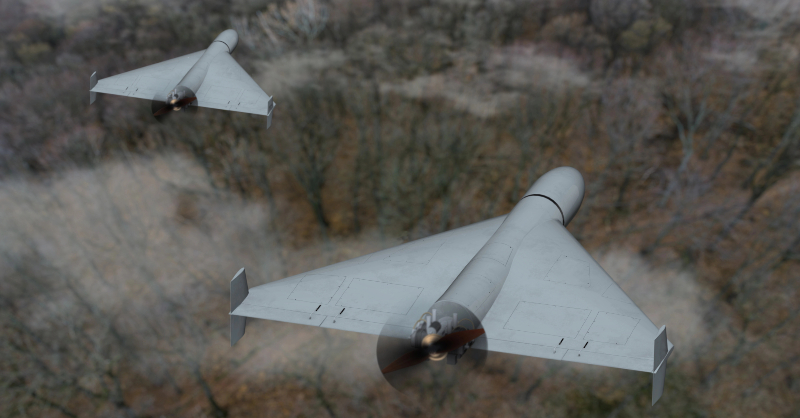
Military forces are using more drones than ever across land, sea, and air. But most systems still need one operator to control one drone, which limits how many can be used at once. This becomes a bigger problem in combat environments where communications or GPS signals are weak or jammed.
A new UK startup is trying to fix this gap. Cambridge-based robotics autonomy company Mutable Tactics has raised $2.1 million in a pre-seed funding round to develop AI software that helps defence drones operate as coordinated teams rather than individually controlled machines.
The round was led by Seraphim Space with participation from the UK National Security Strategic Investment Fund (NSSIF), Koro, Entrepreneurs First and Transpose. The new funding will be used to expand the company’s engineering team in Cambridge and speed up development of its AI decision software.
Mutable Tactics will also work with two European governments to test the technology in real operational scenarios. The company plans to integrate its software with unmanned systems from different partners and run live demonstrations in challenging environments.
Founded by defence and AI experts
Mutable Tactics was founded in August 2024 by former British Army officer Colin MacLeod and robotics AI specialist Enrique Muñoz de Cote. MacLeod served in Iraq and Afghanistan and saw how technology performs in real combat situations.
Mutable Tactics is developing an AI-powered decision layer that sits between human operators and robotic systems. The software converts a commander’s instructions into clear tasks that drones can execute locally, allowing them to adapt to changing conditions and coordinate with each other even if communication links fail.
Instead of needing constant control from humans, the drones can make limited decisions themselves within rules set by the operator. This allows one person to supervise multiple drones at once rather than manually flying each one.
The system is designed to keep humans firmly in charge. Military officers still control the mission goals, rules, and limits, and they can take direct control of any drone whenever needed.
Colin MacLeod, CEO and Co-Founder of Mutable Tactics, said: “Increasingly, the constraint is no longer hardware but human attention. We can deploy more drones than ever before, yet we still ask operators to control them one by one, often in environments where communications are unreliable. True autonomy breaks that one-to-one link, allowing humans to supervise and direct teams of systems rather than individual machines. That shift is essential for supporting modern military missions, where scale, speed and resilience matter, and where operators must remain focused on intent and outcomes rather than manual control.”
While the company is focused on defence applications today, the underlying technology could also play a role in the future of robotics and physical AI. As robots move from controlled environments into the real world, the ability to make reliable decisions under uncertainty will become essential for large-scale deployment.
Enrique Muñoz de Cote, CTO and Co-Founder of Mutable Tactics, added: “There is no single AI technique that solves autonomy. Deep learning allows systems to operate in uncertain, real-world environments, while deterministic AI ensures their behaviour remains explainable and aligned with a commander’s intent. Combining both enables autonomy that is resilient in contested environments while preserving meaningful human control – critical for military deployments. That fusion sits at the core of Mutable Tactics, and the UK’s leadership in probabilistic inference provides an essential foundation for this work.”