
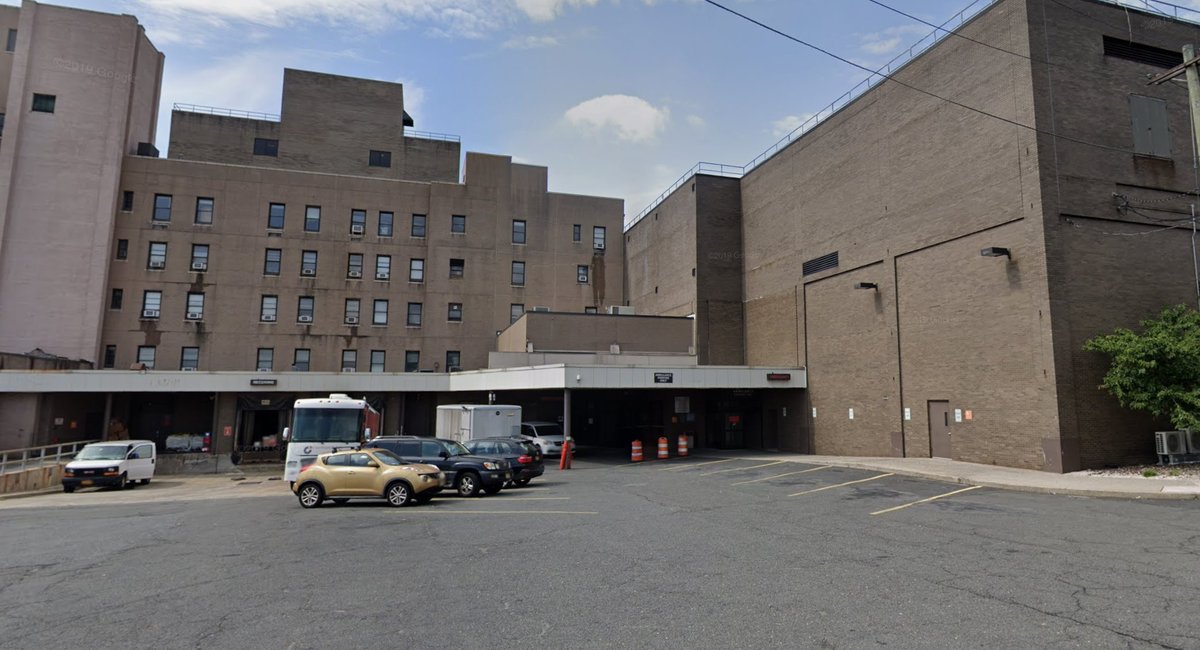
Jersey City is less than two weeks away from losing one of its two emergency rooms, leaving hospitals around Hudson County bracing for increased demand.
Heights University Hospital, formerly known as Christ Hospital, is set to close its ER on March 14, after winding down most other operations last year. Operator Hudson Regional Health said its heavy financial losses threatened the stability of the rest of its network.
The hospital, which has been serving the roughly 50,000-person Heights neighborhood since 1872, was acquired by Hudson Regional Health last year.
Debbie White, president of HPAE, said the nurses her union represents at Heights University Hospital will ultimately be all right when the emergency department closes. She worries most about the residents who are seeking care.
“ These nurses can always find other jobs, but these patients in this city are not going be able to just come up with accessible health care,” White said. “They’re going to have to travel a distance.”
Ambulance services have been delivering trauma patients to other area hospitals for months.
“What the nurses have been told is that if they have a patient who has to be admitted to a hospital that they should call 911,” White said. “An emergency department that had to call 911 is insane to me.”
Vijay Chaudhuri, a spokesperson for the health system, said trauma patients who bring themselves to Heights University Hospital are stabilized before staff arrange for their transfer elsewhere.
Hudson Regional Health originally planned to close the emergency department last weekend, but extended that deadline another two weeks following fierce outcry from local and state officials. The state Department of Health has not approved the hospital’s closure, and has asked Hudson Regional to provide more information in its closure application.
Hudson Regional had “committed to providing long-term, high-quality health care in the Heights, and an additional two weeks fails to fulfill that promise,” Jersey City Mayor James Solomon and two members of the City Council said in a joint statement at the time. His offices referred back to that statement this week.
The state Department of Health would seek to establish that Hudson Regional’s closure plan still leaves residents of the Heights, and the area on the whole, with sufficient resources.
“While the anticipated closure date has been extended, this action does not change the fact that HRH remains out of compliance with regulatory and statutory requirements,” Raynard Washington, the acting state health commissioner, said last week. “The state will continue to exercise all available options to enforce regulatory authority while safeguarding public resources and trust.”
Chaudhuri said Heights University Hospital lost $74 million last year and is projected to lose another $30 million this year as it faces federal cuts to Medicaid, state cuts to charity care and rising rates of uninsured patients. He added that Hudson Regional Health CEO Yan Moshe is putting up $1 million of his own money to keep the hospital open through March 14.
State authorities provided $2 million in emergency aid last fall to help keep the hospital open.
HPAE, the union White leads, also represents nurses and staff at Palisades Medical Center, Bayonne University Hospital and Secaucus University Hospital.
Hudson Regional Health operates three other hospitals in the county: Bayonne University Hospital, Hoboken University Hospital and Secaucus University Hospital.
“Over the past several months, the HRH network in Hoboken, Bayonne and Secaucus — all with sustained, sufficient capacity — has efficiently absorbed patients with the highest level of care,” Chaudhuri said.
Jersey City started the 2000s with three hospitals. Greenville Hospital closed in 2008, and the looming closure of Heights University Hospital this month will leave New Jersey’s second-largest city with just one: Jersey City Medical Center, operated by RWJBarnabas Health.
Patient volume has already increased at Jersey City Medical Center since Heights University was largely shuttered last year. Stacie Newton Hunt, a spokesperson for Jersey City Medical Center, said the hospital continues to invest in its services and infrastructure and is evaluating ways to increase capacity.
“RWJBarnabas Health is, by two times, the state’s largest provider of charity care and of care to beneficiaries of the Medicaid program,” spokesperson Stacie Newton Hunt said. “We will continue to support the health care needs of all Hudson County residents, as we always have.”
Jersey City Councilman Jake Ephros, who represents the Heights, said his constituents are upset about the closure. He expects people will turn to either Jersey City Medical Center or Hoboken University Hospital. That’s an extra challenge for a working class community where many people are underinsured.
“If you’re trying to get to either of those places from the Heights, especially when traffic is backed up, it can take you half an hour, 40 minutes,” Ephros said. “It’s not acceptable as an alternative.”
Lisa Iachetti, president of Palisades Medical Center in North Bergen, said she expects that demand at her hospital will moderately increase when Heights University Hospital closes.
Hackensack Meridian Health is currently expanding the emergency department at Palisades Medical Center. Iachetti, the hospital’s president, said the new capacity will allow them to meet any increase in demand.
“ That will double the size of the ER occupancy,” Iachetti said of the expansion. “It’ll be done by the end of December 2026, but the first phase is already open. If we see some additional patients, we’re more than ready.”
Still, Iachetti said the distance from the Heights to North Bergen will probably deter patients in need from going to Palisades Medical Center. White agreed.
“ I’m sure that’s an option if you really want to drive out there, but I think probably more realistically these patients will go to Jersey City Medical Center,” White said. “And if Hudson Regional has anything to say about it, they’ll divert patients to their own sister hospitals.”