
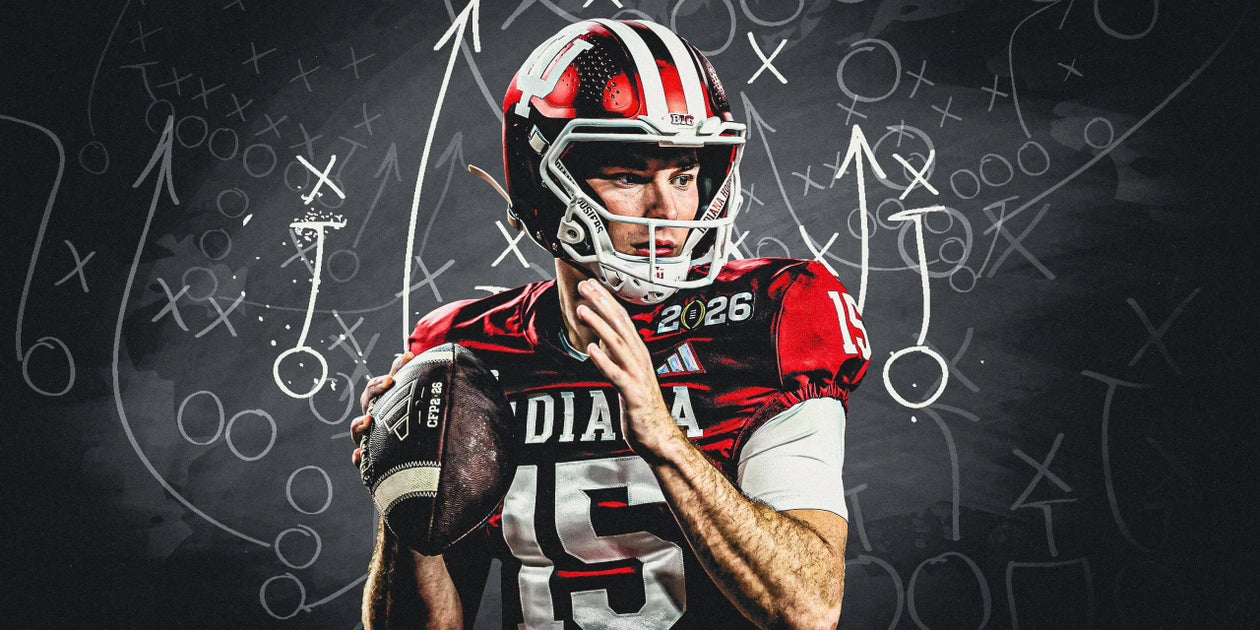
Indiana quarterback Fernando Mendoza is a much different prospect than what the general perception of him is. Many assume that the Heisman Trophy winner, national champion and frontrunner to be the draft’s top pick is a polished pocket passer who’s ready to get plugged into an NFL offense immediately.
After watching the film, he’s a more traits-based quarterback that needs development, but he’s still worthy of the No. 1 pick. He doesn’t have an elite arm, but it’s just a tier below, and he can make high-level throws into all areas of the field with pinpoint accuracy and is an excellent deep-ball thrower. He understands coverages and how to attack them and can throw with proper timing and footwork. He has all the traits that coaches from the Shanahan/McVay tree covet in spades, with prototypical size.
A common talking point is that Mendoza didn’t play under center much in college. And there are plays in which his processing could be quicker, but you can also chalk that up to having to learn an entirely new offensive system and play style, transferring from Cal to Indiana for his final season. To understand Mendoza’s rapid development from his first games at Indiana to peaking in the college football playoffs, I talked to his quarterback coach at Indiana, Chandler Whitmer, who is now the quarterbacks coach for the Buccaneers. Before his one year in Indiana, Whitmer had coached in the NFL since 2021.
Whitmer said Mendoza picked up the offense pretty quickly, but they did ask him to do more than he did at Cal. The base of Indiana’s offense is a heavy run game with run/pass options on early downs, but their run-heavy attack would put Mendoza into second- or third-and-long situations in which he was asked to do more from a mental perspective as far as taking deeper drop-backs, reading coverages and eliminating options pre-snap. It’s obvious when listening to Mendoza in interviews that he understands coverages at a high level and he loves the mental side of the game. It’s one of his most intriguing traits and it showed up in the playoffs.
“I’d say (his football IQ) is pretty high and it’s only going to keep getting better, but the beauty is his capacity is really high,” Whitmer said. “Like I said, he’s got a yearning to learn and then he has the ability to understand, compartmentalize and then take it to the field. (Justin) Herbert was very similar in that way — high intelligence, super smart, obviously. But then to be able to take it to the field and execute and process at a high level at full speed when the bullets are flying and the pictures change … He’s as good as I’ve ever seen in college, for sure.”
One Big 10 defensive assistant, who faced Indiana and saw firsthand what Mendoza, echoed Whitmer’s assessment.
“He never makes mistakes,” the coach said. “He’s gotta be extremely intelligent because he’s always making the right decision. We play one-high; he goes immediately to throw back-shoulder. Two-high shell with the safeties wide, he gets into a cover 2 check to a run play and gets 5 yards. We send pressure here, he changes the play to something else. The efficiency was insane.
“He’s a top pick in the draft. I don’t know who would be better.”
Mendoza’s physical traits are also excellent. He may not have one physical trait that gets an A-plus (unless you count accuracy), but he gets a B-plus across the board.
Mendoza can throw fade passes with different trajectories. Whether he wants to throw low-trajectory passes with zip or throw them with touch, he throws the back shoulder as well as any quarterback in recent years. In Indiana’s offense, the fade from the outside or from the slot was their answer against pressure or man coverage. These are highly difficult passes that Mendoza completed in high-leverage situations, including two in the second half of the national championship game that helped secure a victory.
He’s also adept at throwing out-breaking routes deep, intermediate or short.
He’s not going to be running many option plays, but his straight-line speed will be a legit tool in the NFL. He can get away from the pass rush, and at 6-5, 236 pounds, he’s difficult to bring down. He’ll have to rely less on late-down scrambles, but he’ll pick up his fair share of first downs with his legs.
Mendoza has the mobility to execute boot plays and throws well on the run, which will be essential if he were to get drafted into Klint Kubiak’s Raiders offense.
The biggest flaw in his game is a tendency to hold the ball while not sensing backside pressure. There were times he had open receivers downfield or his check-down open, and he would hesitate and take a sack. His negative play rate — something that tends to be difficult to improve on in the pros — is a red flag. However, I believe some of it was him learning a new system and just believing too much in his athleticism, trying to make plays with his legs. He has to realize that he won’t be able to use his legs as much in the NFL. He’ll have to get rid of the ball quickly more consistently.
NFL evaluators probably want to see more translatable plays from Mendoza, but it’s hard to argue against Indiana head coach Curt Cignetti’s formula that led to a miraculous turnaround and national championship. Mendoza was remarkably consistent in making difficult throws in long-yardage situations. Indiana’s defense kept the team from chasing points often, so Mendoza wasn’t in many comeback situations. The Hoosiers were down 24-20 against Penn State with less than two minutes left in the game and needed Mendoza to lead them down the field to win.
Mendoza didn’t play his best game, but he was dialed in on that last drive and delivered, completing five throws for 87 yards, including the game-winner. Four passes were high-difficulty throws into tight windows.
“We ran simple four verts and we got three different coverages,” Whitmer explained. “And his ability to know exactly where to go on each one of them, whether it be single-high zone, man, or (cover) two, and the way he played that play, and manipulated the defenders, used his eyes, and his feet timed up and the different nuances that come to playing a simple concept like that was a big one for me.”
The first time Indiana called “four verts,” Penn State played cover 3 zone. Mendoza stared down the safety to keep him in the middle of the field. He finished his drop, didn’t take a hitch, and delivered a perfect throw down the seam in rhythm for 22 yards to Omar Cooper Jr.
A few plays later, Indiana called four verts again.
Penn State, 1:13 remaining in the fourth quarter, second-and-10

Penn State initially had all three safeties line up on the same level to disguise their coverage.

After the snap, the defense rotated into a Tampa 2. This time, Mendoza looked off the “hole” player in the middle of the field by staring down Cooper to his left.

As he got to the top of his drop, he reset his feet and took a hitch to throw to tight end Riley Nowakowski to his right.

He layered the ball and threw inside of the underneath defender, but threw a perfect ball to Nowakowski for a 29-yard gain. Indiana called four verts again, two plays later. This time, Penn State played man coverage, so Mendoza looked for his best matchup and went outside to Charlie Becker, throwing a perfect back-shoulder pass for a 17-yard gain. Three plays after that, he backpedaled to create space against a cover-zero blitz and threw a perfect touch pass in the back of the end zone for the game-winning touchdown.
“The Penn State drive was a big one, but just was really cool to see the way he got more and more comfortable throughout the year in the drop-back game, working through progressions, understanding a lot of it was pure progression stuff,” Whitmer said. I think the pure progression ends up being like an all-encompassing-type term, but it’s not that simplified because the way we talked about it was like, ‘Hey, yes, it’s pure progression, but you know, against these couple of coverages, we can eliminate this and this to get to that faster.’ His ability to not just go one, two, three, four, five, as simple as like someone off the street can make it, but quickly eliminate (options) so that the timing of the routes would be what we wanted, rather than be late in the down.”
The ability to internalize information and quickly translate it on the field is one of the most important traits for a quarterback. There are times when you don’t get to go through certain plays or situations in practice, and sometimes, you must be able to execute an adjustment quickly in-game. Mendoza’s most spectacular throw of the season was a great example of executing a play that was just installed that week at the highest level.
“We had this play in L.A. with (Justin) Herbert,” Whitmer said, referring to his time as a Chargers assistant. “Because his arm is so big, on third-and-extra long situations, a lot of teams play deep cover 2. Well, we’d have simply just basically double (go routes) and then a read (route) down the middle, and he’d work the strong-side verticals against the field safety. And if the field safety would squeeze that No. 2 vertical, you’d throw the hole shot down the sideline.”
2021, Chargers vs. Cowboys, 12:32 remaining in the third quarter, third-and-15

On the play above, Herbert saw the safety stay inside with the No. 2 receiver running the option route, so he ripped the hole shot to his No. 2 receiver. Whitmer showed Mendoza clips of Herbert executing this play leading up to Indiana’s game against Iowa.
Iowa, 10:18 remaining in the second quarter, first-and-10

Iowa initially gave a single-high man look, but they would actually blitz the nickel and rotate into a cover 2 zone to the wide side of the field.

Mendoza saw the coverage rotation and saw that the safety was too far inside. Because they were trying to disguise, it would be difficult for the safety to make it all the way outside to make a play on the ball, so Mendoza went to his second read, which was the outside vertical.

With pressure in his face, Mendoza read the coverage, stood strong in the pocket, and executed a difficult throw that had to cover distance and be placed perfectly.

The ball was perfect.
“We had just talked about that the week before on a concept that we put in against Iowa and to see him make that same throw on a shot when they get into a tricky (cover) 2, and be able to drive the ball from the opposite hash in college, which obviously is wider, was pretty special,” Whitmer explained.
Indiana was the best team at converting third downs (56.2 percent) and finished second in third-and-long (7-plus yards) conversion rate (41.4 percent). As mentioned, Mendoza had some issues processing early in the season, but toward the end and into the playoffs, his confidence grew. He processed at a high level against some of the best defenses in the country.
Big 10 Championship, 10:38 remaining in the third quarter, third-and-2

Here against Ohio State, the Buckeyes showed man coverage on third down.

After the snap, the defense rotated into a cover 2 zone to the boundary (short side of the field), an inverted-2 with the corner playing a deep half to the field side.

Mendoza saw it wasn’t man coverage and went away from his usual first read against man. Becker was on the same page and ran into the middle of two safeties.

Mendoza threw a perfect pass more than 50 yards in the air to Becker.
“It was something that we had talked about all week,” Whitmer said. “And it’s a concept that allows you to read it as pure progression. But if it’s man, we’re going to stay on this. If it’s (cover 2), we’re probably going to hit this.”
Former Patriots defensive coordinator Matt Patricia brought NFL disguises to an Ohio State defense that could have three defenders picked in the top 10 in this year’s draft. Mendoza had the most efficient game of any quarterback against them all season.
Mendoza’s football IQ, ability to quickly translate on the field what he’s taught and work ethic, combined with his physical traits, make him worthy of the top pick of the draft. He needs to make some adjustments to his game — get rid of the ball quicker and learn to play under center — and his transition to the NFL game won’t be as easy as some think, but he has all the traits necessary to excel in Kubiak’s scheme.