
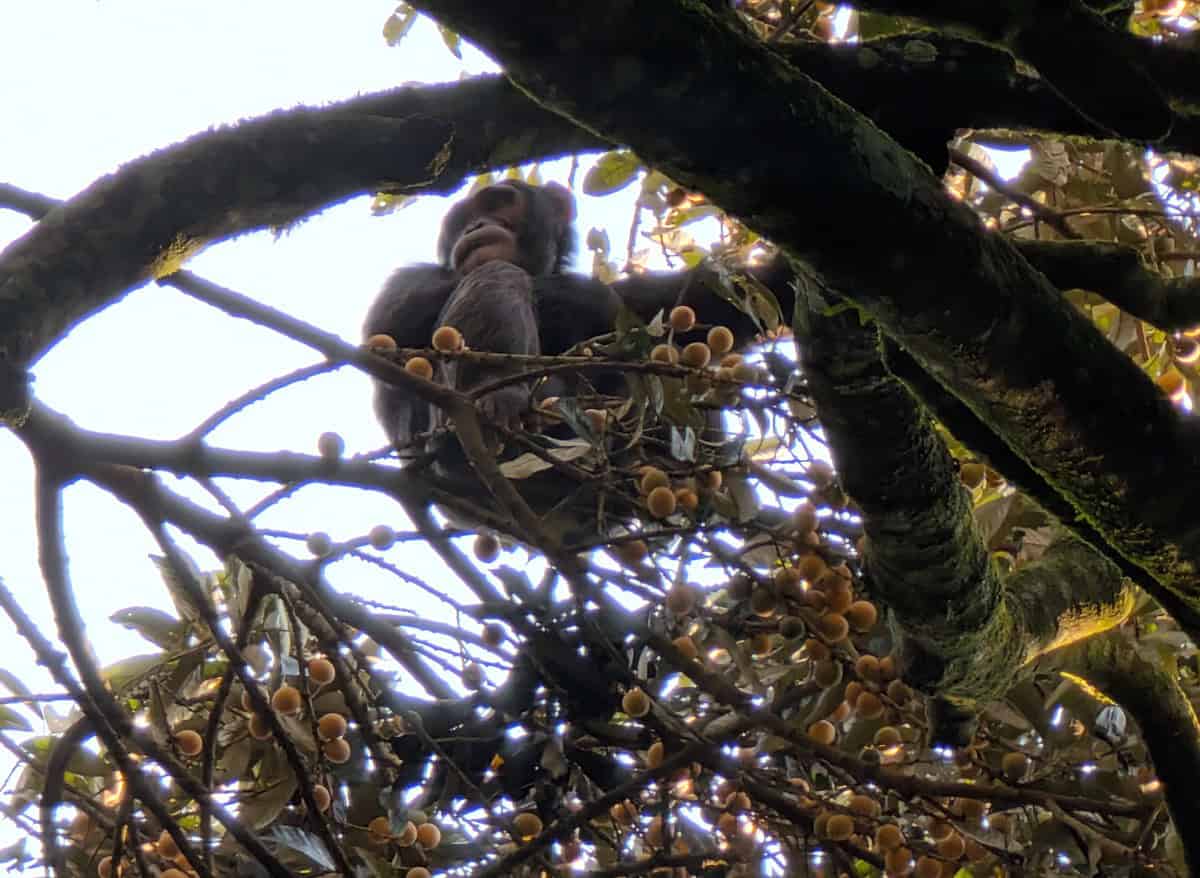
 One of the boozy chimps. Credit: Aleksey Maro/UC Berkeley
Since you can’t exactly breathalyze a wild ape, Aleksey Maro, a UC Berkeley researcher, spent his days collecting chimpanzee urine from the forest floor. Guided by Ugandan student Sharifah Namaganda, Maro used forked branches and plastic bags to catch samples as the chimps relieved themselves.
They conclusions are striking: chimps consume the equivalent of roughly one standard alcoholic drink every day. They get their daily dose simply by eating sugar-rich, fermenting fruits high up in the forest canopy.
“If there’s any doubt about the drunken monkey hypothesis (that there’s enough alcohol in the environment for animals to experience alcohol in a way analogous to humans) it’s been cleared up,”
The Forest Brewery
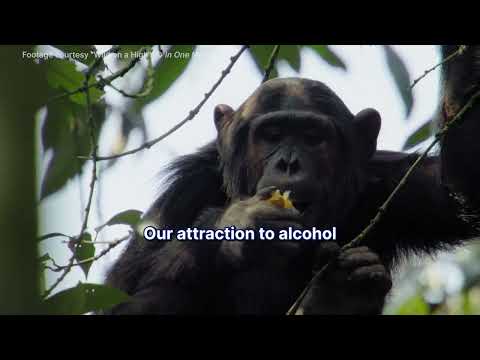
The researchers arrived just as the apes were feasting on a massive crop of African star apples, which naturally ferment and brew alcohol as they ripen. The team tested urine from 19 wild chimpanzees for a specific chemical the body produces only after breaking down alcohol. Maro used simple test strips originally designed to ensure human pilots or heavy machinery operators are completely sober.
The readings were unexpectedly high, and very consistent.
Out of 20 urine samples Maro collected, 17 came back positive for EtG (ethyl glucuronide)—the chemical “smoking gun” of alcohol consumption. That’s an 85% hit rate. But the team wanted to know if these chimps were just having a tiny nibble or a full-on session. They re-tested 11 of those positive samples for a much higher concentration, to see how much the chimps were drinking. Ten of the 11 exceeded the high-concentration threshold. Simply put, chimps were “under the influence.”
As UC Berkeley biologist Robert Dudley explained in a statement:
“In nanograms per milliliter, these are coming in way above some of the clinically relevant and forensically relevant human thresholds.” The apes are consuming roughly 14 grams of alcohol a day.
The Evolutionary Hangover
 Aleksey Maro set up camera traps to capture photos of animals eating the same fruits as the chimpanzees he is studying in Uganda and Ivory Coast. Each of these animals likely consumes fermented fruit and thus consumes some alcohol on a daily basis. Credit: Aleksey Maro/UC Berkeley
For nearly two decades, Dudley has championed the “drunken monkey hypothesis.” He suggests that the human attraction to alcohol is an ancient evolutionary trait. As apes evolved to sniff out ripe, calorie-dense fruits over long distances, they inadvertently adapted to consuming low levels of ethanol.
×
Thank you! One more thing…
Please check your inbox and confirm your subscription.
Skeptics long argued that wild primates simply do not eat fermented fruit. Yet, observational data has increasingly proven otherwise. Initial evidence from a study in Panama found EtG in the urine of five out of six wild spider monkeys. The new chimpanzee data firmly cements the idea that natural ethanol consumption is a normal part of primate life.
Curiously, the chimpanzees abstaining from this forest brewery were mostly juveniles and females in estrus. This raises immediate questions about how alcohol impacts primate physiology. Future studies may reveal whether dietary ethanol influences chimpanzee aggression, territorial patrols, or fertility.
One crucial mystery remains before the hypothesis is fully proven. Researchers must determine if chimpanzees actively seek out the alcohol. “The final link here with the drunken monkey hypothesis remains to be shown: that the chimps are selectively consuming fruits with higher ethanol content,” Dudley explained.
The study was published in Biology Letters.