
The Green Bay Packers might not be major players in free agency next week, but general manager Brian Gutekunst doesn’t think their salary cap situation will hamstring them too much.
In fact, he doesn’t seem to think it’ll restrict Green Bay’s desired spending at all.
“I feel really good again,” Gutekunst said last month of how the Packers are positioned financially entering free agency. “A lot of that will be dependent on the decisions we make with the roster right now and what we do, but I believe we have all the flexibility to do what we need to do. We also have a bunch of young players, really good players, that we would like to keep around here for a while, so we’ll work through that.
“But I feel good about our flexibility and I think the last few years, Russ (executive vice president/director of football operations Russ Ball) has done such a good job of keeping us at a point where, if opportunities present themselves, we’re never not able to do those things … like Micah (Parsons) last year, you know what I mean? So I feel really good about it.”
The Packers rank 25th in cap space at around $5.1 million over the cap, according to Over The Cap. That figure doesn’t yet include the cap space freed up by the restructuring of All-Pro safety Xavier McKinney’s contract, which ESPN first reported Thursday. Green Bay can pull a handful of other levers to not only become cap-compliant but also create ample room to make moves, such as releasing defensive end Rashan Gary and center Elgton Jenkins, and restructuring others.
Even so, they’re probably not going to be in a position to spend as freely as Gutekunst makes it seem, but the ninth-year general manager doesn’t think he’d need to do that, anyway.
“I think we have really good core players coming back,” Gutekunst said. “I feel really good about our core. The guys we’re going to bring in, whether it’s the draft or free agency, we’re going to expect them to play and contribute. But I don’t think it’s one of those overhaul-type situations where we feel we’ve got to overhaul the roster, but there’s some significant issues that we’ve got to make sure that we fix before we get into next season.”
Which players from other teams might the Packers target then, in addition to potentially re-signing some of their own guys? There is a bevy of intriguing options as Gutekunst aims to round out his roster so he can select the best player on his draft board come April. Here are 10 of them, two each at five of Green Bay’s positions of need (scouting reports, ages and contract projections courtesy of Daniel Popper’s top 150 free agent rankings).
Cornerback
Gutekunst said at the NFL combine that the two areas he thinks need the most competition this offseason are in the secondary and at inside linebacker. One can reasonably assume he thinks cornerback needs it more than safety. One position has a top three of McKinney, Evan Williams and Javon Bullard and the other has Keisean Nixon, Carrington Valentine and Nate Hobbs. The Packers might release Hobbs and then eye cornerbacks toward the back end of Popper’s top 150 to compete for a starting job on the outside.
Montaric Brown, 27, Jacksonville Jaguars (2 years, $13 million): A 2022 seventh-round pick, Brown took over a starting role at outside cornerback in Week 6. He set a career high with 12 passes defended, including two interceptions, fitting well in coordinator Anthony Campanile’s diverse scheme. Brown has good size. He is comfortable and in control as a zone defender, both in tracking deep-developing routes and triggering on underneath routes.
Roger McCreary, 26, Los Angeles Rams (3 years, $36 million): The Rams acquired McCreary from the Tennessee Titans via trade in October. He got injured on the first snap of his Rams debut in Week 12 and did not return until Week 17. McCreary was primarily a nickel in Tennessee, but he played more on the outside in the playoffs for the Rams. He can play both spots and has inside-outside flexibility. McCreary has good eyes and instincts. He is physical both as a run defender and a coverage player.
Center
Assuming the Packers cut Jenkins to free up cap space, they have a hole at center since incumbent Sean Rhyan is set to be an unrestricted free agent. They could re-sign him, but there are a couple of viable options on the open market in addition to Rhyan if Gutekunst wants a surefire starter at the position instead of having to gamble on an early draft pick.
Cade Mays, 27, Carolina Panthers (3 years, $22.5 million): Mays took over the Panthers’ center job in Week 3 after an injury to Austin Corbett and proved to be a very capable starter. He is a huge player for the position at 6-6, 325 pounds, and he uses that size well in pass protection, creating a wall on the interior with a sturdy, balanced base. He can match up with big nose tackles. Mays is a bit limited as an athlete, which affects his ability as a move blocker in the run and screen games. Still, he should be a viable option for any teams looking to solidify their interior pass protection.
Luke Fortner, 28, New Orleans Saints (3 years, $18 million): The Saints traded for Fortner in August. He got a chance to start after Erik McCoy went down with a season-ending injury and performed well. Fortner is a natural pass protector with sound eyes and instincts, and he leverages his length well and can anchor down when he needs to. He also pulls the chair on occasion to take advantage of overaggressive rushers. Fortner is not a physically imposing run blocker, but he gets the job done primarily with athleticism. He can move laterally, climb to the second level, pull and play in space.
Inside linebacker
Gutekunst including this position in that top two was interesting because one can reasonably deduce that the Packers don’t need competition at inside linebacker if they re-sign Quay Walker. If they don’t, however, they could use someone to compete for the third inside linebacker spot with Ty’Ron Hopper or perhaps even challenge Isaiah McDuffie for the No. 2 spot behind Edgerrin Cooper.
Leo Chenal, 25, Kansas City Chiefs (3 years, $24 million): Chenal is a versatile chess piece who can wear multiple hats, able to play off the ball, on the edge and even on the interior in certain packages. He can rush the passer, defend the run and play in coverage. He has good closing speed in space as a tackler, and he is excellent moving sideline to sideline while defending stretch runs, flat routes and bootlegs. Fit and usage will be important to Chenal’s success.
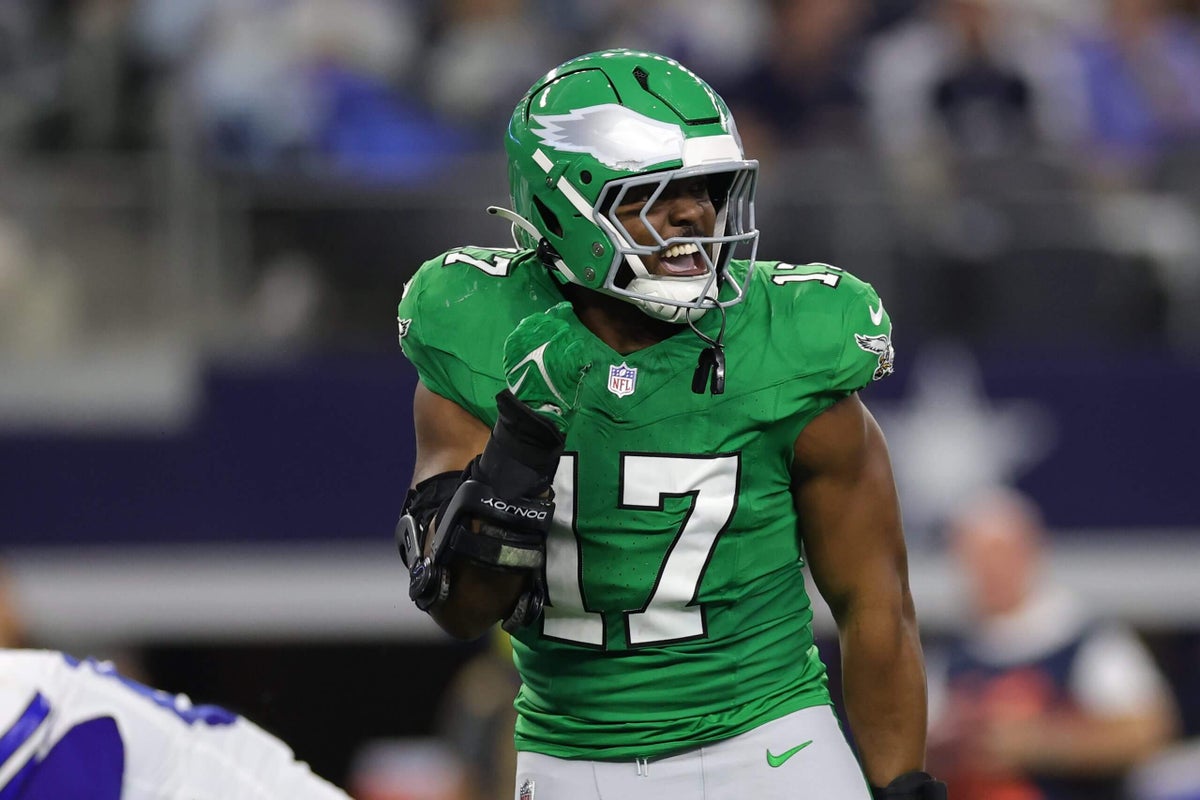
Nakobe Dean, 25, Philadelphia Eagles (4 years, $40 million): Dean is one of the best blitzing linebackers in the league, and he appears to be shot out of a cannon on those reps. He is a matchup advantage against running backs as a pass rusher, with a 35.7 percent pressure rate on 28 pass-rushing snaps. Dean is small and a limited athlete, however. His size prevents him from being an impactful run defender. He relies on instinct and anticipation as a zone-coverage defender.
Running back
The Packers need a new backup to Josh Jacobs if Emanuel Wilson signs elsewhere. It’s a valuable position in Green Bay, especially given Jacobs’ injuries last season. No. 3 running back Chris Brooks inked a two-year, $4.85 million extension on Wednesday, his agency announced, but Brooks isn’t quite No. 2 running back material. The Packers can’t count on MarShawn Lloyd, either, given his injury history.
Aaron Jones, 31, Minnesota Vikings (1 year, $5.25 million): The Vikings are expected to release Jones if they cannot find a trade partner. Jones missed most of the first half of the 2025 season because of a hamstring injury, and he turned 31 in December. That said, he still has vision and burst as a runner. He is a smooth athlete and a capable pass catcher and route runner, particularly out of the backfield. He is also a quality pass protector. At this stage of his career, Jones should be eyed as a third-down back in a committee.
Tyler Allgeier, 26, Atlanta Falcons (1 year, $5.25 million): Allgeier has spent the past three seasons playing behind top-10 pick Bijan Robinson. After a 1,000-yard season as a rookie in 2022, Allgeier’s total production has waned in a second-fiddle role. However, he is a big, imposing back who runs with physicality, leg drive and a high motor. He would be a logical fit in a downhill running game, where he can get north, but he is not explosive as a lateral mover. Allgeier could produce in a more sizable role outside of Atlanta.
Tight end
Luke Musgrave is a lost cause. Tucker Kraft is one of the NFL’s best tight ends, but he’s also coming off a torn ACL. John FitzPatrick is an unrestricted free agent who tore an Achilles tendon in Week 16. Given all that, it might be worth adding a veteran tight end who can also block to play behind Kraft.
Greg Dulcich, 26, Miami Dolphins (2 years, $12 million): Dulcich was waived by the New York Giants on cutdown day. He signed with the Dolphins’ practice squad and was activated in Week 8. Among tight ends with at least 100 routes, he finished second in yards per route behind only the Buffalo Bills’ Dalton Kincaid. Dulcich has vertical speed and is aggressive and physical after the catch, particularly on screens.
Cade Otton, 27, Tampa Bay Buccaneers (3 years, $24 million): Otton is a solid all-around tight end who can contribute in all phases. He is a fine blocker and route runner who has decent hands and can be a safety valve on leaks to the flat. The best part of his game might be his pass protection. Otton is not a plus athlete, though. He lacks burst and speed, and there is nothing overly special about his game.