
Know your rights message
Coinciding with Ramadan, some Muslim groups have issued know-your-rights guidance for navigating immigration enforcement interactions, including for mosques. The Muslim Public Affairs Council, for example, created a safety guide.
MPAC official Dahlia M. Taha said the included guidance for imams aims to help them address congregants’ fears without causing panic or spreading misinformation.
Questions from imams, she said, have included: Can houses of worship be subject to enforcement operations? How to reassure people without giving legal advice? How to address immigration anxiety while keeping Ramadan spiritually centered?
“There is a deep sense of community and peace that always comes with Ramadan,” said Taha, adding that many mosques are well-attended and families are gathering.
Nonetheless, “people are carrying fear, anxiety, and uncertainty alongside our faith,” she said. “Devotion and concern are existing side by side. I think everyone is just exhausted.”
Ibrahim Dyfan, executive director of Masjid Al Shareef, a 2,000-strong mosque in Long Beach, California, said his community, like other Muslim congregations, is coping with stress related to rising Islamophobia, immigration enforcement and the Middle East conflicts.
The mosque also boosted security for prayer services during Ramadan, he said.
“All we can do is continue praying and fasting,” he said. “This, like everything else, will pass. At the same time, we also need to pay attention to what is happening around us, and take the necessary precautions.”
Islamophobia in politics
A wave of anti-Muslim language intensified in Republican campaigns early this election year, most prominently in Texas, which held its primaries Tuesday. Gov. Greg Abbott, who clinched the GOP nomination for a fourth term, helped lead efforts to stop a Muslim-centered planned community near Dallas.
In Congress, several bills have been introduced recently targeting Shariah — the framework that guides Muslims, including on prayer and ethical conduct. Rep. Randy Fine, R-Fla., in a recent social media post, compared Muslims unfavorably to dogs, prompting the Council on American-Islamic Relations and some Democratic members of Congress to call for his resignation.
Muslim American leaders view the vitriol as election-year scaremongering — more intense now than in recent campaign seasons. Their alarm was only partially eased by recent election victories for Muslim candidates, notably Zohran Mamdani becoming mayor of New York.
“Every election year, you see an increase in anti-Muslim bigotry in certain parts of the country, where politicians see Muslims Americans a useful political football,” said CAIR’s national deputy director, Edward Ahmed Mitchell. “We expect that — but it’s so much worse than usual this time.”
War worries emerge
In Paterson, according to Rania Mustafa, many families worry about relatives in conflict-wracked parts of North Africa and the Middle East, including those in Gaza struggling to access sufficient food supplies.
But she is proud of her community’s perseverance.
“Despite what’s going on in the world, Ramadan reminds us of the strength and resilience of our community,” she said. “People are still gathering for prayer, sharing meals, checking on one another, and supporting families who are struggling.”
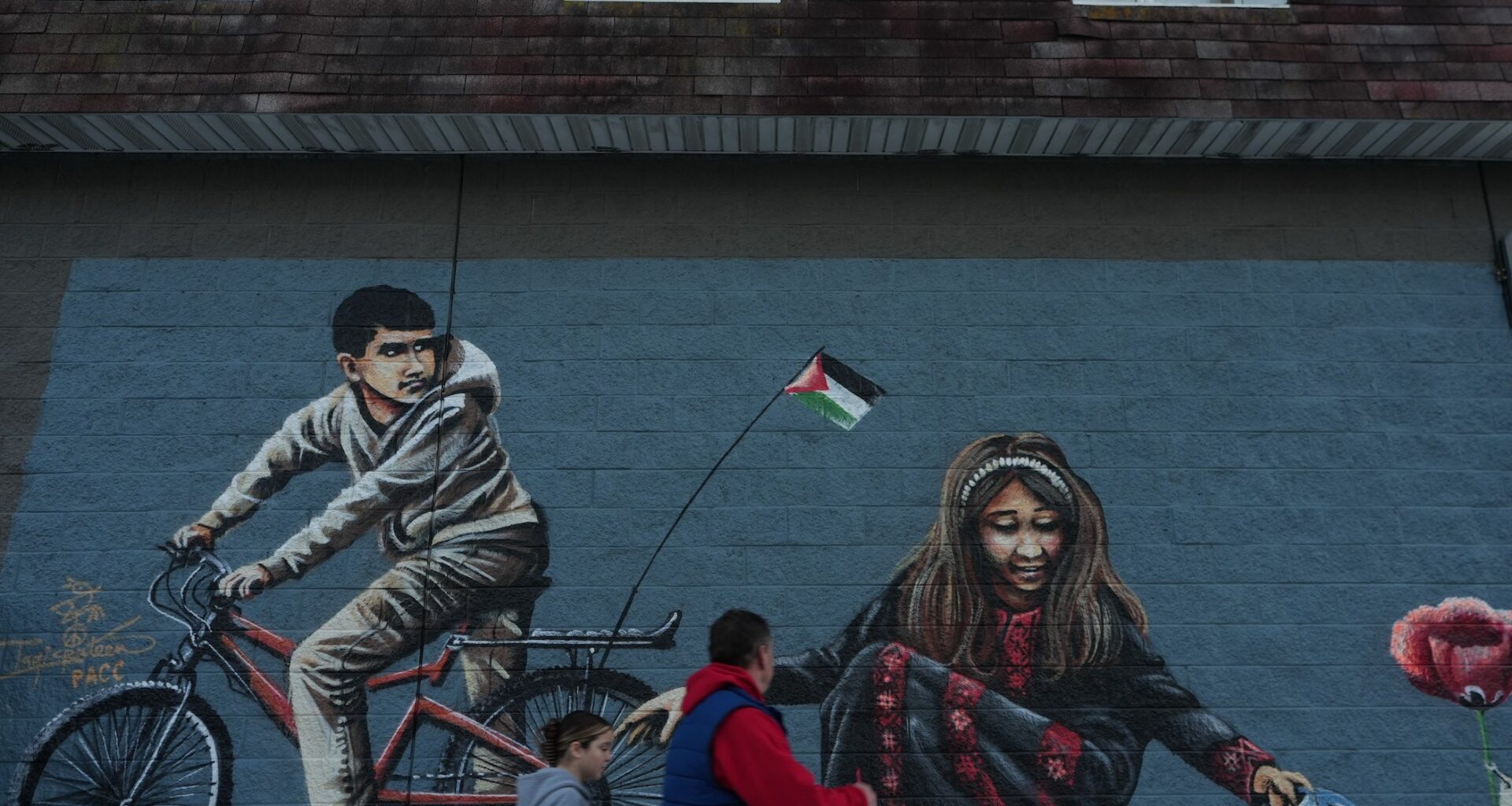
As the sun set on a section of Paterson’s Main Street renamed “Palestine Way” — flanked by Palestinian and U.S. flags — people arrived at homes and restaurants to break the fast on a recent evening. Some rushed to pastry shops, others headed to the Palestine Hair Salon.
Raed Odeh, the salon’s owner and top barber, lamented how the Middle East’s tumult and the U.S. immigration crackdown were dampening what should be a joyful month.
“This is not only affecting those who don’t have documents, this is also affecting everyone else around,” said Odeh, Paterson’s deputy mayor, as he shaved a client’s beard.
Like other city leaders, he urged the release of Leqaa Kordia, a Palestinian woman and Paterson resident who has been held in an immigration jail for a year after attending a protest in New York. Recently, Kordia said she suffered a seizure, an episode she linked to “inhumane” conditions inside the detention facility.
At a time of turmoil, Odeh said he shares the hope of many — regardless of their ethnicity or religion — during Ramadan: “Of course, everybody is hoping for peace.”
___
Fam reported from Cairo. AP journalists Deepa Bharath in Los Angeles and David Crary in New York contributed.