
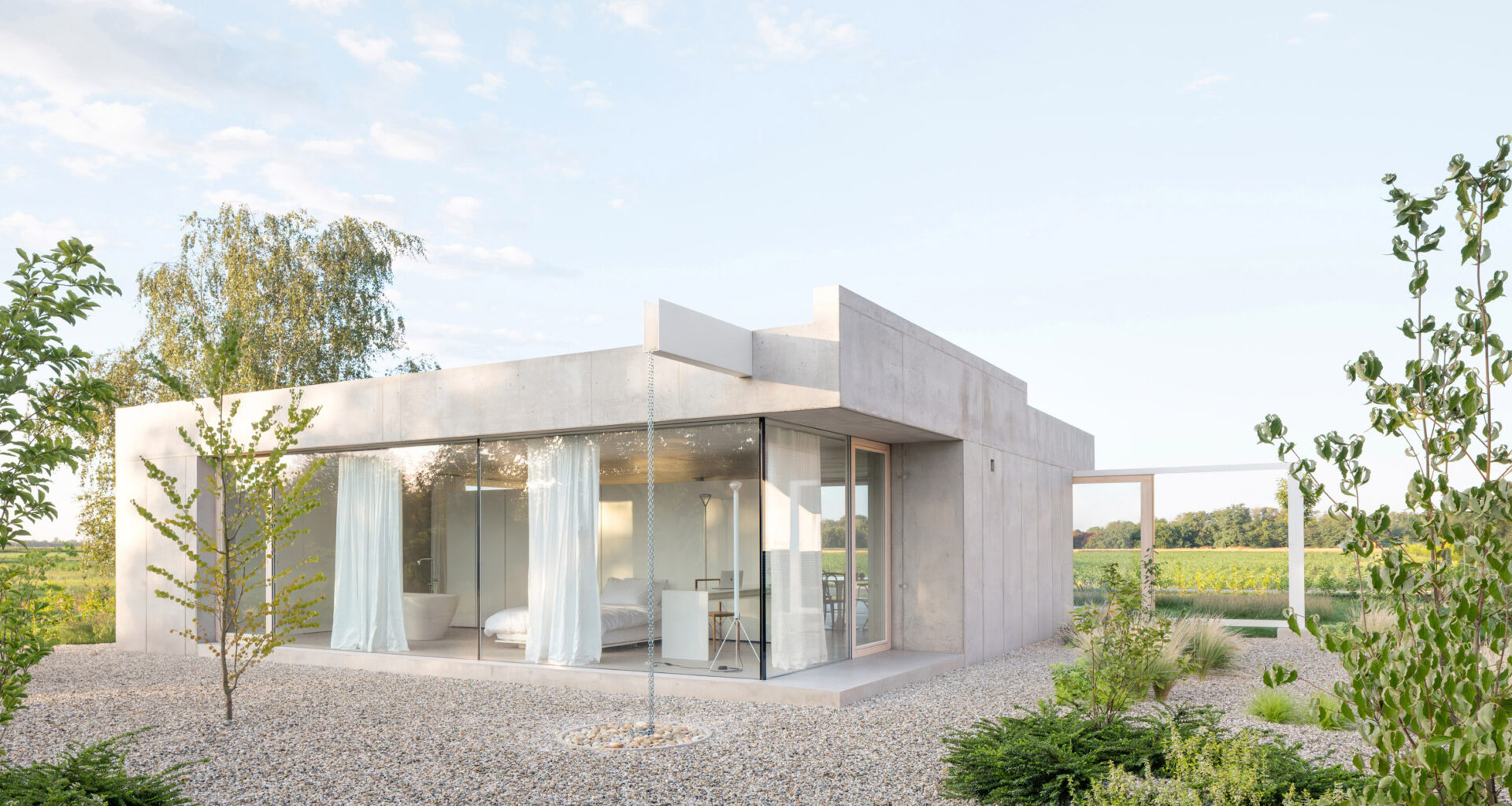
Local studio Skupaj Arhitekti has completed House on the Edge of the Plain in Slovenia, a minimalist concrete home that frames the landscape through expanses of full-height glazing.
Located on the outskirts of Murska Sobota, the home sits within the fertile green landscapes of Prekmurje – the largest plain in Slovenia – which stretches alongside the river Mur.
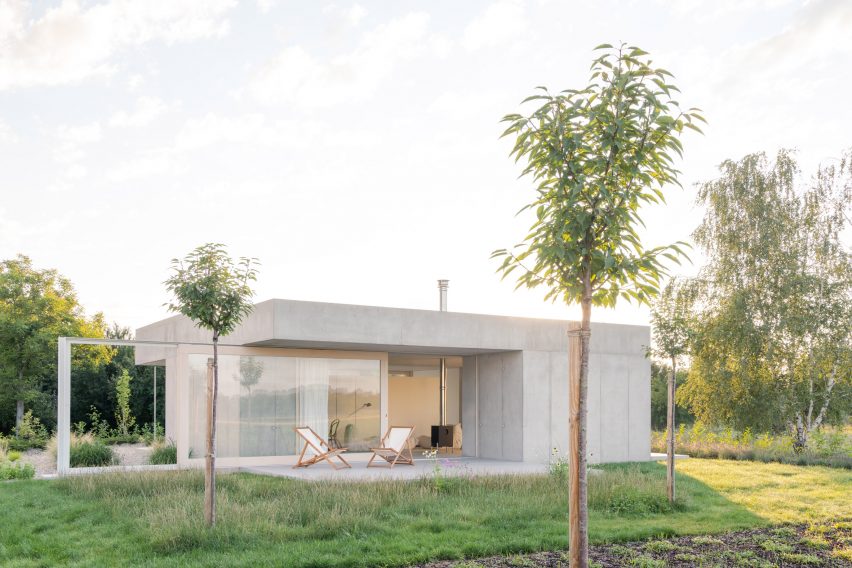 Skupaj Arhitekti has created House on the Edge of the Plain
Skupaj Arhitekti created a low-lying, exposed-concrete home that contrasts thick, monolithic walls with generous expanses of glazing.
According to the studio, the design is a nod to both the flatness of this landscape and the notable examples of 20th-century modernism found in the nearby town, rather than what it called “unambitious” suburban buildings closeby.
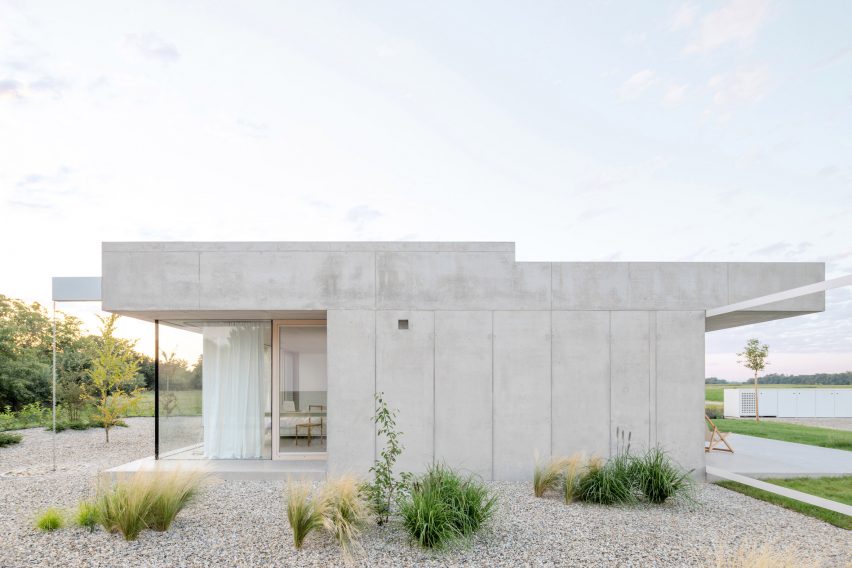 It has a low-lying, exposed-concrete form
“The project originates from a deliberate dialogue with the modernist legacy of Murska Sobota – a city defined by flatness, horizontality and functionalist thinking,” Skupaj Arhitekti partner Tomaž Ebenšpanger told Dezeen.
“Situated at the edge of an architecturally unambitious suburban development, the house consciously refuses contextual mimicry,” he added.
“Instead, it turns outward towards the open, unbuilt horizon of the Pannonian plain. Conceived as a villa for a contemporary individual or couple, it is a space of inhabitation and retreat rather than daily routine.”
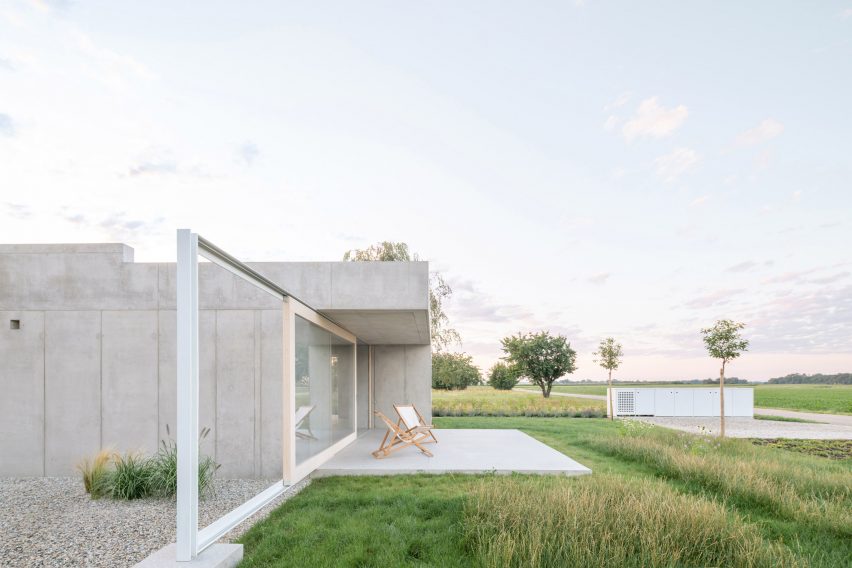 Its design nods to the flatness of this landscape
While the home was originally intended to be built from rammed earth, Ebenšpanger explains that both contemporary regulations and the loss of local construction knowledge led to the use of concrete made from aggregate sourced from the Mura river.
This concrete was subtly pigmented in a pale shade to “evoke the tone of clay” and cast using rough, recycled formwork that gave its exposed surfaces a rough texture.
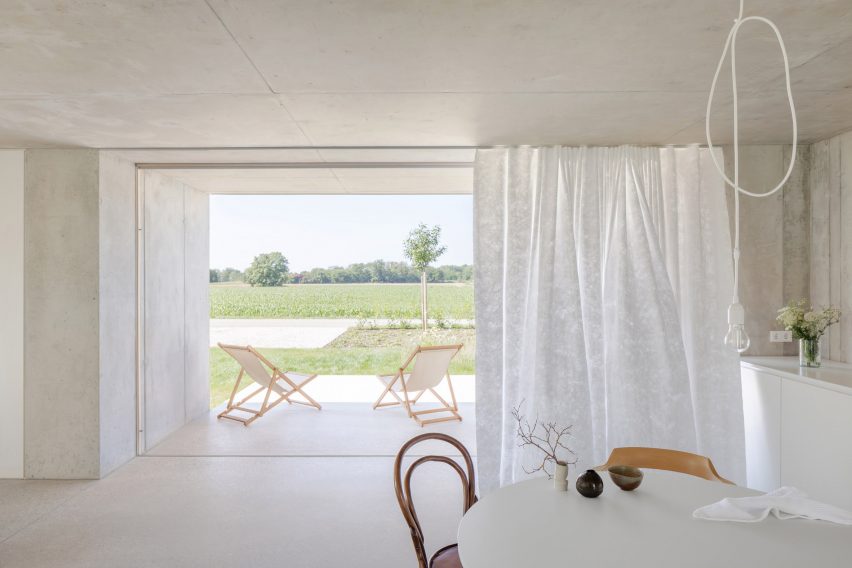 Both halves of the plan are open to the landscape
A large freestanding storage unit in the centre of the home’s plan divides a bedroom area to the north from a living, kitchen and dining area to the south, with two “cores” next to each containing a bathroom and services.
Both halves of the plan are open to the landscape – the bedroom via a full-height glazed corner, and the living area via a large sliding glass door. This is housed within a white-steel track that extends beyond the western edge of the home to frame its garden.
OFIS Arhitekti renovates stone house in Slovenia to feel “ancient and alive”
An entrance porch to the east and dining terrace to the south are both sheltered by thick sections of concrete roof, while to the north, a protruding white-steel gutter ends in a rain chain that channels water into the pebble garden.
“The square footprint conceals a striking clarity of organisation: only two enclosed programmes – a service core and a bathroom – alongside a generous kitchen niche and a single, fluid living space,” Ebenšpanger said.
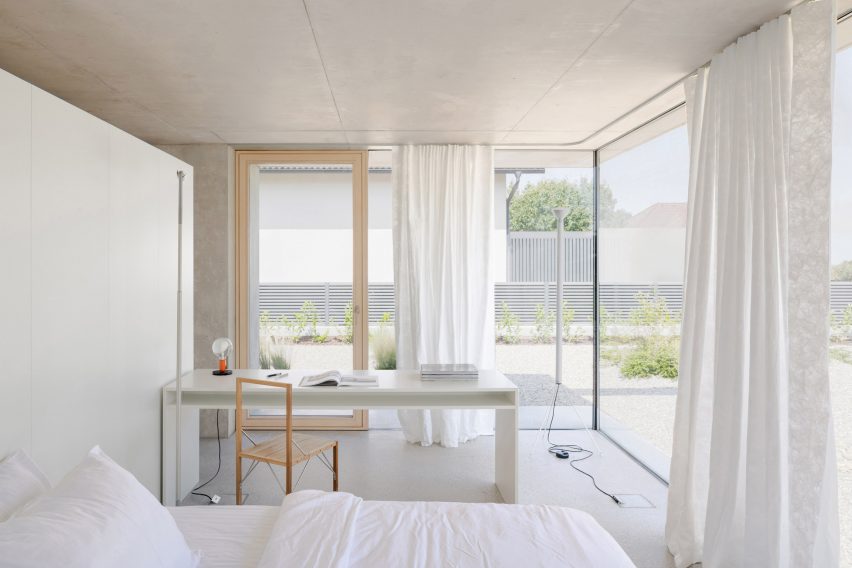 The bedroom has a full-height glazed corner
“The radically open plan dissolves the boundary between interior and exterior, while the glass envelope operates simultaneously as enclosure and as a framing device,” continued Ebenšpanger.
“Privacy is not inherent but elective – activated through curtains, precisely when and how the inhabitant chooses.”
Elsewhere in Slovenia, local studio OFIS Arhitekti recently reconstructed a home in the historic post-war housing development of Naselje Murgle in Ljubljana, adding a “greenhouse-like” extension overlooking its garden, and it also renovated a stone house in Avber to feel “ancient and alive”.
The photography is by Ana Skobe.