
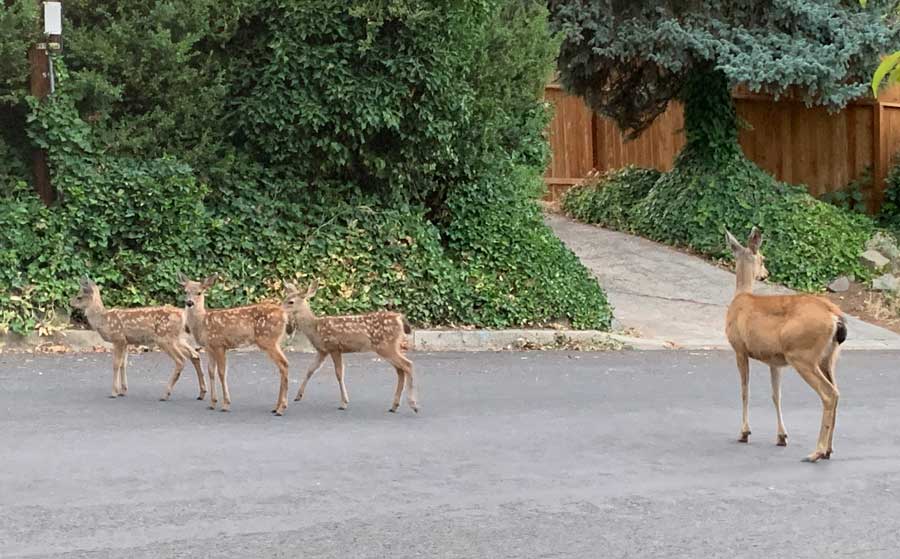
City leaders say habituated deer are losing fear of people, prompting more attacks and safety concerns
By Steve Mitchell, Ashland.news
Growing conflicts between people and habituated deer are pushing Ashland city leaders toward a public education campaign, and possibly, as a last resort, lethal removal of problem animals.
During a Monday, March 2, Ashland City Council study session, Matthew Vargas, Rogue District wildlife biologist with the Oregon Department of Fish & Wildlife and city staff discussed an escalating situation in which deer are spending their entire lives inside city limits, losing their fear of people, and increasingly posing safety risks, especially to seniors and children.
Last year, as reported by Ashland.news, an Ashland resident, Marilyn Hawkins, was knocked down and kicked by a doe while walking her dog. For his part, Ashland Police Chief Tighe O’Meara said that it was the first time the police department considered using lethal removal against an aggressive deer.
Vargas presented data showing that wildlife conflict calls have climbed in recent years across Jackson, Josephine, and Curry counties, with 2022 marking the highest complaint year on record.
While Ashland does not have more deer than other cities, conflicts between deer and humans are more common in those reports, especially in Ashland.
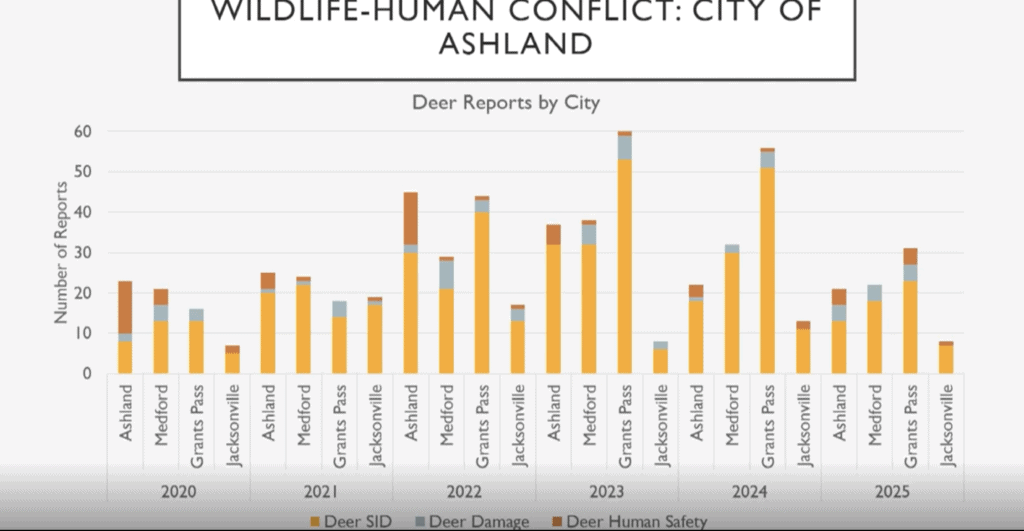 Data from the Oregon Department of Fish and Wildlife shows that calls related to wildlife conflicts have climbed in recent years across Jackson, Josephine, and Curry counties, with 2022 marking the highest complaint year on record. Deer dominate those reports, especially in Ashland, according to the state agency. Screen grab, ODFW presentation.
Vargas said the complaints fall into three main categories: human safety, damage to the landscape, and problem deer accessing yards and sheds, and sick, injured, or dead deer.
Ashland has logged more human-safety reports related to deer than nearby cities, with 2022 the highest year on record for such attacks, when people reported nearly 15 incidents.
For her part, Mayor Tonya Graham said many incidents likely go unreported. Graham said that during part of the year, she walks around with a piece of rebar for protection because her neighborhood is “simply overrun” with deer. When there are up to 12 deer in a group, they’re not easy to scare, she said.
“I think we have a much bigger problem than what the data shows,” Graham said.
She said that many people see little point in calling authorities once a deer has already moved on.
 Matthew Vargas, Rogue District wildlife biologist with the Oregon Department of Fish and Wildlife, addresses the Ashland City Council during a Monday, March 2, study session. Screen capture from RVTV video
She said in the last five years, there have been deer that simply do not care that somebody doesn’t want them where they are.
“They don’t even flinch,” she said.
Vargas said a mix of geography and weather is behind the unusually high deer activity in Ashland. Unlike Talent and Phoenix, Ashland seamlessly flows up into the forest and national watershed, especially on the southwest side. Unlike Talent, Phoenix and Medford, Ashland does not have large agricultural fields that act as a buffer between deer and humans.
In years with high deer activity, Ashland has seen mild winters that have disrupted natural food sources, Vargas said.
Vargas said 2022 brought a mild winter with little snowpack and warm temperatures in February and March, then, in late April, a cold snap hit, killing off food sources for animals, such as berries and acorns.
With natural forage reduced, deer and other wildlife turned increasingly to town, Vargas said.
“When we have those things, bears and deer are looking for food all summer, and if it’s not in the natural sources, they’re going to move down to the artificial sources of cities,” he said.
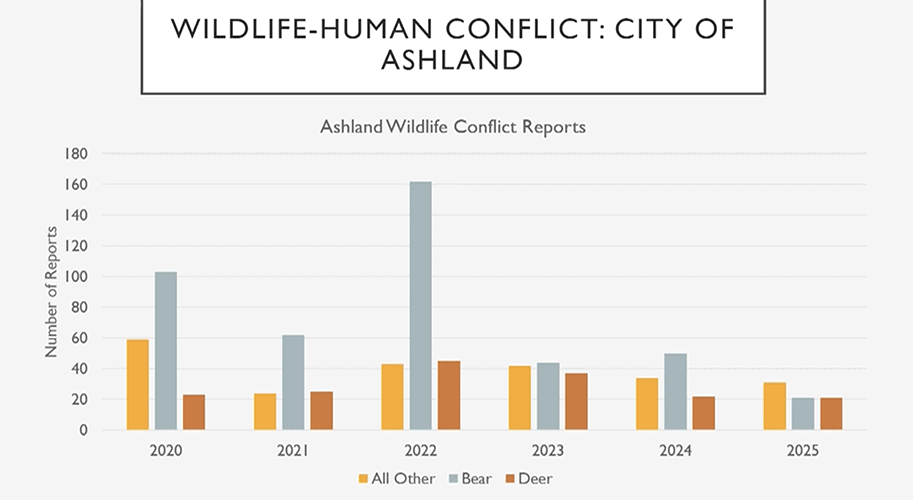 Ashland has continued to see conflicts between deer and humans in recent years, though reports are down from 2022 and 2023. Screen grab, ODFW presentation
Vargas said people in Ashland need to reinforce a negative experience with deer. He said residents should consider installing motion-activated sprinklers and planting deer-resistant plants.
He said the idea is to stop treating deer like tame neighborhood animals. He said people should stop feeding deer entirely and use hazing tactics to restore deer’s wariness, including hoses, sprinklers, or even tossing small stones to startle animals away.
Harrassing deer to scare them away will not result in people being cited for a violation, Vargas said.
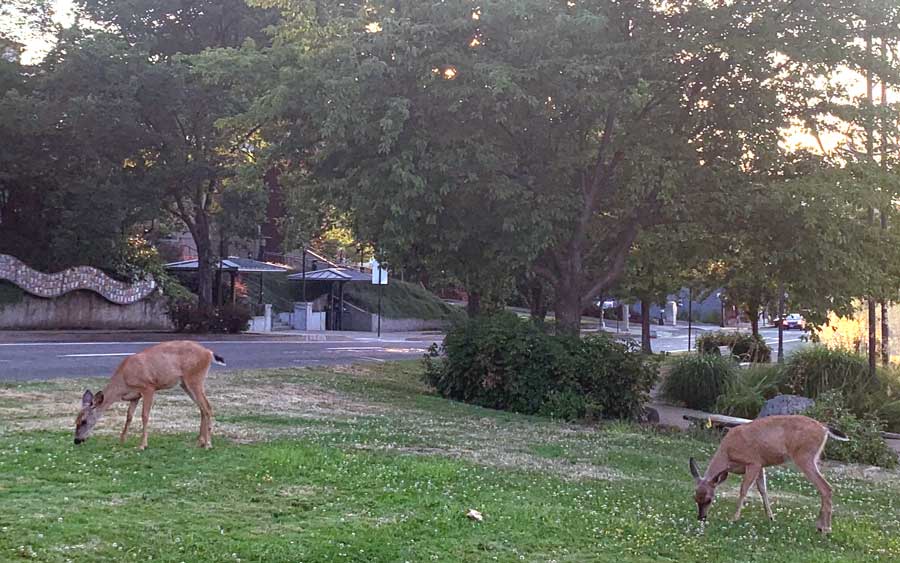 Deer graze on on Gateway Island at the intersection of Lithia Way, East Main Street and Siskiyou Boulevard, between Ashland Public Library (at left) and Ashland Fire & Rescue Station No. 1 (behind photographer). Ashland.news photo by Bert Etling
Under a state pilot program, Vargas said, cities can petition ODFW for kill permits if they declare deer a public nuisance and enact ordinances to restrict human behavior that attracts deer, such as feeding them. From there, he said, ODFW then works with the city to set limits on how many deer can be taken, which sex, and when and where they can be taken.
Vargas said the town of Union recently used the program to remove about 50 deer in the city. The carcasses were donated to charity. He said Union’s “tipping point” was a dog killed by a deer. Deer had also knocked people over, including children.
Vargas said that while Ashland has exceeded what Union went through, every town is different and has its own tolerance levels.
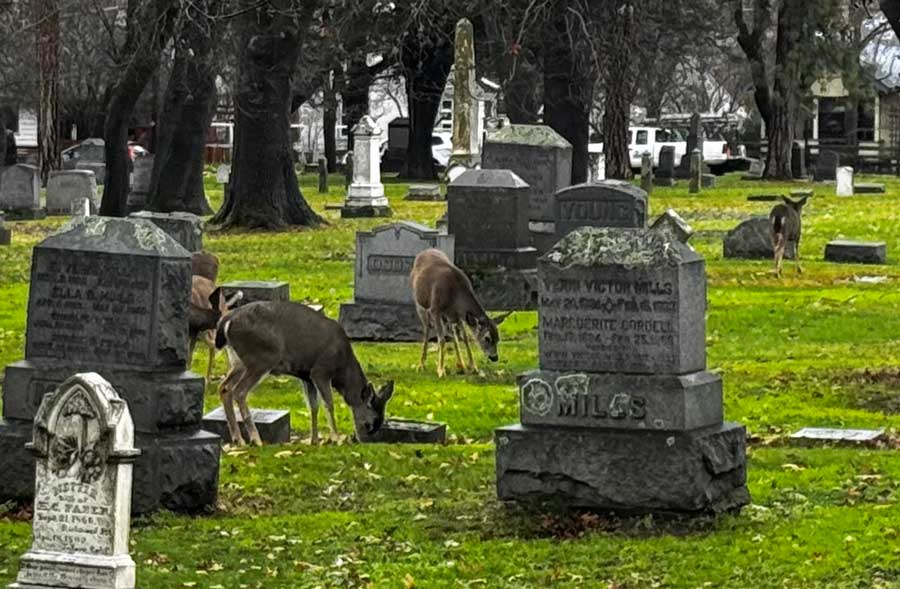 Four deer in Ashland Cemetery adjacent to Safeway in downtown Ashland. Ashland.news photo by Bert Etling
Graham said the city would like to avoid killing deer if possible. However, city officials might need to consider it if the problem continues.
Meanwhile, city officials plan to kick off a public education campaign urging residents and visitors to scare deer rather than feed them.
“Deer are not pets,” Vargas said. “These are wild animals. Treat them as such, scare them off, don’t try to get closer and don’t take photos.”
Email Ashland.news associate editor Steve Mitchell at stevem@ashland.news.
Related stories
Ashland resident is injured by deer, agencies assessing response (June 27, 2025)
Ashland dog walkers report aggressive behavior by deer toward dogs (June 24, 2024)
Mayor answers questions about water rate hikes, deer attacks (Jan. 28, 2024)
‘These deer are not Bambi’: Aggressive doe kills dog in Ashland (June 23, 2023)
Aggressive deer reported in Ashland and other areas of Jackson, Josephine counties (July 23, 2022)
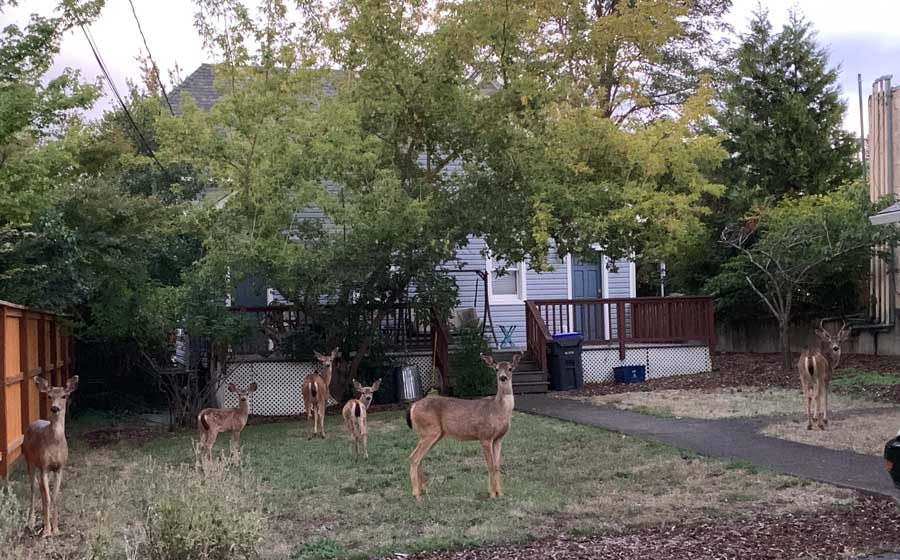 Six deer, including a buck (right) graze in a residential yard downtown almost immediately adjacent to the post office. Ashland.news photo by Bert Etling