
(Credits: Far Out / Alamy)
Sat 7 March 2026 18:30, UK
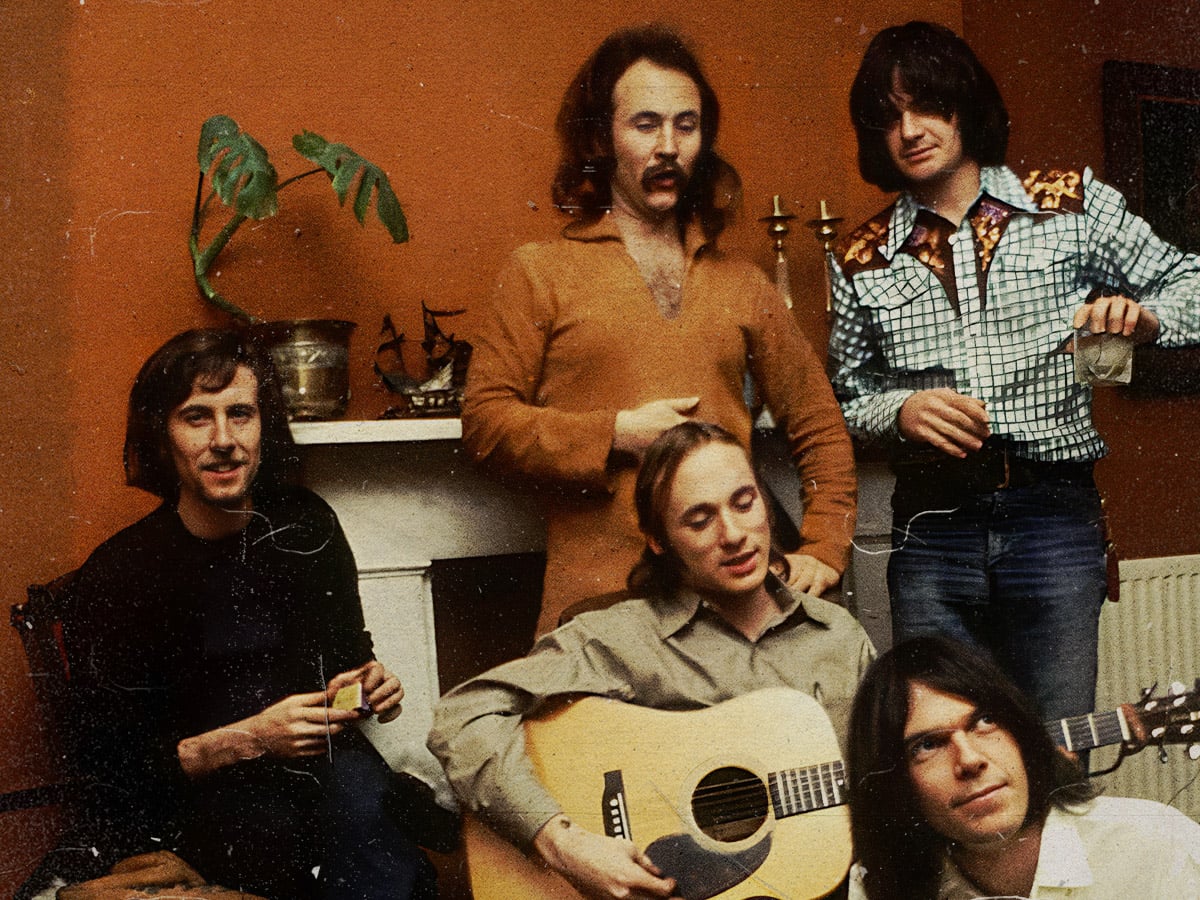
Despite being one of the most renowned names in music, introducing Neil Young to Crosby, Stills, and Nash was always a dangerous move.
The three transatlantic musicians who made up the original lineup of the band had something of an unspoken alchemy that made their debut album so unique. Against all odds, their voices came together to make a signature three-part harmony that delicately balanced all of the individual ingredients of each musician.
In any case, disrupting that with the inclusion of an extra musician ought to be approached with intense caution, but when that musician is as uncompromising and fearless as Young, well then the end result is deeply unprecedented.
At all times, Young did things his own way, and that encompassed both his musical and personal life. The former made him one of the most dogged songwriters of the generation, following the natural course of his own ideas and guitar playing to make music that could be structurally simple, but emotionally unique, which naturally crossed over with the passionate politicism of his personal life.
Young saw the world with his blinkers on, and he wouldn’t allow for his music to widen that view. And initially, that strong-willed approach injected some steel into the CSN soundscape. Young’s cutting guitar playing brought the best out of their inner darkness, and as a four-piece, they delved further into the jagged edges of rock and roll, penning politically charged anthems like ‘Ohio’.
But the tension that made this starry four-piece so brilliant, inevitably began to boil over after just one record with Young in it. Internal squabbling, drug abuse and an inevitable desire from the Canadian to move on to the next thing meant that after their 1970 record Deja Vu, Young packed up his guitar case and returned to solitude.
“It’s just what I wanted to do – I wanted to focus on this thing of what the songs were about, and the look on people’s faces, the people who came to see us and how we connected with them,” Young told Howard Stern.
Adding, “To me that was the Holy Grail, that was it. That was all that mattered to me. And once we started drifting away from that, I was gone. I didn’t think about it from the standpoint of anybody else. I just thought if I’m gonna be me, I’m gonna be me. This is who I am, I can’t do what I do if I don’t act like I believe.”
While it’s refreshing to hear Young’s cut-and-dry approach to the situation, it made for something of an abrupt change for the band. In deciding that a change was needed, Young acted immediately and left the band midway through a tour.
Nash explained that the pair had struck up a breakfast-time tradition, grabbing a bite the morning of every show. But one morning, Young broke that tradition and, with it, announced his swift exit from the band. Nash said, “He called me around breakfast time and said, ‘Hey, are you going to breakfast? Well, I’m not because I’m in Los Angeles.’ He’d left. No explanation, no discussion, no reason. When we saw each other later on, we simply didn’t mention it.”
That was the everyday by-product of such an uncompromising artist. Young’s staunch individualism is what made him the musician he was, but also the worst bandmate in the history of music.