
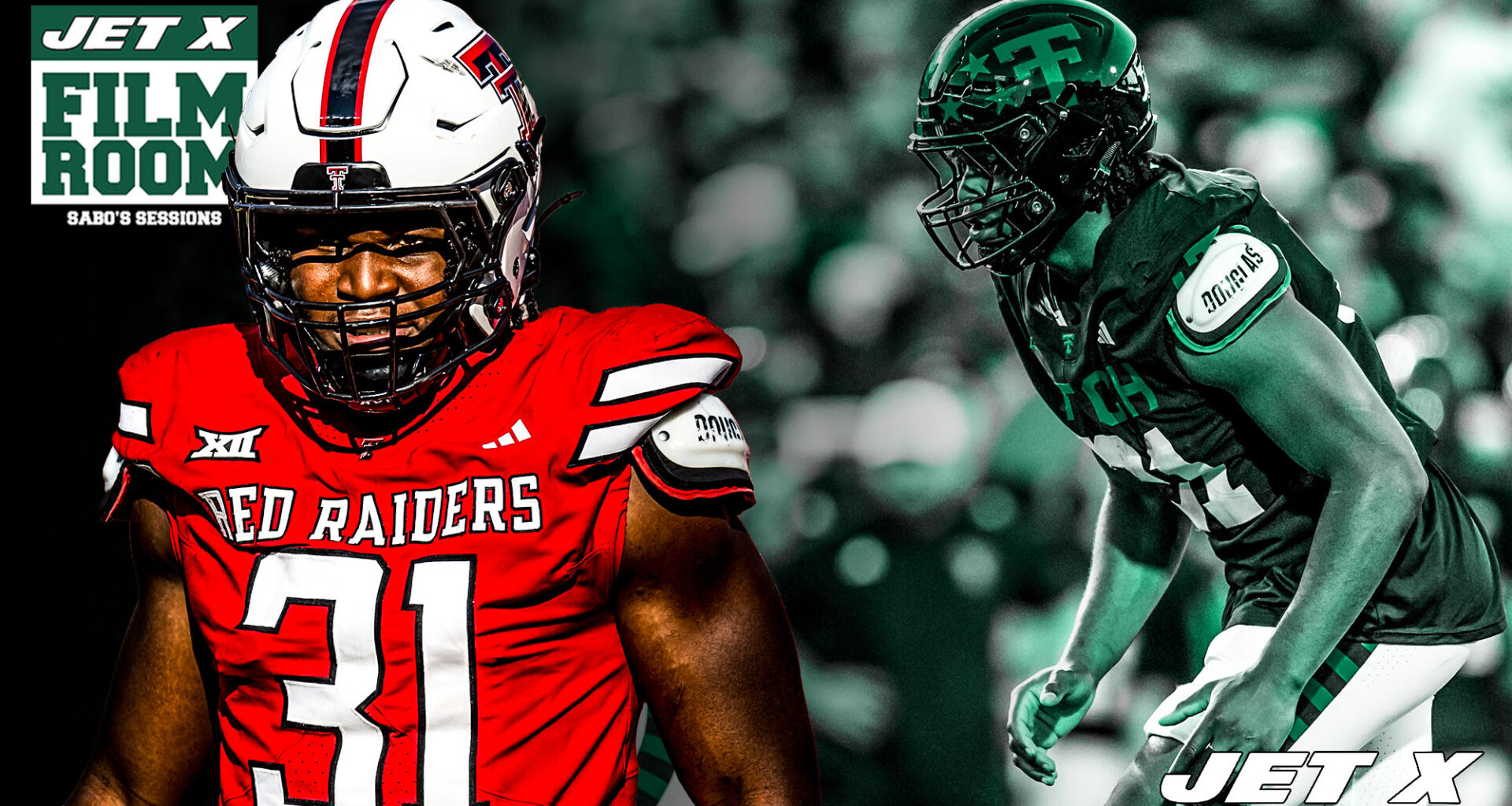
One prospect is extremely physical and violent when it’s required. The other prospect avoids contact at all costs.
One prospect sticks to the defensive play-call structure while understanding how critical he is within an 11-man unit. The other prospect freestyles in a 1-on-1 manner that makes the early 2000s AND1 Mixtape ballers blush.
One prospect is named Arvell Reese, a football player whose all-around prowess is impossible to miss on tape. The other prospect is David Bailey, a football player whose skill set can’t translate into anything beyond a specialist.
For Aaron Glenn and the New York Jets, the No. 2 overall selection in the 2026 NFL draft should be treated as all but elementary at this point. It’s not even close between the two edge prospects, particularly when analyzing the Jets’ current situation.
Any team that selects Bailey over Reese is committing football malpractice.
The meat and potatoes of it all feature one of the prospect’s brutal deficiencies as a football player — something that should automatically disqualify a prospect at No. 2 in the NFL draft.
Soft at the point of attack
Some NFL draft experts mention this surefire weakness, but there isn’t nearly enough talk about it. David Bailey’s run defense at the point of attack is egregious.
Plus, Texas Tech played him a lot at the 5 and 4-tech, which meant he could be classified as an “interior defender.” Thanks to the nature of the Big 12, calling that position an interior spot is a stretch, but the point is simple: Never will an NFL team place Bailey there.
He simply doesn’t hold up physically.
Speaking of which, everybody’s idea of what the Big 12 is these days remains flawed. The conference is still viewed too closely to that of the Big Ten and SEC, when the reality is far different. Once the likes of Oklahoma, Texas, Nebraska, and Texas A&M bolted, the quality of play dramatically decreased.
Against Utah right tackle Spencer Fano, who’s slated to also go in the first round of the draft, Bailey cannot hold up:
More David Bailey run D for which a defensive coach needs more. On the play-side this time as a 5/4T player against Fano and Utah (first play of the game).
Not a zone concept, so no flow up front; can’t lose this much ground 1v1. #Jets pic.twitter.com/danpUVGD9D
— Robby Sabo (@RobbySabo) March 7, 2026
He’s driven backwards and to the perimeter entirely too much, offering little to no resistance. This is a common theme for the Texas Tech defensive lineman.
The next play features Bailey inside-stepping way too hard against Kansas State. It’s a mix of trying to play hero ball and over-extending in a fashion that destroys the integrity of the defense:
Just a brutal one from David Bailey here. POA, I need stoutness and discipline. Stay on the OT’s outer-half, knockback, maintain spacing. Again, everything Bailey does (even against the run) is hands into finesse/elude blocks, which often hurts his defensive teammates. #Jets pic.twitter.com/vkDFOLXVsg
— Robby Sabo (@RobbySabo) March 5, 2026
The play featured an off-ball linebacker playing the force (edge contain) to the strong side (right), but Bailey’s intent to penetrate and make a play creates an incredible amount of space for the offense.
Against Oregon in the College Football Playoff, Bailey, lined up in his familiar place within Tech’s 3-3-5 on balanced rush-pass downs, is double-teamed and driven back:
The positionless convo also pertains to David Bailey bc he played a lot of 5/4T for TT, meaning he was a semi-interior defender a lot of the time (having a force outside of him). NFL teams will never use him this way on run-pass downs. Never.
He’s working against a double here. pic.twitter.com/BaNc7MfUwk
— Robby Sabo (@RobbySabo) March 7, 2026
NFL teams will not use Bailey in this type of position — at least not on balanced downs — but that doesn’t change the fact that his resistance at the point of attack is a grave concern.
There’s never any aggression, violence, or knockback in his game. This is a terrible sign when watching a prospect’s Big 12 college tape.
Playing rogue (outside of the structure)
If that wasn’t enough, David Bailey has a habit of destroying the defensive integrity. Instead of playing as 1 of 11, he goes off-script in an effort to play hero ball.
Instead of making the correct football play that puts his defense in a better position, he often seeks the big play for himself.
The next play comes against Utah again, only this time, Bailey loses to Fano out in space:
David Bailey goes rogue in team defense on this one. Just can’t have him so easily give up on the down-the-line/flow on an outside concept. Can’t allow reach/seal so easily either.
It’s not like I’m searching for these; they’re just incredibly easy to stumble upon. pic.twitter.com/240Lhij16d
— Robby Sabo (@RobbySabo) March 7, 2026
A defensive lineman cannot allow the offensive tackle to reach like that. If he does, however, the motor and down-the-line fight has to be uber-present.
Instead, Bailey can’t resist the downhill move while trying to make a noticeable play.
As promising as his pass-rushing ability is, there’s no guarantee it’ll translate to the NFL. Worse yet, a lot of his pass-rushing game depends upon get-off and straight-line targets.
The following play showcases Bailey winning a pass-rush rep (which certainly improves his pass-rush win rate), yet he does it at the detriment of his own squad:
A David Bailey fly-by that plays well for Oregon. Bailey’s a nice 1v1 pass-rushing prospect who really uses hands extremely well (uses get-off, too, which is worth hawking), but there are times when his one-track mind hurts the defense.
I’d draft him; just not at No. 2. #Jets pic.twitter.com/cuEl9dAnR5
— Robby Sabo (@RobbySabo) March 4, 2026
There are times when an edge rusher has to play it smartly and responsibly. Here, with under 30 seconds left in the first half and down 6-0, the situation called for a more conservative approach.
Rushing on the 1-tech side, flying by the quarterback is a sin. Bailey went for all the glory and smoke, as opposed to playing contain — not allowing Dante Moore to so easily break the pocket on the field side.
In today’s NFL, pass-rushing opportunities are becoming fewer and farther between. The rise of mobile quarterbacks keeps sack numbers relatively similar (due to collecting cheap sacks), but the nature of today’s 3-step/quick-passing game demands that pass rushers play defensive football in a more all-around, balanced fashion.
Positive run defense
The David Bailey positives on the ground game usually fall under the same category. If he can use his active hands while eluding run blocks and/or avoiding physicality in a direct way, he has a chance to make a play.
The best way to think about Bailey’s run defense is this: He plays the run in a way that mimics his pass rushing. While that can flash on the broadcast at times, resulting in tackles for loss and big plays, the poor plays are rarely noticed in real time and never mentioned on the broadcast.
In short, he hurts his teammates badly.
The first play of the two in the following breakdown features a classic Bailey run defense win:
Two David Bailey run D plays here (one positive, one negative). ✅ The theme for Bailey is this: Excellent 1v1 pass-rusher (when given freedom), uses get-off, great/active hands, BUT he treats run D similarly too often (hands, eludes), as opposed to POA positioning/violence. pic.twitter.com/N9WkDsEQE2
— Robby Sabo (@RobbySabo) March 4, 2026
He wins with active hands on a third-and-2 situation, goes around the blocker while using his momentum against him, and darts into the backfield for the big stop. Bailey’s only positive run-defensive path comes from non-physical block shedding.
The second play shows Bailey not getting down in the line in a backside situation. He allows the left tackle to get too much of a piece with a mere one-handed punch, and then allows the tight end to seal him.
Lastly, Bailey reads this jet-motion rush concept beautifully:
A David Bailey positive run D play: left naked, offense working misdirection with GT, taking the chance he sucks in/downhill, but he reads it nicely and flattens his angle instantly.
This is a prime example of where he’s solid against the run (no POA physicality/force). #Jets pic.twitter.com/ml3NXCAAFB
— Robby Sabo (@RobbySabo) March 7, 2026
Left unblocked, courtesy of the GT counter play-fake, Bailey read K-State’s jet-motion all the way. After taking a first downhill step, he quickly corrected by chasing front-side down the line.
His pursuit angle was flat and appropriate. Again, however, it’s the non-violent, non-point-of-attack run scenarios in which he has a chance to make a play.
Final thoughts
Anybody who believes the New York Jets should draft David Bailey over Arvell Reese at No. 2 should have their head examined. Several hardened reasons exist for this rationale.
For one, Bailey’s tape suggests he’s a pass-rushing specialist. How would that work exactly, with Bailey and Will McDonald on the field at the same time?
If you thought the Jets’ run defense was poor this past season, just wait to see how that dynamic duo performs as force players off the edge.
Secondly, the Jets’ current program status is that of an organization needing the best football players. Granted, Bailey has a chance to become an impactful pass-rusher at the NFL level — but just a chance, as the thinking about that possibility is entirely too optimistic from the current consensus.
However, his deficiencies are entirely too much to overcome. This Jets defense needs all-around football players, not specialists.
Anybody who thinks Aaron Glenn will favor a pass-rushing specialist who thrives when physicality and violence aren’t a part of the equation, over a guy who thrives on violence and aggression, isn’t paying attention.
Perhaps it’s due to the lack of top 10 talent in the 2026 NFL draft, or maybe it’s due to the narrow-minded thinking about pass-rushing — the reason isn’t known for sure — but David Bailey’s draft stock has inaccurately shot through the roof and beyond the moon, in a way that doesn’t reflect reality.
His tape mirrors that of a Will McDonald-type, who also frequently played the 5/4-tech at Iowa State, which is also a Big 12 program.
Forget the fact that Arvell Reese is the better football player (right now) in every way; David Bailey’s tape isn’t top-10 worthy. Hopefully, the New York Jets are way ahead of me.