
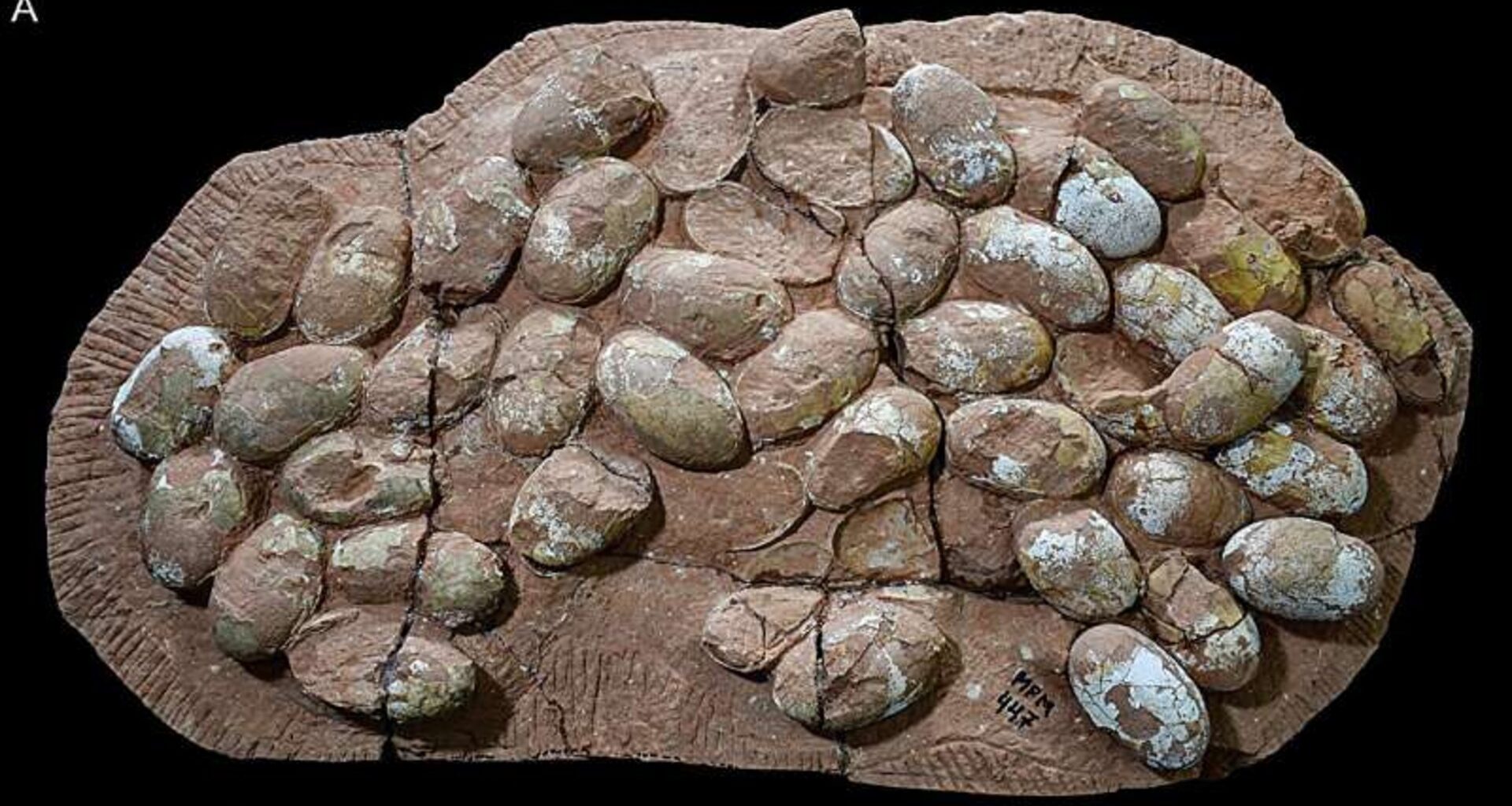
In a famous fossil bed in Brazil, researchers have discovered a new treasure of three egg clutches. These provide new insights into semi-aquatic peirosaurid crocodyliforms and expand our understanding of their reproductive strategies.
The Upper Cretaceous units of the Bauru Group in Brazil boast one of the most impressive fossil records of reptilian clades, according to a new study published in the Journal of Vertebrate Paleontology.
Researchers had already discovered a wealth of turtles, crocodyliforms, and dinosaurs there in the past. And now, “cropping out in the city of Presidente Prudente,” as the study authors explained, they have found a total of 83 eggs across three clutches, plus numerous isolated eggshells.
One of these collections, which might belong to different species, contained 47 eggs, making this the largest Mesozoic crocodyliform clutch ever found.
“The new discovery shows new evolutionary implications for one of the world’s most diverse fossil crocodylomorph faunas, revealing more complex and successful reproductive habits with potential adaptations to occasionally wetter environments,” the study authors stated.
A seriously important clutch
As the authors stated in the study, “cropping out in the city of Presidente Prudente,” the clutches were first discovered in 2004 by Dr. William Nava, one of the study’s authors. Researchers didn’t realize what they held for another 16 years, until they finally understood they had stumbled upon a real treasure of eggs.
Between 2021 and 2023, they excavated the area and found they were looking at clutches of 21, 47, and 15 eggs.
Ellipsoidal in shape with blunt ends, these thin shells and trapezoidal shell units immediately communicated to researchers which animals they once belonged to, Phys.org described. Though some had never hatched, these features made it impossible to identify them as anything other than crocodyliform eggs.
Though the exact species remains unidentified, researchers believe these eggs are from the Notosuchia subgroup, as the Bauru Group holds a large collection of these fossils. The thickness and size of the shells suggest they were laid in a wetter, more humid environment. Other Bauru Group crocodyliform eggs tend to be smaller and drier; in other words, different subspecies adapted to different environments. This damp-environment feature would suggest a semi-aquatic peirosaurid crocodyliform as the mother, Phys.org continued.
New discoveries to be made about reproductive habits
Given that most fossil clutches tend to hold only two to five eggs, while modern crocodyliforms can lay between 10 and 80 eggs per clutch, researchers noted that the difference in clutch sizes reflects taxon-specific adaptations. They might represent multiple nesting events or communal nesting.
“The spatial arrangement of the nests suggests not only a crocodylomorph colonial nesting ground, but also a broader nesting site that may have supported interactions among different species,” study author Dr. Paixão explained to Phys.org.
Could some of these eggs have belonged to dinosaurs? Further studies intend to explore other clues on-site to solve this budding, exciting mystery. Currently, the study authors are pursuing clutches that may belong to theropod dinosaurs.
“This finding expands our understanding of the reproductive strategies within the group, including nesting behavior and parental care,” the study authors concluded.