
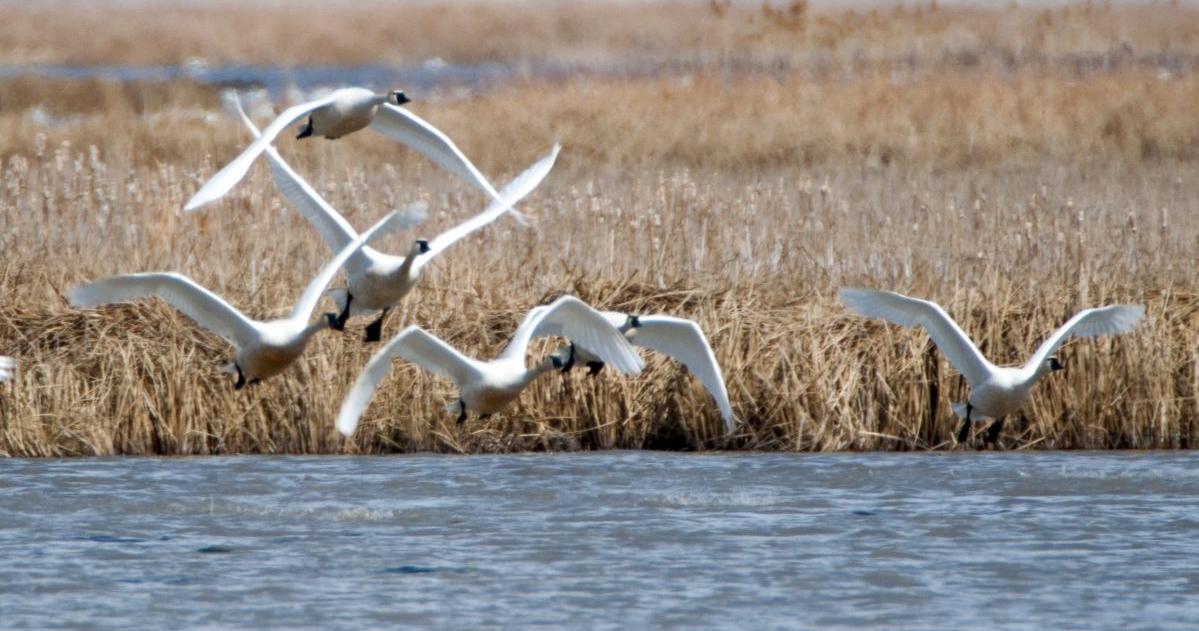
BRIGHAM CITY – For many, catching a glimpse of a group of swans in the wild would be a once-in-a-lifetime event. Utahns are uniquely fortunate to be located directly along one of their primary migration routes, the universal icon of grace and devotion.
There are two types of swans that migrate through Utah during this time of year: tundra and trumpeter swans. Both swan species stop in Utah’s wetlands for some much-needed rest and refuel for their migration north in the spring.

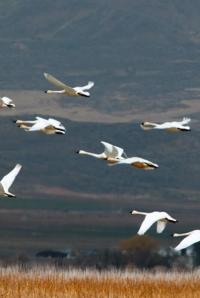
Swans fly through on of Utah’s Widlife Management areasin Utah.
DWR photo
Trumpeter swans are larger than tundra swans and are the largest waterfowl species in North America, with wingspans exceeding 8 feet. They also make a distinctive trumpet-like sound, hence their name. Tundra swans have a yellow-colored spot near their eyes which is a defining characteristic.
“Witnessing these rhythmic, graceful giants descending upon our marshes is a special reminder of how vital Utah’s wild spaces are,” Utah Division of Wildlife Resources Northern Region Outreach Manager Crystal Ross said. “Between their massive wingspans and snowy-white feathers, they are a sight that’s impossible to miss. I love that their journey brings them right through our backyard.”
The peak time to see them in the spring is typically March, you can also see swans in Utah during fall in early-to-mid November.
Box Elder County has some great places to see swans in Utah this spring:
Salt Creek Waterfowl Management Area
The Compton’s Knoll viewing area is a small hill on the southeast side of the DWR’s Salt Creek Waterfowl Management Area. The knoll is a perfect place to view swans and other birds. The hill places visitors above the marsh, providing fantastic viewing opportunities for those people who have binoculars or spotting scopes. Two bird-viewing blinds are also located at the bottom of the hill.
The Salt Creek WMA is located about 12 miles northwest of Corinne. Except for Compton’s Knoll viewing area, the rest of the WMA is closed for different parts of the year. Please stay behind closed gates and only view the swans from Compton’s Knoll or the two bird-viewing blinds at the bottom of the hill.
Bear River Migratory Bird Refuge
The other area is the managed by the U.S. Fish and Wildlife Service. The refuge and its Bear River Migratory Bird Refuge Auto Tour Route is another great place to see migrating swans in Utah. It is located about 12 miles west of Brigham City.
To take the auto tour route take on I-15 exit 363, and travel west on West Forest Street until you come to a large parking area with an observation tower. Stop at the tower to look for swans in the marsh to the north. Visitors can drive along the 12-mile auto tour route. The route will take you on a journey through the heart of the refuge. There are generally thousands of swans in the wetlands along the driving route.