
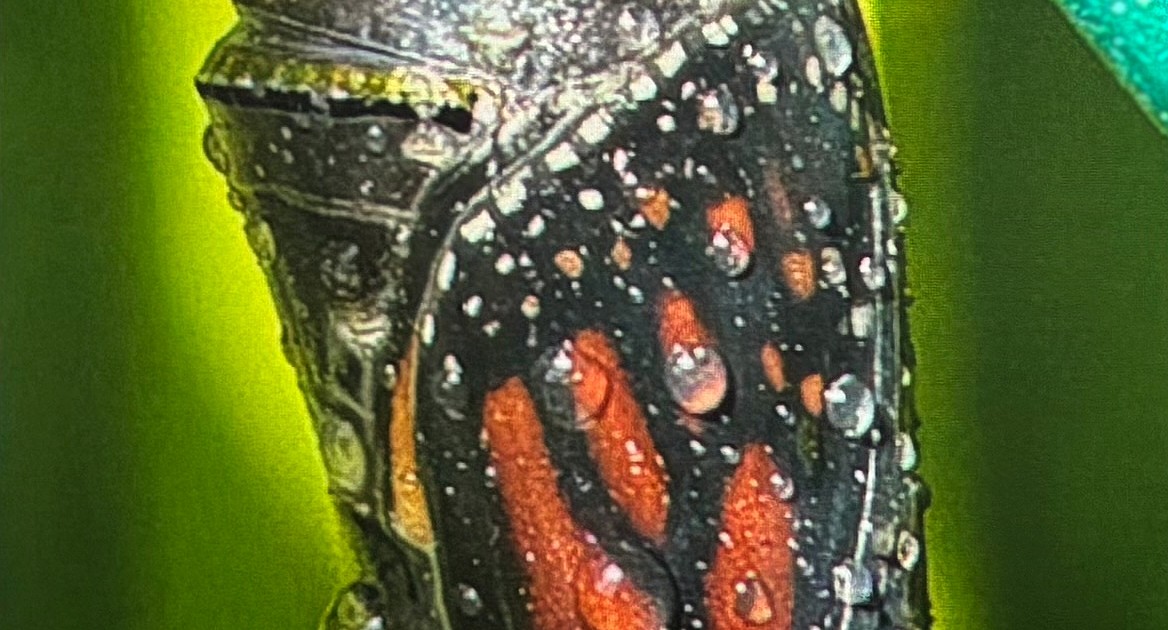
The monarch butterfly is iconic in North America — but in Montana, it is a rare sight.
That’s why when Kathy Ross discovered monarchs breeding in her Bigfork garden last summer, she knew it was extraordinary.
“I grew up with monarchs in the Midwest and I’ve lived out here for 37 years — never seen a monarch — but I know historically, they are here, whether they’re few and far between. But I had never heard of documentation of them actually breeding in the Flathead Valley,” Ross told an audience during a Feb. 23 presentation part of the Glacier National Park Volunteer Associates winter speaker series.
Ross, a landscaper, conservationist and citizen scientist, initially found eight monarch caterpillars and ended the season with four butterflies taking flight from her garden, adding to a population that has faced severe declines over the decades.
To understand why that matters, Glenn Marangelo, development director and co-founder of the Missoula Butterfly House and Insectarium, walked the audience through the monarch’s remarkable lifecycle.
A MONARCH’S life begins with a single egg laid on one plant — milkweed.
Each egg is laid individually on the underside of a milkweed leaf. In five to 10 days, a caterpillar emerges.
Then it eats.
“In two to three weeks, they will grow 2,700 times their initial size. They’ll take on this beautiful light black and yellow kind of striped coloration,” Marangelo said.
During that time, it molts, passing through five developmental stages called instars. When fully grown, the caterpillar anchors itself to a protected surface — not necessarily milkweed — by a small silken pad. It hangs in a “J” shape before shedding its skin one final time to form a chrysalis, or pupa.
Ross spotted that unmistakable J-shape in her garden in early August. This particular caterpillar had attached itself to a chain link fence.
“At this point, when they go into a chrysalis … they don’t need milkweed anymore,” Ross said, just something secure that offers protection.
She remarked on the beauty of the mint-green chrysalis and its glittery gold band at the top.
“I wasn’t able to stay and watch the chrysalis form … I knew it sometimes can take 12 hours. I came back later in the day and sure enough, I had a chrysalis and I know exactly where it was and when it had started,” Ross said.
Inside, the metamorphosis continues. Over roughly eight to 15 days — longer if temperatures are cool — the caterpillar’s body breaks down into a cellular soup, reorganizing into a butterfly.
Ross documented the process like a field researcher, tracking temperatures and weather. This particular chrysalis took 18 days to mature during a stretch of cool nights in the 40s and warm days in the 80s with a mix of wet and sunny weather.
When the chrysalis turned transparent and the orange-and-black wings became visible inside, she knew it wouldn’t be long before it emerged.
“They don’t usually open up at night,” Ross said. “The first thing the next morning I called my friend Debra. … We were like expectant mothers.”
As the sun shone down, the chrysalis split, the butterfly pushing it apart, slipping out, unfurling an engorged abdomen and wings. The moment was captured in a 20-second video by her friend, which elicited “wows” from the audience.
“And that beautiful butterfly came into the world,” she said.
Over the next hour, the hemolymph (the insect equivalent of blood) contained in the abdomen is pumped into its wings, expanding them before drying in the sunlight.
“This was one of the most beautiful parts to me, because it was like a monarch meditation. or a butterfly meditation. I just sat there and took deep breaths along with it as it dried its wings,” she said. “And realize that this beautiful butterfly is adjusting to the world as a new being and that just kind of blows my mind,” she said, noting that as it was occurring, two more monarch butterflies were drinking nectar behind the pair of friends.
Once dry, the butterfly will take flight. That wasn’t the case in this instance, Ross said. Realizing it was going to be a hot day, she picked up the butterfly using a leaf and moved it into the shade.
“It took almost 48 hours for her to finally fly, which was a really long time, but she did,” Ross said, smiling.
From egg to adult, metamorphosis can take four to six weeks, Marangelo said, dependent on the temperature. If it’s cooler, it may take longer. Warmer temps may hasten the process.
Adults may live only two to six weeks during the breeding season, though migratory monarchs can survive up to nine months. Once ready, a female will seek milkweed and begin the cycle again.
THE SUN-LOVING milkweed plant is what brought the monarch butterflies to Ross’ garden.
It is the only plant monarchs will lay eggs on, and the only food monarch caterpillars eat.
Monarchs locate it using chemoreceptors on their feet and antennae. When a butterfly lands, it effectively tastes the plant.
Milkweed contains toxins called cardenolides. The compounds evolved as a defense, but monarch caterpillars have developed resistance to it. They accumulate the toxins in their bodies, making both caterpillars and adult butterflies distasteful to predators.
Birds quickly learn the lesson as Marangelo showed photos of a blue jay eating and then vomiting a monarch. Parasites, however, are another story. Certain wasps and flies have adapted to bypass those defenses and can impact monarchs’ survival.
Milkweed itself is disappearing as urbanization and herbicide-tolerant corn and soybean crops and herbicide use in general proliferates.
NORTH AMERICA hosts two primary monarch populations, the eastern and western populations. Not all monarch butterflies migrate, but for those that do, the path is long, with some traveling 3,000 miles. The butterflies use a combination of air currents and thermals to travel that distance, according to the Forest Service.
The eastern population overwinters in high elevation oyamel fir forests in central Mexico, protected in part by the Monarch Butterfly Biosphere Reserve, a World Heritage Site.
Each spring, they migrate north, breeding and dying along the way. It takes three to four generations to reach the northern United States and southern Canada. The final generation returns to Mexico in fall — to the same forest their ancestors left months earlier.
“So, think of them as relay racers. At that point, they’re passing the baton on to the next generation. And it’s going to take three to four generations of monarch butterflies to kind of get their way up north,”Marangelo said.
Western monarchs overwinter along the Pacific Coast of California before spreading inland to states including Nevada, Arizona, Utah, Oregon, Washington, Idaho and, to a lesser degree, Montana.
“In the 1990s, nearly 700 million monarchs made the epic flight each fall from the northern plains of the U.S. and Canada to sites in the cool and moist oyamel fir forests north of Mexico City, and more than one million monarchs overwintered in forested groves on the California Coast,” according to the Xerces Society for Invertebrate Conservation.
That population is estimated to have declined by more than 80% from central Mexico since the ’90s and by more than 95% on the California coast since the ’90s, according to the nonprofit, researchers and citizen scientists.
Numbers in recent years have remained steady with a marginal increase in 2024.
Hot, dry conditions in breeding grounds, extreme storms in overwintering forests, shrinking habitat, pesticide and herbicide use have all contributed to the collapse.
Only about 2% of the original oyamel fir forest remains. As the climate warms, the cool, moist conditions monarchs rely on are retreating upslope — much like a shrinking snowpack, according to Marangelo.
He said that Montana may become more important in the coming decades due to climate change.
The state may not be a migratory hotspot, but its size means many butterflies may be passing through unnoticed.
WHAT WORKED in one Bigfork garden may work for others in the valley. Ross attributes the presence of breeding monarchs on three things: milkweed, no pesticides and favorable weather and temperatures.
She does not use chemical or organic pesticides, herbicides, or fungicides — what Flathead Conservation District Program Manager and speaker Jessie Walthers simply calls “the cides.”
Milkweed thrives in sunny areas and grows in prairies, meadows, wetlands, open fields and roadsides. But habitat loss — especially along agricultural edges — has reduced its presence.
Modern farming practices compound the issue. Herbicide-tolerant corn and soybean crops allow entire fields to be sprayed, eliminating everything but the crop.
Another major threat is neonicotinoid insecticides, Marangelo said. These systemic chemicals are absorbed into all parts of a plant, including pollen and nectar. Even if a plant looks healthy, its tissues can be toxic to pollinators.
Gardeners are encouraged to ask nurseries whether plants have been treated with systemic pesticides, Ross said. Many large-scale growers use them to produce the “perfect” plants that consumers have come to expect.
Ross and Walthers cautioned against planting milkweed or attracting pollinators in other ways for people who want to continue using pesticides or herbicides. They also cautioned against attracting pollinators if they live next to neighbors or farms using them. If they do, there are ways to create barriers to block some of the spray carried by the wind.
SUPPORTING MONARCHS and other pollinators, such as bees, does not require a lot of land. About 85% of flowering plants depend on pollinators, Walthers said.
Ross recommended less lawn and more trees, shrubs and flowers, preferably native. Walthers said to include a variety of flowering plants that bloom from spring to fall to provide consistent food sources. Walthers also recommended avoiding or limiting pesticide/herbicide use, applying it as the directions indicate, saying that this is a case where more isn’t better.
Most of all, Walthers emphasized, is learning to tolerate imperfect lawns.
Dandelions and clovers provide early food sources for pollinators. Leaf litter, standing stems and small brush and rock piles offer shelter. Many native bees nest in soil, so patches of bare ground are beneficial, Walthers said, while layers of mulch create barriers.
She noted that the conservation district has signs to put into yards advising neighbors that it is a pollinator-friendly lawn.
“Habitat loss and fragmentation is a big part of the challenge for pollinators, and so even providing little buffer strips, you don’t have to have a huge area, just a little area in a small yard or in your garden. Little buffer areas can provide a great patchwork and network for pollinators,” Walthers said.
Marangelo left the audience with a question to contemplate:
“If you were a species that only had one place to really live and survive, and you only had one food source that could sustain your population, would you be a little worried? I think I would be. And unfortunately, there’s a lot to worry about monarch butterflies,” he said.
Their survival hinges on milkweed, intact migration corridors and overwintering in habitats that are shrinking under pressure from climate change and development.
Yet Ross’ garden — tucked away in Bigfork — shows what is possible. Four butterflies took flight last summer. Each lifecycle starting with a single tiny egg on a leaf.
What it took was a patch of milkweed. No chemicals and a willingness to let lawn and garden look a little wild.
“Insects are really resilient, if we can do what we can to protect habitat, reduce pesticide use, keep our fingers crossed that Mother Nature doesn’t throw any big curve balls. Their numbers can rebound,” Marangelo said. “But the bad news is we’ve got a really long way to go, and there’s a lot of things to overcome.”
To ramp up local conservation efforts in the Flathead Valley, the Flathead Conservation District is incorporating the monarch butterfly into its Flathead Pollinator Initiative. Through the initiative, the conservation district provides free wildflower seeds to people who want to create gardens that attract native and beneficial insects, including butterflies, moths and bees. The Flathead Conservation District will also provide technical assistance to participants, including site selections, preparation, timing of planting and determining maintenance seeds, according to flatheadcd.org. For more information about the program, visit flatheadcd.org or call 752-4420.
Reporter Hilary Matheson may be reached at 758-4431 or [email protected].
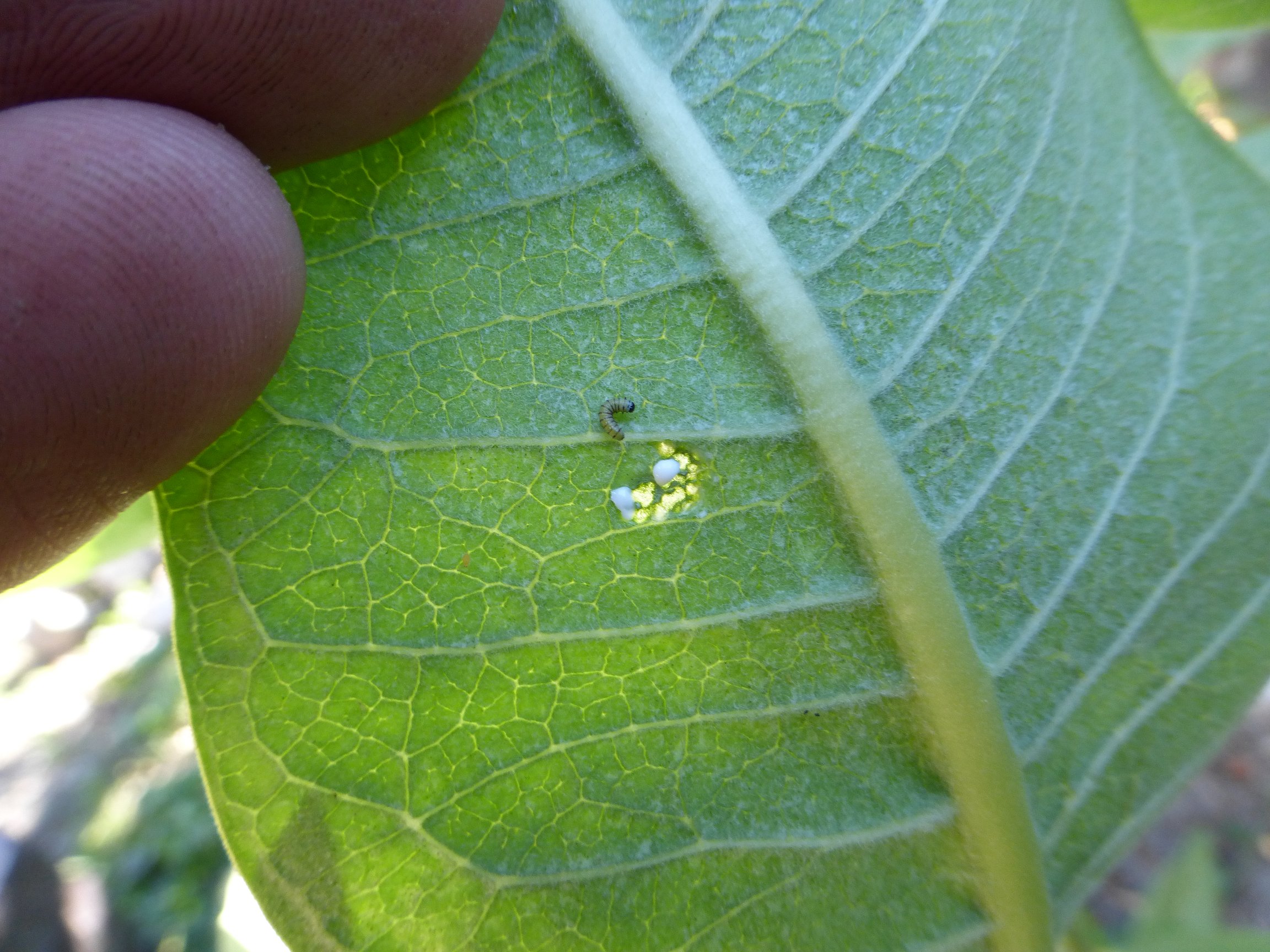 A monarch butterfly caterpillar, about two to three days old, has eaten a milkweed leaf in Glenn Marangelo’s backyard in Missoula. The Missoula Butterfly House and Insectarium development director said the dots of sticky, milky sap seeping from the damaged area contain toxins, which the larva is resistant to. The monarch butterfly caterpillar exclusively eats the milkweed, using the toxin buildup to its advantage by becoming unappetizing to predators. (Photo by Glenn Marangelo)
 Kathy Ross of Bigfork found eight monarch caterpillars on native showy milkweed in her garden on July 28, 2025. (Photo by Kathy Ross)
 A monarch caterpillar anchors itself to a chainlink fence in Kath Ross’ Bigfork garden, preparing to form the chrysalis. (Photo by Kathy Ross)
 A monarch butterfly emerges from its chrysalis in Kathy Ross’ Bigfork garden on Aug. 24, 2025. Ross, a local landscaper, conservationist and citizen scientist, said the butterfly was one of four adults that survived from the eight caterpillars she initially found in her garden, an unprecdented occurance in the Flathead Valley. (Photo by Kathy Ross)
A monarch caterpillar anchors itself to a chainlink fence in Kath Ross’ Bigfork garden, preparing to form the chrysalis. (Photo by Kathy Ross)