
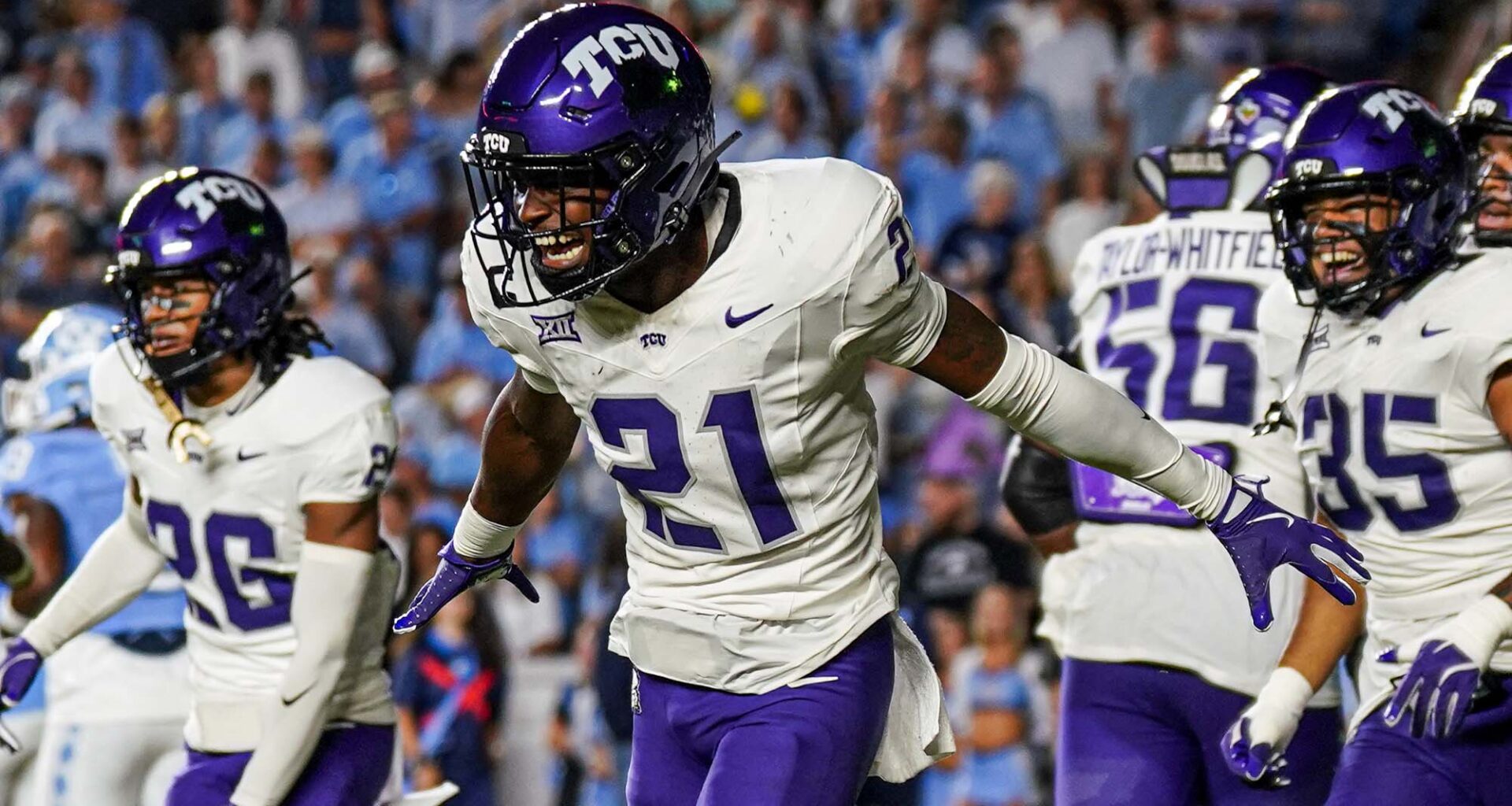
The next edition of our New York Jets’ top 50 draft prospect fit series takes us back into the defensive backfield. Considering the 2025 Jets intercepted zero passes, you have to imagine that a ball-hawk at cornerback or safety is high on the priority list.
Why not look at a player who can play both? Let’s take a deeper look at TCU’s Bud Clark.
Check out the previous editions of the Jets’ big board series anytime:
Bud Clark measurables and stats
General big board rank: No. 99
2026 Combine results
Height – 6’1’’
Weight – 188
Arm – 31.5’’
Wingspan – N/A
Hand – 9.0’’
40-yard dash – 4.41
10-yard split – 1.56
Vertical – 38’’
Broad jump – N/A
2025 Statistical Overview (PFF)
Completion Rate – 66.5%
Coverage Yards Allowed – 256
Touchdowns Allowed – 4
Pass Deflections – 6
Interceptions – 4
Penalties – 7
Tackles – 56
Missed Tackle % – 14.5%
Positives
Clark is a smart, perceptive DB who always has a nose for the football. His body is built lean, but he has the potential to add more functional weight.
Clark plays with great poise and discipline against the run, utilizing proper pursuit angles and showing good closing speed from depth when charging towards the ball carrier to make a tackle. He takes on anything that gets in front of him and does not back down from contact because of his smaller stature.
Clark’s coverage ability is characterized by strong awareness and route recognition, particularly in zone coverage, where he reads the QB’s eyes and positions himself to disrupt passing lanes. He has excellent ball skills for the position, attacking the ball like a WR.
Throughout his career, Clark has had 14 PBUs and 11 interceptions, and he has regularly been at the catch point to break up passes. Clark has strong processing skills with route combinations and can easily click and close on short-throw attempts.
Throughout his time at TCU, Clark demonstrated both experience and solid leadership. He has proven himself reliable by being elected team captain. Throughout his career, he has also had many opportunities to show his value as a member of the special teams unit.
Negatives
Clark is a sixth-year senior with a history of not staying healthy, and because of his slender build, there might be concerns about play strength.
His build and length are similar to those of a cornerback, and at times he has relied on dive and drag tackle methods, resulting in a career missed-tackle rate of about 15%. This has enabled some ball carriers to gain extra yards when they contact Clark, underscoring the need for continued development of his strength.
In addition, his aggressive instinct to jump passing lanes has at times led to him allowing explosive plays. The hero-ball mentality needs to be honed, as there have been instances littered throughout his college tape of him pressing the “feast or famine” button.
Fit
Clark shows himself to be an intelligent and instinctive player, able to play various defensive positions and backed by the football IQ to do so. His best position at the next level is likely to start out as a sub-package safety or nickel corner, where he can use his awareness in coverage, ability to read routes, and his ability to make plays on the football.
Clark is that true ball-hawking playmaker that the Jets’ defense has been void of since Marcus Maye left the team. Considering how much they struggled intercepting the ball last year, anyone who can be a difference maker in the turnover column has to garner some interest.
Being a 25-year-old prospect with an injury history will hinder him, but he was a standout in Mobile at the Senior Bowl and seemed to revitalize his draft stock.
The Jets would be smart to consider Clark with the first of their fourth-round selections (if he is still on the board). He would come in and be a younger, faster, more electric version of what Aaron Glenn had in Isaiah Oliver, making him a solid choice for a defense in need of a complete overhaul.