
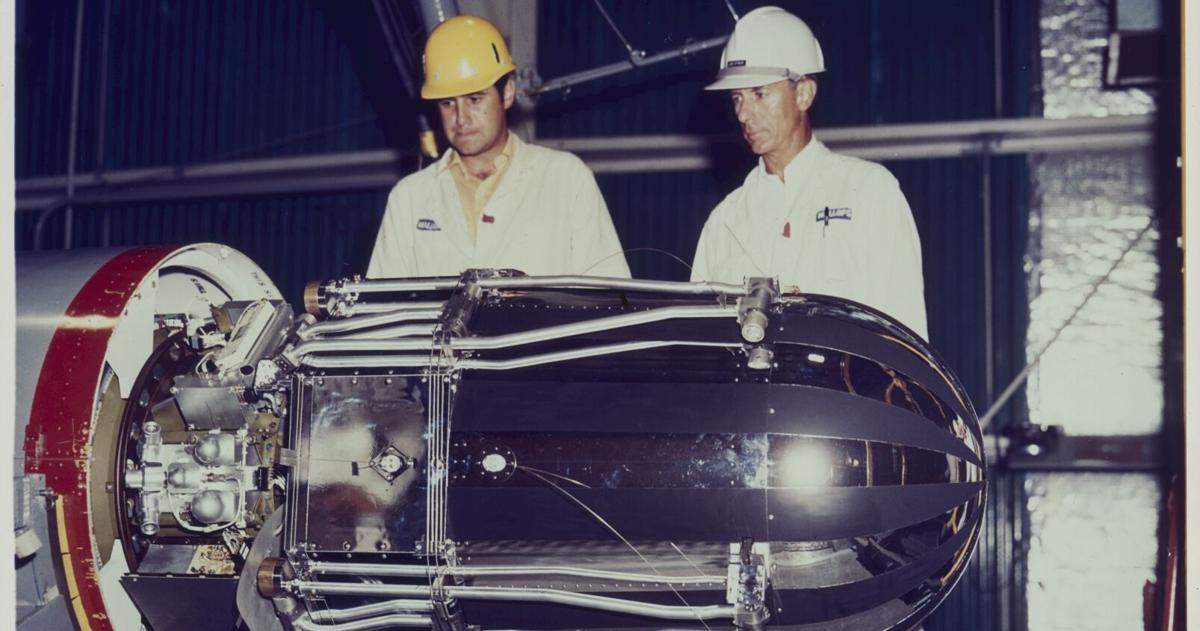

NASA engineers attach the Orbiting Frog Otolith spacecraft to a four stage Scout Vehicle for the National Aeronautics and Space Administration’s launch of two bullfrogs from the City of Rayne from Wallops Island Station, Virginia, into space in November 1970. The Louisiana frogs were being used in an inner ear study, which would later aid American astronauts.
PROVIDED PHOTO BY NASA
Frogs? In space?
Cue a froggy theme song by John Williams while the “Frogs in Space” prologue slowly scrolls from the bottom of the screen into the infinite galaxy. This is where the Frogs must find a way to destroy the Death Star before it obliterates the universe, right?
Wrong. Unfortunately, frogs don’t really factor into heroics at all when it comes to outer space, that is, unless commendations are awarded for inner ear studies, which was the National Aeronautical Space Administration’s main interest when it launched two bullfrogs from Rayne into the earth’s orbit in 1970.
This basically answers Mark Jeffers’ question about Rayne’s space frogs.
“I remember hearing a story about Louisiana giving NASA two frogs from Rayne when I was a kid,” the Baton Rouge reader said. “Is this true? And if it is, what was the purpose?”
NASA launched the Orbiting Frog Otolith with a Scout rocket like the one seen here. The capsule containing the frogs from Rayne was located at the top tip of the rocket.
PUBLIC DOMAIN
Frog capital and ears
Yes, it’s true, and Louisiana used it as an opportunity to promote the City of Rayne as the Frog Capital of the World while helping NASA investigate the effects of microgravity on balance, specifically targeting the causes of space motion sickness, which had significantly affected Apollo astronauts.
As reported by NASA at the time, a frog’s inner ear structure is similar to that of humans. The frog’s smaller size provided a simplified but accurate model for the study.
“Since 1965, NASA has flown more than 80 different organisms as biological payloads to space,” said NASA Chief Historian Brian C. Odom. “These space biology studies have explored fundamental questions related to fields such as cell and molecular biology, developmental biology and neuroscience, just to name a few.”
The 1970 mission, Odom said, was called the Orbiting Frog Otolith, or the OTO experiment.
Edwin Edwards, seen in the center of this Oct. 6, 1970, Advocate photo, was serving as representative of Louisiana’s 7th Congressional District, which included the City of Rayne. Edwards spearheaded the campaign for Rayne’s frogs to be used in the NASA experiment.
FILE PHOTO
Otoliths are small, oval, calcareous bodies in the inner ear of vertebrates involved in sensing gravity and movement. Humans have two otoliths inside each ear. Frogs have three.
“One of the goals of NASA’s Office of Advanced Research and Technology at that time was to study vestibular organ function in space and on the Earth,” Odom said. “The OFO-A mission was designed to collect neurophysiological data on the response of the otolith, a part of the inner ear that is associated with equilibrium control, to prolonged periods of weightlessness.”
A case for Louisiana frogs
According to a Sept. 27, 1970, article in The Advocate, the City of Rayne made a “strong bid to have its famous bullfrogs or ‘wah-wah-rons,’ as they are called in the best Acadian circles, included in the ‘OFO’ spacecraft projects to be launched … by NASA from Wallops Island, Va.”
The City of Rayne’s state historical marker for the Louisiana Frog Co. includes the story of NASA’s use of two of the city’s frogs in its 1970 Orbiting Frog Otolith experiment.
PROVIDED PHOTO BY HISTORIC MARKER DATABASE
Rayne earned its moniker of “Frog Capital of the World” when entrepreneur Louis Baer teamed up with brothers Lionel, Desire and Pete Babineaux in 1933 to establish the Louisiana Frog Co. The business operated out of Rayne and became the world’s largest shipper of edible frogs.
However, Rayne’s road to frog fame began in the 1880s with chef and barkeep Donat Pucheu, who harvested and sold local bullfrogs to New Orleans restaurants.
Then came French immigrant Jacques Weil, who, along with his brothers Edmond and Gontran, founded the Jacques Weil Co. in 1899, which expanded Rayne’s frog industry globally, shipping frog legs to restaurants in New York and Paris.
This marked the beginning of Rayne’s reign as Frog Capital of the World. The Louisiana Frog Co. was Rayne’s global supplier of frogs when NASA initiated its OFO program.
NASA produced a postcard commemorating the Orbiting Frog Otolith experiment, in which two frogs from the City of Rayne were launched into space in November 1970. The experiment was a study of the frogs’ inner ears.
PUBLIC DOMAIN
The finest frogs
“Effort to have only the finest frogs from Rayne included in the pending NASA program have been aided by Rep. Edwin Edwards,” The Advocate’s Sept. 27, 1970, article continued.
Yes, this was the same Edwin Edwards who would later serve four terms as Louisiana’s governor. He was representing Louisiana’s 7th Congressional District at the time, which included Rayne.
“Edwards, knowing the superior quality of Rayne frogs, contacted the National Aeronautics and Space Administration as soon as he learned of the experimental launch to see if there was a possibility that the two male bullfrogs to be used on the OFO might be supplied by Rayne,” the article stated.
The National Aeronautics and Space Administration’s Orbiting Frog Otolith, or OFO, spacecraft is shown on the spin table during a pre-flight systems test. The spacecraft, a truncated cone with a spherical cap, is 30 inches in diameter and 47 inches in length, was the transport vehicle for two bullfrogs from the City of Rayne in November 1970. The frogs were used in an inner ear study, which later benefited American astronauts.
PROVIDED PHOTO BY NASA
The frogs were to be monitored in their weightless environment while orbiting the earth for at least five days.
On Oct. 6, 1970, The Advocate reported that 20 bullfrogs were to be jetted to NASA’s Wallops Flight Facility in Virginia.
“Brief ceremonies were staged at Louisiana Frog Co. Friday afternoon as a ‘send-off’ for the bullfrogs,” the article stated. “Participating were Congressman (Edwin) Edwards; Mayor W.J. (Bill) Cossen; Mayor Pro Tem Ralph Stutes; Miss Sue Guidry, who is Rayne’s Frog Queen … and (David ‘Pete’) Babineaux (of Louisiana Frog Co.), who personally caught the frogs and who will be responsible for placing them on the plane for Salisbury, Md., where they will be met by NASA personnel and taken to Wallops Station.”
A diagram shows how the Rayne bullfrogs were stowed during their space orbit. NASA launched two bullfrogs supplied by the Louisiana Frog Co. of Rayne into space in November 1970.
PROVIDED IMAGE BY NASA
Pierre and Tee-Nom
Once at the NASA station, two frogs were chosen: Pierre and Tee-Nom, who were launched into space on the 292-pound craft on Nov. 9, 1970. Both were sealed in water-filled capsules containing artificial lungs and heaters to keep them stable. Their limb nerves had been cut to prevent them from dislodging electrodes, while also lowering their metabolic rates so they could survive without food for up to a month.
Pierre and Tee-Nom died from heart failure on Nov. 15, their sixth day in orbit. But they didn’t die in vain.
“The Rayne residents who staged a diligent effort to have the space agency use their frogs may take comfort in knowing all experiments were completed before death came,” The Advocate reported on Nov. 16, 1970. “The National Aeronautics and Space Administration declared the mission fully successful before death came.”
As for the other 18 frogs who made the trip from Rayne to Wallops Island, Virginia, nothing is mentioned of their fate. But Pierre and Tee-Nom will forever be immortalized as Louisiana’s “Frogs in Space.”