

KUALA LUMPUR (March 9): The Securities Commission Malaysia (SC) is considering institutionalising angel syndicates — a structure where multiple early-stage investors pool funds to jointly invest in start-ups — as part of efforts to strengthen the country’s venture capital (VC) ecosystem and improve funding access for young companies.
The proposal aims to improve risk-sharing among investors while increasing the visibility and funding opportunities of Malaysian start-ups, according to the market regulator in its Capital Market Masterplan 2026–2030 (CMP4).
“On the VC and start-up front, SC will continue its collaboration with like-minded stakeholders under national projects such as KL20 and the MyStartUp platform, as well as ecosystem stakeholders, including the Malaysian Business Angel Network (MBAN), Malaysian Venture Capital and Private Equity Association (MVCA) and emerging corporate venturing programmes.
“The SC will continue to support initiatives under the respective ministries and agencies to address the needs of the start-up community and will consider institutionalising angel syndicates for better risk pooling and raising the visibility of start-ups in Malaysia,” the regulator said in the report.
Angel syndicates typically involve groups of high-net-worth individuals or early-stage investors who combine their capital to co-invest in start-ups, allowing them to diversify risk while providing founders with larger funding rounds and broader investor networks.
While Malaysia’s venture capital industry plays a key role in supporting start-up growth, the SC highlighted that it still “lacks the scale and talent” needed to significantly expand the supply of investable assets in the market, while other structural challenges also remain.
These include weak exit pathways for investors, a lack of tax-efficient and flexible locally domiciled fund structures for venture capital and private equity, as well as capital control restrictions that could hinder cross-border deal-making, according to the report.
Addressing these issues will be crucial for Malaysia as it seeks to strengthen innovation-driven sectors and improve its global competitiveness. The government aims for Malaysia to advance into the top 20 of the Global Innovation Index by 2030, from its current ranking of 34th.
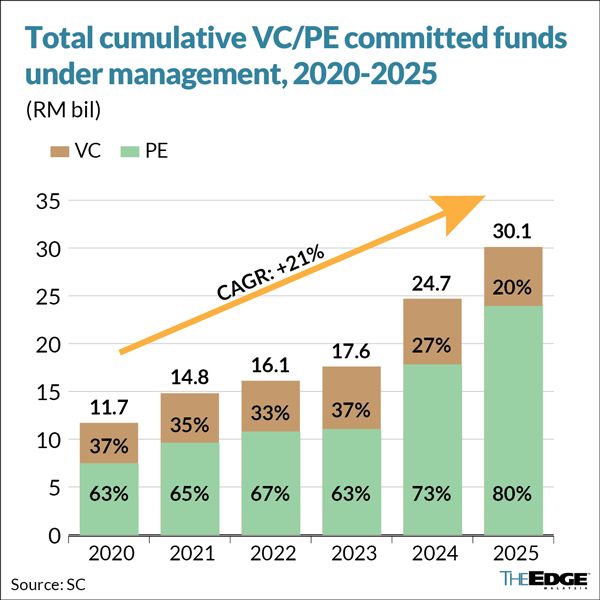
Total committed VC and private equity funds under management grew at a compound annual growth rate of 21% between 2020 and 2025, supported by clearer regulations, sovereign-backed fund-of-funds initiatives and rising investor interest in high-growth sectors such as technology, semiconductors and fintech.
By 2025, total committed funds reached RM30.1 billion — with RM2.8 billion deployed across 117 deals during the year, compared with RM24.7 billion in 2024.
However, the SC said further expansion is needed to support innovative start-ups and small and medium enterprises (SMEs) in high-value sectors including electrical and electronics, data infrastructure and medical devices.
These industries are seen as strategic for Malaysia’s economic development and align with CMP4’s broader themes of “market vibrancy, inclusivity, sustainability and regional expansion”.
The SC also plans to introduce several reforms including reviewing tax frameworks, legal structures and capital control efficiency issues to enhance competitiveness, as well as strengthening training programmes to develop industry talent, among others.
Click here for all you need to know about the Capital Market Masterplan 2026-2030.