
by Mike McMahon/Staff Writer (@mikemcmahon)

As college teams begin to fall out of postseason play, keep an eye on the NHL transaction wire. For a number of the best players around the country, it’s officially free-agent season.

Below is a shortlist of players at each position who could draw interest from NHL teams this spring. Several of the names included are players that at least one NHL scout told me their organization is strongly considering pursuing as a free agent during this cycle.
Of course, circumstances can change quickly. Some players turn down entry-level contracts and return to school — particularly in this new era of revenue sharing and NIL opportunities, where a player can sometimes earn as much as he would in the AHL. In other cases, teams shift their attention elsewhere.
As one scout joked to me last week, “Sometimes I’ll recommend a player to my GM, he watches him play, tells me I’m an idiot, and we don’t offer the kid.”
In other words, nothing is set in stone until the ink dries on a contract. But here’s a look at several players worth monitoring over the next month.
Forwards
T.J. Hughes, Michigan
Hughes likely had opportunities to turn pro over the last two years, but he opted to return to Michigan and served as the team’s captain this season.
Scoring has followed Hughes at every stop. In his final junior season with the Brooks Bandits in 2021–22, he piled up a staggering 150 points (71 games). Since arriving at Michigan, the production hasn’t slowed. Hughes has totaled 169 points (65 goals, 104 assists) in 150 career games.
Over the past three seasons, Hughes has established himself as one of the premier offensive players in college hockey. He’s particularly dangerous in transition, where his speed and playmaking consistently tilt the ice in Michigan’s favor.
Jack Musa, Massachusetts
Musa has been a point-per-game player for UMass this season as a junior and has already posted a career high in assists.
Musa projects as more of a bottom-six playmaker at the NHL level, but his vision and passing ability have stood out throughout the college season. He’s been among the top distributors in college hockey, with a particular knack for finding teammates in the slot.
Like many of the forwards we’ll discuss, he’s also effective in transition — an essential trait at the NHL level.
Matthew DiMarsico, Penn State
DiMarsico has quietly established himself as one of the best offensive players in college hockey.
He may not dazzle with flashy displays of skill, but DiMarsico’s game is built on a high-end hockey IQ. He consistently finds soft ice, anticipates plays before they develop, and routinely outsmarts opponents — a trait that creates scoring opportunities both for himself and for his teammates.
DiMarsico’s shooting ability is what jumps off the page, but his game isn’t limited to offense. He’s effective in transition and responsible defensively, making him a true three-zone player — at least at the college level. At just 22 years old, there is still meaningful development runway ahead.
Others to keep an eye on:
J.J. Wiebusch, Penn StateJack Stockfish, Holy CrossBennett Schimek, Arizona StateGrant Slukynsky, Western MichiganDylan Hryckowian, NortheasternTyson Gross, St. Cloud StateMarty Lavins, New HampshireHayden Stavroff, DartmouthLucas Wahlin, St. ThomasFelix Trudeau, Sacred HeartDefensemen
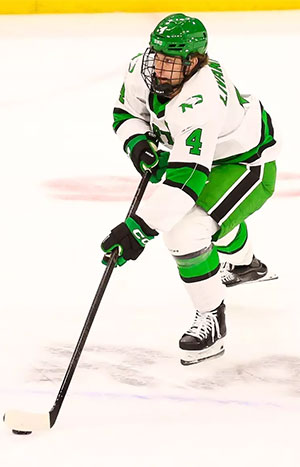
Jake Livanavage, North Dakota
Livanavage is a 5-foot-10 offensive defenseman — undersized by NHL standards — who appears ready for the next step after three solid seasons with the Fighting Hawks.
Consistency has defined Livanavage’s career at North Dakota. This season, he has produced 25 points in 35 games, continuing a steady upward trajectory.
He’s particularly effective in transition, comfortable carrying the puck through the neutral zone and initiating breakouts. What really stands out, though, is his offensive instinct and play-driving ability. In a quiet, understated way, Livanavage has become one of the best puck-moving defensemen in college hockey.
Given his skill set, it’s fair to wonder how his draft stock might have looked with a different frame. If Livanavage had stood 6-foot-2 in his draft year, he likely would have been a Top-60 selection. The NHL has become more accepting of smaller defensemen in recent years, but only about 15 percent of the defensemen in the league are shorter than six feet tall, with 6-foot-2 still a rough average for the position. That might limit his trajectory, but maybe not. It certainly hasn’t hurt some other recent undersized college defensemen.
Vinny Borgesi, Northeastern
Borgesi is even more undersized than Livanavage, but it’s hard to imagine that no one gives him an opportunity at the next level given how outstanding he has been for Northeastern. Borgesi is an exceptionally smart defenseman who understands when to activate offensively and rarely finds himself out of position or making costly mistakes.
There’s a reason Northeastern coach Jerry Keefe has leaned on him for nearly 30 minutes per game over the past two seasons.
His size, of course, presents the obvious question mark. But given some of the defensemen NHL teams have taken chances on in recent years, it would be surprising if someone didn’t roll the dice on Borgesi. Aside from his frame, there are few holes in his game that would suggest he couldn’t develop into a capable NHL player. Perhaps his size ultimately proves limiting — but it’s far from a certainty. And if he can overcome that, he could make the GM who decides to give him a chance look very smart.
Boston Buckberger, Denver
Buckberger is also undersized by NHL standards — a fairly common theme among NCAA defensemen. Many possess NHL-level skill but lack NHL-level size, which is often why they remain in college rather than already playing at the professional level.
Offensively, the puck seems to find Buckberger’s stick often. He’s equally reliable in his own zone, where he wins puck battles and forces turnovers, showing the kind of two-way awareness that keeps coaches comfortable putting him on the ice in any situation.
Others to keep an eye on:
Ty Hanson, Minnesota DuluthEvan Murr, Minnesota StateC.J. Foley, DartmouthSeamus Powell, MerrimackMac Gadowsky, Penn StateGoaltenders
Max Lundgren, Merrimack
Lundgren has played every minute for Merrimack this season, posting a .919 save percentage over 2,000 minutes. What will make him particularly attractive to NHL teams isn’t just the raw numbers, but the frame — at 6-foot-5, he checks a significant box at the pro level.
Having watched Lundgren extensively this season, the most impressive aspect of his game is his ability to make the first save and eliminate second chances. Rebounds are rarely an issue, and when they do occur, they’re typically steered to low-danger areas where opposing teams struggle to generate follow-up opportunities.
His combination of size, technical ability, and performance in Hockey East this season should present him with some NHL opportunities.
Josh Kotai, Augustana
Kotai has posted a .935 save percentage since the start of last season, a span that covers 61 games, and he continues to deliver high-end performances on a consistent basis.
Kotai has average size for the NHL at the position (6-foot-2) and he has worn the underdog label for much of his career. Under-recruited out of the SJHL, he’s continued to defy expectations at every stop. He uses his size effectively and pairs it with quick-twitch athleticism that allows him to make difficult saves.
From an NHL evaluation standpoint, scouts will inevitably factor in his competition level in the CCHA. Whether that’s fair or not is debatable, but it’s a reality of the process. Performances in Hockey East, the NCHC, and the Big Ten tend to carry more weight in NHL circles. I’m not saying I agree with that assessment, but it’s something that has been raised in conversations with scouts and front office personnel.
That said, Kotai profiles as a sensible depth signing for an NHL organization. At worst, you’re getting a dependable, hard-working fourth or fifth goaltender within a system. At best, you may uncover a legitimate diamond in the rough — much like Augustana did when it brought him into the program in 2023.
Kotai went to development camp with the Pittsburgh Penguins last season, and they only have one goaltender who is currently under contract for the 2026-27 season.
Others to keep an eye on:
Joshua Fleming, Penn StateAlbin Boija, MaineJan Spunar, North DakotaCameron Korpi, UnionLassi Lehti, AlaskaOwen Bartoszkiewicz, Michigan TechAlex Tracy, Minnesota StateLawton Zacher, Northeastern