
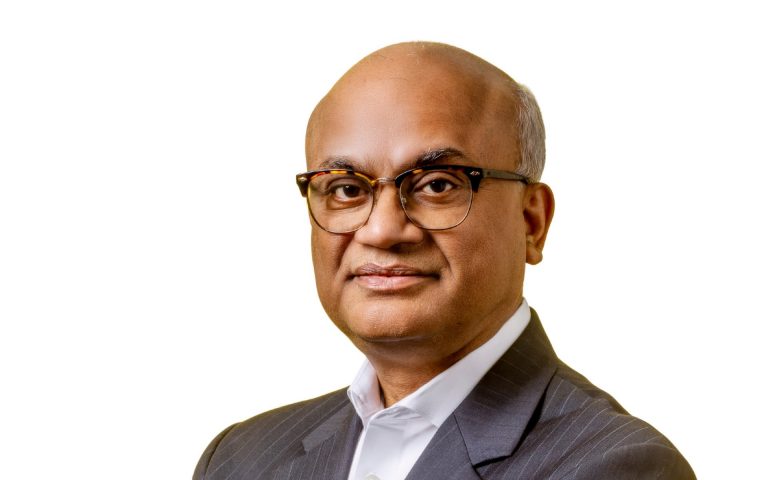
The Stanford Medicine community mourns the loss of Sridhar Seshadri, president of the Stanford Medicine Cancer Center, who passed away at Stanford Hospital on Nov. 26, 2025. He was 66.
Colleagues recall a man of wisdom, kindness and thoughtfulness who possessed the passion, tenacity and skills necessary to take on extraordinarily complex tasks over two decades of service to Stanford Health Care, its patients and their loved ones. His impact will be felt by Stanford Medicine cancer patients and clinicians for generations.
“Sri was a remarkable leader who brought together the rigor of an engineer, the vision of a strategist, and a deep compassion for patients and families,” said David Entwistle, president and chief executive officer of Stanford Health Care. “Over more than two decades at Stanford Health Care — including many years leading and advancing our cancer program — he united research, clinical care and innovation in service of the communities we serve. He listened carefully, acted boldly and never lost sight of our shared purpose. His legacy will live on in the strength of the system he helped build and in the lives improved by his leadership.”
“Sri’s contributions to the Stanford Medicine mission over the past two decades were vast,” said Lloyd Minor, MD, the Carl and Elizabeth Naumann Professor for the Dean of the School of Medicine and vice president for medical affairs at Stanford University. “He worked tirelessly to understand all sides of the many complex issues he navigated daily, and he respected input from people at every level of the organization. He had an outsized impact, and his loss is tremendous.”
Seshadri possessed an uncommon ability to unite people from varied backgrounds to achieve a common goal — whether in industry advancing medical imaging at Eastman Kodak Company’s Health Imaging Division, helping hospitals in the U.S. and Europe implement operational improvements as a senior leader of General Electric’s Medical Systems division, or in academia at Stanford Medicine where he was instrumental to landmark initiatives. Those include a joint venture with Sutter Health to establish a cancer center in the East Bay, the creation of the Stanford Cancer Institute, the opening of the Stanford Medicine Cancer Center on Blake Wilbur Drive, and the planning and implementation of a new Stanford Medicine cancer center campus that will span research, education and clinical missions.
“It was built into Sri’s DNA to navigate complex, high-stakes situations and relationships in really productive ways,” said Rick Shumway, executive vice president and chief operating officer at Stanford Health Care. “He knew what he was doing was so impactful, and he spent a tremendous amount of time thinking about how to do the right thing to accomplish the organization’s goals.”
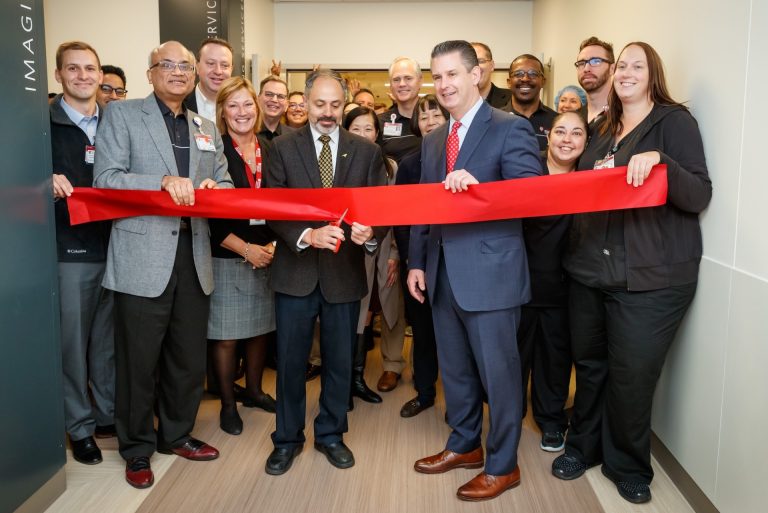
Sri Seshadri, holding the tape at left, with the late Sam Gambhir cutting the tape and David Entwistle to his right, along with Stanford Hospital staff at its opening on Nov. 19, 2019. Photo by Kevin Meynell
Seshadri was keenly aware that the success of any initiative rested on the people behind the mission. He cultivated meaningful relationships not just with those he worked with directly, but also with the people who worked around him and others who would be affected by his decisions and actions. He had a talent for making others feel noticed and appreciated, and he frequently diverted praise of his own contributions to emphasize the teamwork involved in accomplishing difficult tasks.
“He cared about people, whether those were people who worked for him, people who worked with him, people who worked around him, people who were impacted by things that he did and even people who were not in his direct orbit,” Shumway said.
A start in engineering
Seshadri’s humble demeanor hid a keen intellectual curiosity evident since his childhood in India. This curiosity propelled him through a career that began with a bachelor of science in electrical engineering from Visvesvaraya College of Engineering of Bangalore University, and a master of science in electrical engineering from Drexel University. In 1985 he joined the Hospital of the University of Pennsylvania. As the leader of their medical informatics group, he devised the hospitalwide picture archiving and communications system to digitize X-rays, allowing physicians instant access to critical diagnostic images from computers throughout the hospital.
While at Penn, Seshadri enrolled in the Executive MBA Program at the Wharton School. His wife remembers him juggling full-time work and school with dexterity and grace. Later, at Stanford Medicine, he completed a doctor of management (now known as doctor of business administration) from the Weatherhead School of Management at Case Western Reserve University. During this time he travelled regularly between Cleveland and his home in Alamo, California, while also helping his wife, Sushma Hegde, PhD, raise their two young daughters.
Seshadri started at Stanford Health Care in 2003 as the vice president of Stanford Health Care’s Process Excellence Department; in this role he was responsible for improving the quality, patient experience and operational efficiencies in the hospital and the clinics. He also served as the vice president and chief administrative officer for destination service lines with oversight over the cancer, cardiovascular, radiology and transplant programs. He was responsible for the creation of the SHC Leadership Academy whose objective is to develop a cadre of empowered leaders to help Stanford Health Care achieve its long-term objectives.
“Sri’s mission to bring people together necessarily put him in many challenging situations over his career,” Shumway said. “Despite that, I have not heard of anybody who didn’t love Sri or have a good connection to him.”
Steven Artandi, MD, PhD, the Laurie Kraus Lacob Director of the Stanford Cancer Institute, spoke when Seshadri was awarded the 2025 John Levin Excellence in Leadership Award, which is conferred annually by Stanford Medicine on a member of the Stanford Health Care community. “He operates by a simple guideline: Listen intently and act big,” Artandi said of Seshadri. “Put into practice, that means stretching beyond the intermingling of academic disciplines and initiating the purposeful crossing of boundaries to forge bridges between basic researchers, hospital administrators, financial stakeholders and more — something that Sri excels at. Time and again, he’s demonstrated the power of this approach, creating a cancer care system that thrives on inclusion, collaboration and responsible risk taking.”
Colleagues remember him not just as a willing mentor but a friend with whom they could discuss both professional and personal issues.
“When I became chair, Sri had a bigger view as to how the department of radiation oncology could operate within the larger context of Stanford Health Care,” said Quynh-Thu Le, MD, the Katharine Dexter McCormick and Stanley McCormick Memorial Professor and chair of radiation oncology. “He guided me to hire people who would allow the department to grow. We had phone calls at 5 a.m. and at 7 p.m. I saw him as not just an advisor, but a friend. From him I learned how to be strategic about things and how to get people to work together toward a common purpose by communicating with them in their own language.”
Supportive husband and father
As driven as Seshadri was to pursue all career and educational opportunities available to him throughout his life, he was equally dedicated to his family. He encouraged his daughters to be strong women, taking the time to learn about and cultivate their interests. He also supported Hegde as she completed her own doctorate at UT Southwestern Medical Center in Dallas. To do so, Seshadri commuted regularly between Dallas and his Chicago office at General Electric.
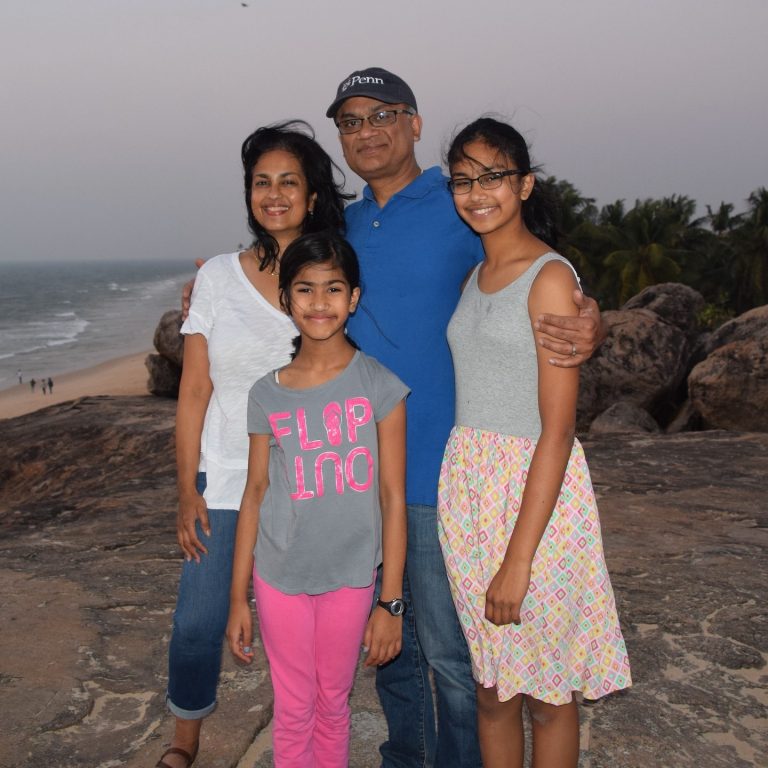
The family (clockwise from left, Sushma Hegde, Sri Seshadri, Apurva Seshadri and Aadhya Seshadri) in Udupi, India, in 2018. Courtesy of Sushma Hegde
“He never wanted our daughters to set limits for themselves,” Hegde said. “He was a feminist before it was popular. He always encouraged them to do their best, not be the best. And there was never any pressure to follow our paths into STEM fields. He was incredibly supportive of both the girls and myself. I discovered my voice only after I married Sri.”
Seshadri came from a prominent family in Bangalore — his grandfather Dr. M. Sivaram was one of the founders of the Bangalore Medical College and the founder of the pioneering Kannada humor magazine Koravanji. His early education was at the Bishop Cotton Boys’ School in Bangalore. Although he applied to and was accepted by the prestigious Indian Institute of Technology of Kharagpur to study naval architecture (a field of study assigned by the school), Seshadri chose to enroll in Visvesvaraya College of Engineering to pursue his love of electrical engineering.
“He knew what he wanted. He was always very single minded and driven,” Hegde said.
Seshadri was an avid reader of books, from those focusing on physics and mathematics, to novels set in his native India, as well as Sherlock Holmes stories and the flamboyant antics of Sir P.G. Wodehouse’s characters Bertie and Jeeves. He also loved maps and had a keen interest in politics and social sciences, particularly the reasons for the rise and fall of civilizations. On the lighter side he enjoyed reading The Adventures of Tintin series, and the pun-filled Asterix comic books. While at work his dedication to treat all people with dignity and respect could seem serious — for example, setting a timer to ensure meetings stuck to schedule as a way to value others’ time — at home he was a lover of silly puns, always laughing loudly at his own jokes while also tackling household tasks with his consummate organization skills.
“He didn’t like to just sit around and relax,” Hegde said. “He was always looking for projects to complete, problems to solve. From early on, he was striving for work-life balance. Amazingly, he somehow managed it.”
Seshadri published over 120 papers and two book chapters, largely focusing on medical imaging informatics and cost-effectiveness analyses. (Earlier in his career he was a member of the Radiological Society of North America and the Society of Photo Instrumentation Engineers.)
Upon receipt of the Levin award, Seshadri reflected, “I’ve dedicated my career to health care, and I am so grateful to have had a variety of professional experiences that have ultimately helped guide the big questions I always come back to: How do you take the expansive view? How do you move fluidly across academic research, the hospital ecosystem and the technology builders of industry to facilitate a care enterprise that’s more than the sum of its parts, and that — most importantly — provides the best care possible for our patients? It’s always all for our patients.”
“Long after all of us are gone, the things that Sri did while he was here will certainly live on at the university and in the Stanford Medicine ecosystem,” Shumway said. “People will be impacted by what he did for generations. His contributions are just countless. Innumerable.”
Seshadri is survived by his wife, Sushma Hegde, and daughters, Apurva and Aadhya Seshadri. Donations can be made in Seshadri’s memory to Stanford Health Care to support cancer research initiatives. Donations to the Sridhar B. Seshadri Memorial Fund may be made online or by contacting Wendy Keefe, senior director of development, Stanford Health Care, at wkeefe@stanford.edu.