
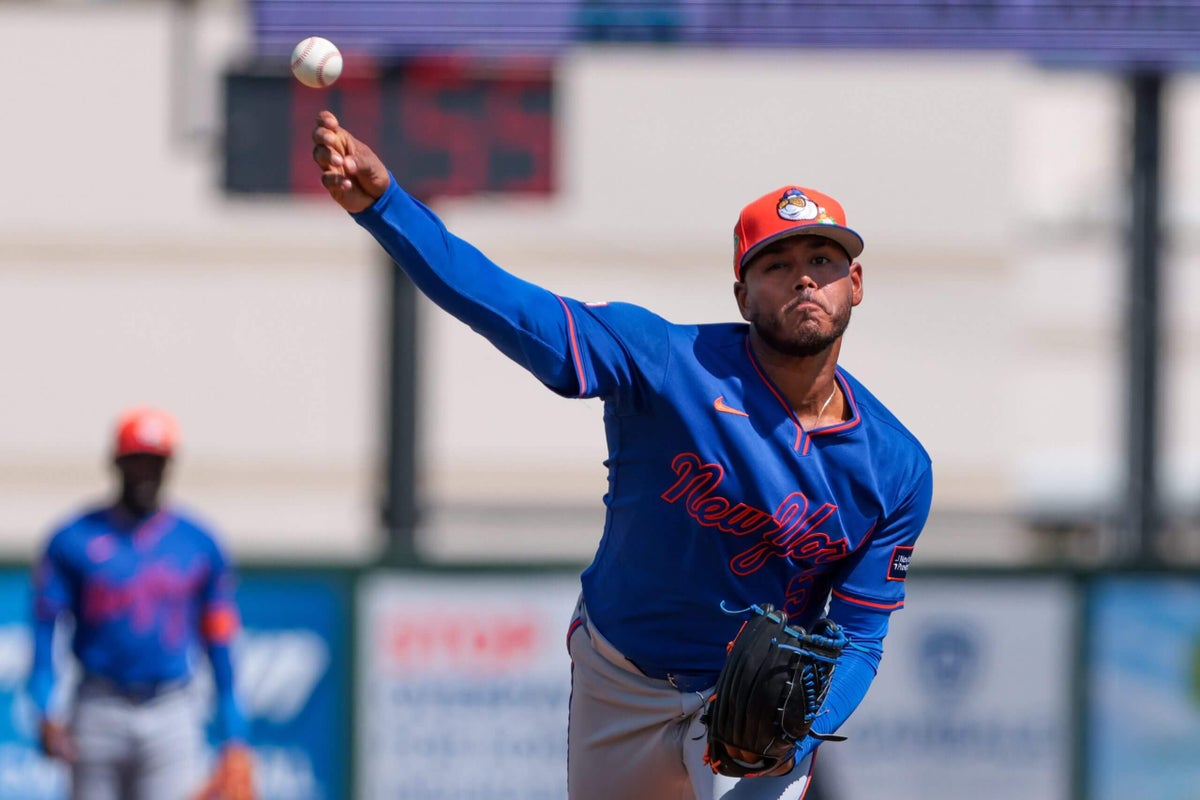
PORT ST. LUCIE, Fla. — Few players have ever looked as excited to play in New York as Freddy Peralta. The right-hander has been a joyful presence in the Mets’ Clover Park clubhouse all spring, and he’s pitched well in two Grapefruit League starts.
How long can this relationship continue?
Peralta has been open about his desire for a long-term extension with the Mets. President of baseball operations David Stearns has been quiet, only pointing out how much the Mets value Peralta’s contributions on and off the field.
These final two weeks of spring training are when we often see a lot of extensions get done. So let’s examine the extension dynamic for Peralta and the Mets.
Peralta’s preferred length would not have much precedent
Peralta has said he would like to sign for seven or eight years. No pitcher has ever signed an eight-year extension (as far as I can tell). In the past decade, the only starters to sign extensions seven years long are Stephen Strasburg (2016 with Washington) and José Berríos (2022 with Toronto).
Long SP extensions
Length
Last Signed
Player
Age
8 years
Never
N/A
7 years
2022
28
6 years
2025
26
5 years
2026
28
Limit it to pitchers already in their 30s, like Peralta, and nobody gets more than five years — only Tyler Glasnow (2024), Joe Musgrove (2023) and Luis Castillo (2023) this decade have signed extensions that long. Those deals all covered their age-30 through age-34 seasons; Peralta’s would start with his age-31 season.
So, most franchises would shy away from that length of commitment, to say nothing of the Mets’ relatively conservative approach to starting pitching under Stearns: The three-year deals for Sean Manaea and Clay Holmes are as long as Stearns has gone for a starter in free agency. To be fair, Stearns was willing to go as long as 12 years for Yoshinobu Yamamoto in free agency, when Yamamoto was 25. A new deal for Peralta would kick in at 31, six years older than Yamamoto was.
Which is all to say, if Peralta really wants a deal of that length, he’ll probably have to wait for free agency and other bidders. (Max Fried was the same age as Peralta when he signed his eight-year deal with the Yankees back ahead of the 2025 season.)
The free-agent class is thinning
Looking ahead to this winter, two-time defending Cy Young winner Tarik Skubal will be in a class of his own — capable of pushing the market for starting pitchers beyond $400 million. But the tier behind Skubal is thinning out with extensions this spring for Jesús Luzardo and Chris Sale. Peralta’s remaining peer in that group is probably Kevin Gausman, who is five years his senior and has talked about retirement.
Luzardo signed a five-year, $135 million extension with the Phillies on Monday. Sale signed an extension that adds one season to his team control, also at an average annual value of $27 million.
So Peralta should be the clear No. 2 in free agency if he reaches that point.
What does Luzardo’s deal mean for Peralta?
The Phillies’ valuation of Luzardo aligns with the market overall; similar pitchers like Carlos Rodón signed for around the same amount. (If anything, the Phillies did well to sign Luzardo only through his age-33 season; most of these deals last at least through age-34.) And Luzardo is a decent comp for Peralta.
Player
Age
fWAR1
fWAR3
fWAR5
28
5.3
9.8
11.9
30
3.6
8.9
14.9
While Luzardo has not been the consistent performer that Peralta has been, he’s had a higher ceiling on his results, as you can see here:
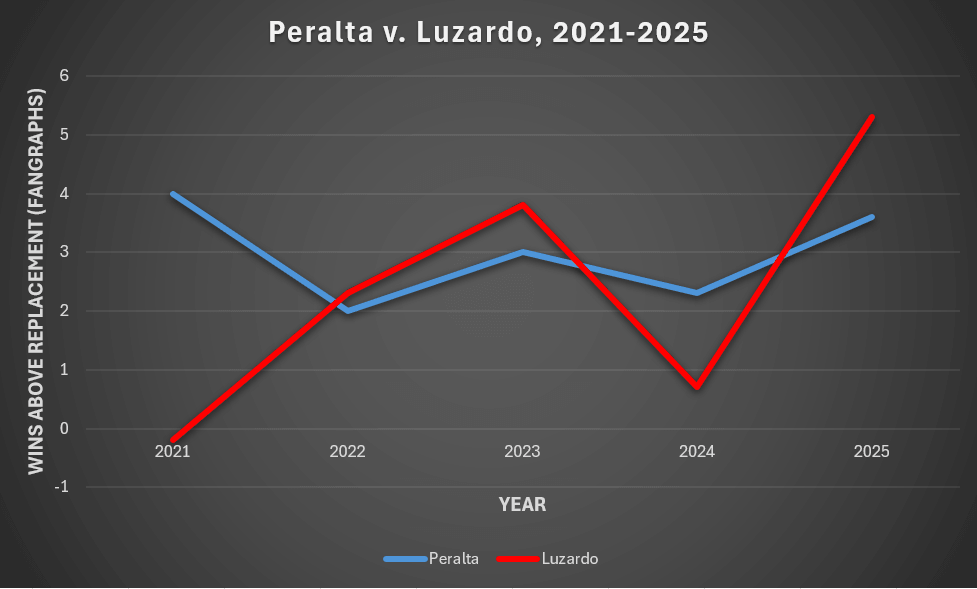
(I know, I know, you want to point out that Luzardo’s ERA was more than a run higher than Peralta’s last season, so why is his WAR so much better? The Brewers’ defense was one of the best in baseball, and Philadelphia’s was average to below-average. The batting average on balls in play against Peralta last season was .246 compared to .324 for Luzardo, even as the contact against them suggested closer alignment. It’s my experience that pitchers get paid more for WAR than for ERA.)
Previously, I’d projected a Peralta extension around four years and $112 million ($28 million AAV). That doesn’t really change with the Luzardo deal. If Peralta really does value a longer deal at a lower AAV, maybe he ends up going with five years and $130 million ($26 million AAV). However, unlike some other large-market teams, Stearns’ Mets have not wanted to go longer on a deal to save on AAV. They’ve preferred to go the other way, as shown in their deals for Manaea and Bo Bichette and their pursuit of Kyle Tucker.