
I really hope you guys enjoy this week’s mailbag because I’ll go ahead and warn you right now: Next week’s will be a distracted, disjointed mess. I’ll be busy filling out 37 different brackets.
How does Alabama fall down to mortal, but Ohio State never dips? As a Penn State fan, I am both impressed and devastated that they’re always a top 5 team. — Luke M.
It’s truly astounding that Ohio State has won at least 10 games in 21 of the past 23 full seasons, including 11-plus for each of the past 13. It’s why I had that school No. 1 over Alabama in my list last year of the top programs of the 2000s, though the large majority of commenters disagreed with me. Every single other blue blood in the sport has had at least one down period this century, though Oklahoma’s under Brent Venables was admittedly brief.
It mostly comes down to the fact that Alabama is just one of several SEC teams, along with Georgia, LSU, Texas and Texas A&M, that consistently recruit at an elite level, whereas Ohio State has long been 1-of-1 in the Big Ten. Even that is starting to change now with Oregon and USC in the mix. Michigan and Penn State obviously do well themselves, but they’re not fielding annual top-five classes like the Buckeyes.
What’s interesting is the composition of those classes has changed considerably over time. Jim Tressel maintained a virtual stranglehold over kids in Ohio and built his classes around them. Then Urban Meyer got there and started turning the roster more national. Now Ryan Day’s classes are almost entirely national in scope. The brand is just that powerful.
The question is, can Ohio State continue this run in the transfer portal era, where high-school recruiting, while still the backbone of most top programs, is no longer the sole factor in roster construction?
To this point, Day has done an excellent job of building and maintaining continuity, while using the portal more sparingly to fill a few needs. The 2024 national title team’s lineup was almost entirely homegrown, but with transfers Will Howard, Quinshon Judkins and Caleb Downs playing big roles. Last year’s team saw a slight uptick in transfers, but only a couple played key roles. (I consider quarterback Julian Sayin homegrown because he was barely at Alabama before transferring.)
But 2026 could be a little different, as Ohio State signed 16 transfers. My colleague Cameron Teague Robinson’s initial projected depth chart has at least eight of them as a starter (Florida State safety Earl Little Jr., UTSA nose tackle John Walker) or the top backup.
There’s no reason to think the program won’t just keep reloading year after year. It will end at some point. But probably not this fall.
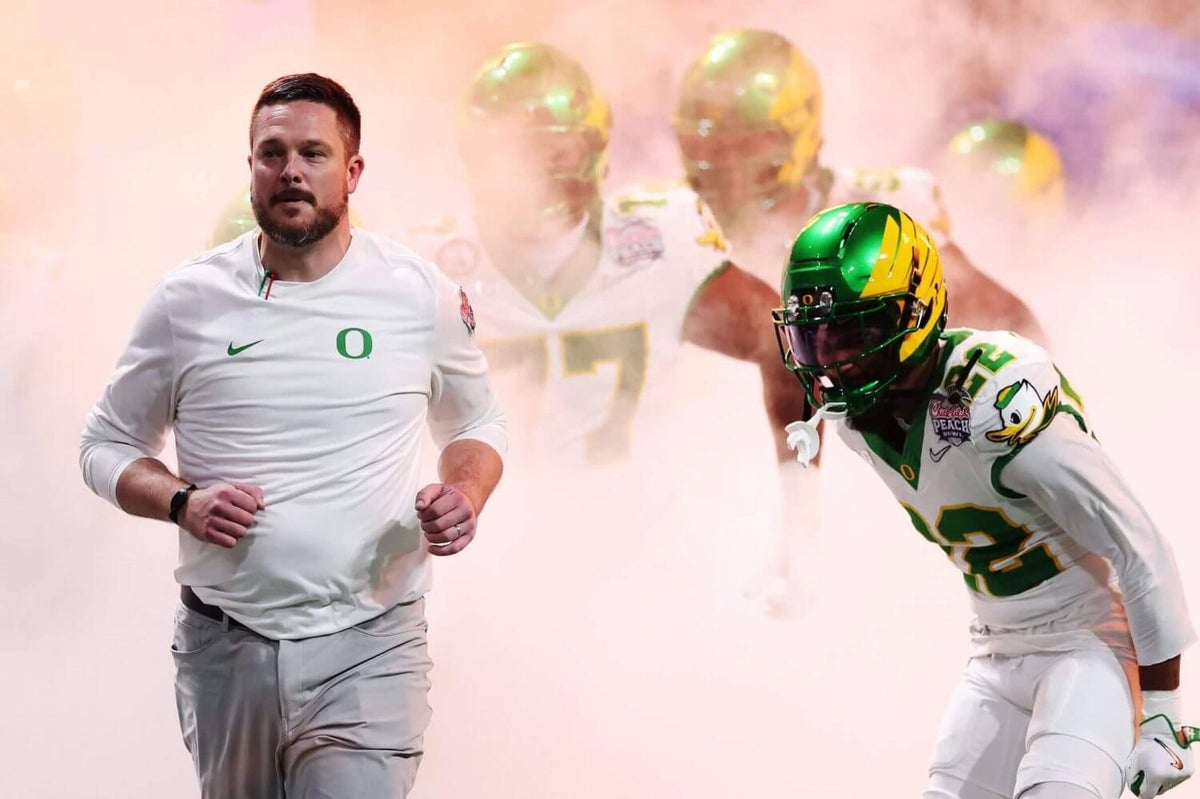
Has Dan Lanning reached his peak as a head coach? Meaning, the Nike money obtains him talent to the point he can make the Playoff and win a game or two, but the final eight teams all have talent, so coaching becomes the differentiator. — Jorge A.
I get that Lanning’s teams have suffered blowout CFP losses the last two years, but I don’t consider that a knock on his coaching ability. His teams have been wildly successful. They’ve only lost five games in the last three years, and all five were to teams that won or reached the national championship game (2023 Washington twice, 2024 Ohio State once, 2025 Indiana twice). They also beat those 2024 Buckeyes during the regular season, and the two Washington losses were both decided by three points.
The Ducks have also had some bad CFP luck the last two years. They drew an uber-talented Ohio State team in that 2024 quarterfinal; the Buckeyes would have been a higher seed in the new format. With true seeds, Oregon might have reached the championship game. And last year the Ducks had to face Indiana with seemingly no running backs left on their entire team. Oregon probably would have lost anyway, but perhaps it would have been more competitive.
If college football were as simple as “the team with the most NIL money wins,” Texas Tech would have won at least one CFP game last season, Steve Sarkisian would have a national title by now and Mario Cristobal would have two or three. You still have to hit on the right players, come up with the best gameplans and call the right plays.
History has shown that if a coach can win at a high level, year-in and year-out, he’s probably going to break through at some point. See: Tom Osborne. Or Bobby Bowden. Or Mack Brown. Or more recently, Jim Harbaugh, Kirby Smart and Ryan Day.
Lanning’s day is coming.
Hey Stew: As a long-time fan of a lower-tier Big 12 school, there’s something I’ve never understood: Why was the Big Ten able to create a super power and the Big 12 not? For most of their shared existence I viewed them as relatively equal: two A-level teams (Texas/Oklahoma, Ohio State/Michigan), a couple that could compete in an up year (Oklahoma State/K-State, Penn State/Iowa) and a lot of junk at the bottom. — Tyler, Los Angeles
On the field, they were fairly similar for many years, and in fact I’d contend the Big 12 was the stronger conference for most of the 2000s when Oklahoma and Texas were at their peaks, while Michigan and Penn State were fading. Even into the early 2010s, when the Big 12 became the up-tempo, high-scoring conference that kept churning out NFL quarterbacks. Nor did it feel to me like the Big 12 had a lot of junk.
But as realignment constantly hammers home, conference hierarchy has a lot more to do with spreadsheets than spread offenses. (Too cheesy?)
The Big Ten’s biggest advantage going back to the ’90s was always its demographics. It has big nationally known universities with huge alumni bases and a deep lineup of major-city TV markets, starting with Chicago. The Big 12 had all of Texas, obviously, but otherwise a lot of largely rural markets. So that put them on different plains financially even pre-realignment.
And then the Big 12 started losing some of its biggest brands, most notably Nebraska, while the Big Ten only added more of them and then eventually expanded its TV footprint from coast to coast.
Another big difference: The Big 12 was created out of a forced marriage in the mid-’90s between the legacy Big 8 schools and four Southwest Conference defectors (Texas, Texas A&M, Texas Tech and Baylor). The tension between the factions remained mostly behind the scenes in those early years but eventually spilled out into the open. Whereas the Big Ten always put on a unified front under Jim Delany. (Today, not so much.)
And of course, once Texas and Oklahoma left for the SEC, the chasm became massive.
That being said, give the Big 12 credit for one major accomplishment: It survived. From the time of former Pac-12 commissioner Larry Scott’s hostile takeover attempt in 2010 through the tenuous 10-team era that same decade to the SEC raid, people spent 12 years predicting that league’s demise. Instead, Brett Yormark flipped the script and helped extinguish the Pac-12. It’s not a superpower, but it’s finally on solid ground.
Can you think of programs that were strong, either recently or a long time ago, that could make a revival and become a relevant Playoff competitor when factoring resources, administration alignment, current coaches or attractiveness to future coaches? Candidates that came to mind include: Wisconsin, Nebraska, Virginia Tech, Colorado and UCLA. — Justin D.
Scratch Nebraska, Colorado and UCLA, though the latter just made my highest-graded hire of the coaching carousel in Bob Chesney. I believe he’ll turn the Bruins back into consistent winners, but the university itself can’t get out of its own way long enough to sustain a regular Playoff contender.
Wisconsin, which is only a couple of years removed from three decades of consistency, definitely fits the bill, whether or not Luke Fickell is the guy to lead that turnaround. The school finally seems to have alignment on NIL. And Virginia Tech under James Franklin is a no-brainer. The football culture alone gives that school a leg up on all but a few ACC programs.
But the former giant just waiting to be awoken is Florida.
It makes no sense whatsoever that the Gators have been floundering for more than 15 years at this point. Both Steve Spurrier (1990-2001) and Urban Meyer (2005-10) proved that Florida’s ceiling is national title contender. Which makes sense, given its location, its resources and its strong overall athletic department. If the Gators can thrive in men’s basketball, they can certainly thrive in football.
It’s been one failed coaching hire after another post-Meyer, from Will Muschamp to Jim McElwain to Dan Mullen (who, it should be noted, did field three straight top-12 teams) to Billy Napier. But most of those coaches also had to deal with chronic dysfunction at the top of the university.
I have lot of confidence in Jon Sumrall, and he can turn Florida back into a regular championship contender so long as he has the necessary support.
Do you believe that a college that has five games a year scheduled by the ACC and is also locked into an annual series with two other ACC teams plus a farce rivalry with a military academy is “independent?” — Colin M., Madison, Ind.
Is said school eligible for any conference championship? Because that should give your answer.
Now that the NCAA Tournament is near, what are five universities which are evenly split between being football and basketball programs in terms of popularity on campus? I would have BYU, Illinois, Arkansas, Boston College and Baylor. Your five? — Justin, Keokuk, Iowa
You’d be hard-pressed to find more than a couple that are evenly split all the time. That may be the case right this moment at BYU, where AJ Dybantsa is fueling interest in hoops the way Jimmer Fredette did in the early 2010s, but BYU is indisputably a football school. So is Arkansas. Illinois is a basketball school. BC is a hockey school.
Baylor may fit the bill, though. While football is usually the undisputed king in the state of Texas, basketball has been much more relevant nationally for some time under Scott Drew. I’d consider putting Iowa State in this category as well. And I’d be curious to hear from some folks at Houston. They’re so much better at hoops than football, but I still kinda think of it as a football school. I may be completely wrong.
I recently posed a related question: Has any school ever completely transformed its identity from one to the other?
Some folks suggested Utah, which was a hoops powerhouse under the late Rick Majerus before Urban Meyer launched the Utes’ meteoric rise in football. No question it’s a football school today. Going further back, Syracuse went from being the school once synonymous with Jim Brown and Ernie Davis to nearly 50 years of the Jim Boeheim 2-3 zone.
The reason I asked: I wonder if Indiana is about to undergo its own transformation. I realize the Hoosiers have a long, proud basketball tradition, but they’ve been mostly dormant for the last 25 years, while IU football just reached the pinnacle of its sport. In a couple more years there will be no students left who remember a world pre-Curt Cignetti.
Is Jayden Maiava the most underrated returning quarterback Lincoln Riley has ever had? In 2025, he was No. 12 nationally in passer rating (157.8), No. 5 in total yards (3,711) and No. 2 in QBR (89.9). And yet he very rarely seems to crack the Top 10 in national returning quarterback lists for 2026 despite having his entire starting offensive line back and arguably the best QB coach in the sport. — Joseph D., Scottsdale, Ariz.
It’s odd in hindsight that Maiava managed to fly under the radar all season despite playing at a such a highly visible program. If anything, USC’s stud receivers, Makai Lemon and Ja’Kobi Lane, got the bulk of the credit for the Trojans’ strong passing game, and both are now gone.
But I don’t think it’s too big a mystery why: The Trojans went 9-4 and had no real big wins. They did wallop then 15th-ranked Michigan at home, but that didn’t seem to move the needle. More folks noticed them lose at Notre Dame and at Oregon over the back half of the schedule, then blow a late lead against TCU in the Alamo Bowl.
Maiava’s lower profile may also be linked to Riley’s sagging reputation. His past three USC teams have been underwhelming, at 8-5, 7-6 and an empty-calorie 9-4. There are several reasons for that, but it has a halo effect on everything surrounding USC football. Including the quarterback.
For the first time in Riley’s tenure, USC may be underrated going into the season. The Trojans are going to be strong up front and at running back, with King Miller and Waymond Jordan, and Tanook Hines could be their next great receiver.
But they need to win something. USC’s first four games are a joke, but Oregon comes to town in late September, Ohio State visits on Halloween, and there’s a trip to national champion Indiana on Nov. 14. That’s a lot of showcase opportunities for Maiava and his team.
This offseason, a number of G6 head coaches moved up to Power 4 jobs at Florida (Jon Sumrall), UCLA (Bob Chesney), Auburn (Alex Golesh), Arkansas (Ryan Silverfield), Oklahoma State (Eric Morris) and Iowa State (Jimmy Rogers). It seems like that has depleted the pool of up-and-coming G6 coaches. Who are the hot names remaining? I imagine Charles Huff would get a lot of interest with another big year, but who else? — Chris, Atlanta
These things go in waves, so I’d imagine next year’s G6-to-P4 pipeline will be smaller, but there are certainly candidates. Though it would help if ADs were willing to shed their service academy biases.
How did four coaches from the American move up this cycle and none of them were Army’s Jeff Monken? Not only has he been winning there for a dozen years, he went 12-2 and won the American only a year earlier. It seems like ADs are automatically dismissive because of the triple option, but I’m certain Monken wouldn’t run the option at a P4 school. Longtime Navy coach Ken Niumatalolo produced a top-10 passing offense in his first year at San Jose State in 2024.
Monken, a Midwest native and power-run proponent, would make a lot of sense at Wisconsin if that job opens this year.
Meanwhile, Brian Newberry has only been at the helm of Navy for three seasons, but he has gone 10-3 and 11-2 the past two seasons. If nothing else, the fact that no one has plucked Midshipmen offensive coordinator Drew Cronic tells you how overlooked the academies can be. He’s running one of the most creative offenses in the sport right now.
New Mexico’s Jason Eck turned a lot of heads in his first season there, taking the completely rebuilt Lobos to their first bowl game since 2016 and first nine-win season since 2007. This after taking Idaho to three straight FCS playoff berths. I’d imagine the former Wisconsin offensive lineman would also be popular in Madison with another big year. (Now watch Luke Fickell win 10 games and keep his job.)
And don’t forget about UTSA’s Jeff Traylor, who was the hot name several years back when the Roadrunners went 12-2/11-3 in 2021/’22. The Roadrunners have regressed since, but they’ve still gone to a bowl in all six years of his tenure. I was mildly surprised he didn’t get much traction at Oklahoma State or Arkansas, but recency bias is a central tenant of the coaching carousel.
Finally, I assume Dan Mullen will get another bite at the apple after winning 10 games in his first season at UNLV. Probably not a return to the SEC, but perhaps an ACC job like Boston College or … umm, UNC.
Hey Stewart, since we’re in football purgatory for a while, can you settle one major debate that refuses to go away? Skyline or Gold Star? — David, Cincinnati
I was Skyline all the way growing up. Full disclosure, though: I have not had either in quite some time. At 50, I don’t have the, um, gastrointestinal fortitude I did at 20.
But I did make several trips to Graeter’s the last time I visited. Thankfully they have great non-dairy flavors. (Yes, I’m old.)