
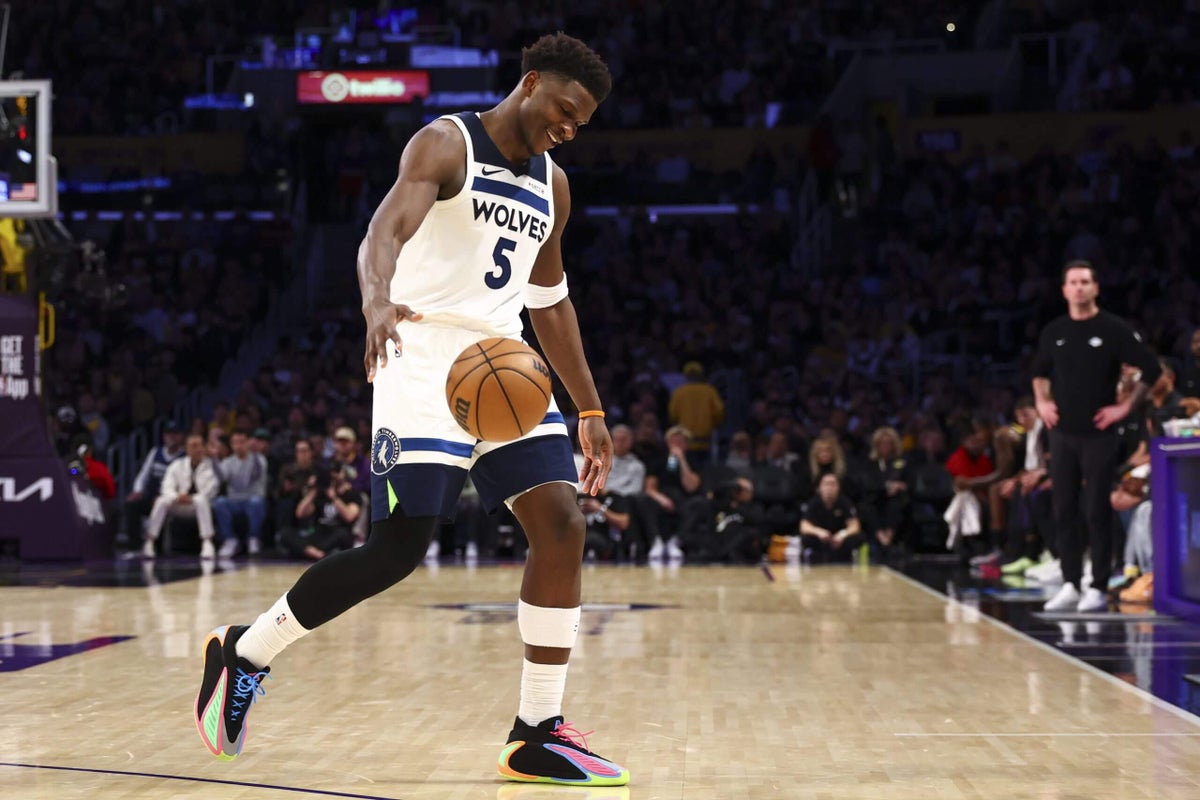
LOS ANGELES — The Minnesota Timberwolves have not hidden their ambition all season long. From the moment they showed up to training camp at the end of September, coming off two straight runs to the Western Conference finals, they have made it clear that they believe they are ready to take the final step.
A championship is the stated goal. From Anthony Edwards and Julius Randle. From Rudy Gobert and Donte DiVincenzo. From so many inside the organization. With 17 games remaining and the playoffs just over a month away, it’s time for the Wolves to start acting like it.
Championship-level teams step onto the national stage against the Los Angeles Lakers and send a message. They don’t go 1 of 12 from 3 in the first quarter and trail by as many as 23 points against a team missing LeBron James. Championship-level teams respond after being embarrassed at home by the Orlando Magic by putting forth high-level effort on both ends of the floor. They don’t come out flat as a Botoxed forehead on a Real Housewife of Orange County and get out-worked on the offensive glass to waste any chance they had at building a lead while the Lakers tossed up bricks in the first quarter.
Championship-level teams don’t openly talk about not adhering to the game plan the coaches set out for them, especially in games against teams that are right in the hunt with them in the playoff chase.
The Timberwolves walked into Crypto.com Arena on Tuesday night sitting in third place in the Western Conference, with a chance to let the Lakers know that a potential first-round matchup would not end well for them. Instead, the Wolves delivered perhaps their most disappointing performance of the season, a display of offensive ineptitude so damning that the Lakers scored a measly 16 points in the first quarter and still cruised to a 120-106 victory that pushed them into fourth place in the West and dropped Minnesota (40-25) to fifth.
“We believe in where we want to go. The goal is not changing. But we need some urgency,” Gobert said. “When you have these type of games and they mean what they mean for us to put ourselves in a better position when it comes to the playoffs to try to achieve our goal to win a championship, it’s got to mean more.”
Through the first three quarters in which the game was up for grabs, the Wolves shot 39 percent from the field, 19 percent from 3-point range and turned the ball over 10 times. There are nights throughout a long NBA season when the shots just aren’t falling. But this was more than a “make or miss league” loss.
Yes, the Wolves, collectively, could not hit a shot to save their lives. Edwards (1 of 10), Jaden McDaniels (0 of 5), Randle (1 of 5) and Naz Reid (1 of 5) combined to shoot 3 of 25 from deep in the first three quarters. The Lakers were nearly as bad, shooting 42 percent from the field and 19 percent from 3. But they built a 16-point lead because they took 15 more shots than the Wolves, thanks to superior effort on the offensive glass and more determination on defense.
The Lakers grabbed 14 offensive rebounds, scored 18 second-chance points and turned 11 Minnesota turnovers into 20 points to run away with the game.
“I thought defense in the first half was, largely, pretty good,” coach Chris Finch said. “But then 11 offensive rebounds at halftime … that’s what kept us from being able to build any kind of lead in the game. Even when we weren’t getting enough scoring, we weren’t getting enough stops to have our nose in front.”
Edwards was just 2 of 15 for the game, shocking for one of the best shooters in the league. He did go 9 of 10 from the free-throw line to finish with 14 points, but he only had two rebounds and four assists in an ISO-heavy game. The lack of production in areas other than scoring came in stark contrast to Luka Dončić, who missed seven of his first eight shots but made up for the poor shooting with 11 rebounds and 11 assists. Excelling in the other areas helped the Lakers overcome an equally putrid shooting start. They missed their first 15 shots from 3 and were still shooting 36 percent from the field at halftime.
The Timberwolves could have built a substantial lead, but they couldn’t take advantage because they gave in to the Lakers’ frenetic energy on defense. L.A.’s game plan was to force Edwards and Randle into isolation play and limit the opportunities for their teammates. It worked like a charm, taking away any rhythm the Wolves hoped to have.
“Just play in the flow. Try to trust the game plan that the coach gives us. Just run actions, run our plays,” Gobert said. “Give that a chance and see how that goes. We could’ve been up 15-2. It’s where there is a lot of growth for us. Just try to let the game flow. Do it together.”
This is not the first time a player has referred to teammates not sticking to the game plan. While many Wolves fans have expressed frustration with Finch throughout this season, the players in the locker room indicated that the call is coming from inside the house.
“It’s game plan,” DiVincenzo said. “We’ve just got to follow the game plan. We’re so talented top to bottom that we can get away with it most nights. But with how aggressive they were in their game plan with what they wanted to do, collectively, we fought it a little bit. And also, offensively, just the little things we’ve got to clean up.”
In last season’s playoffs, the Wolves dispatched the Lakers in five games thanks to superior size and athleticism and a willingness to sacrifice for the greater good. With so much attention on Edwards, Randle and Gobert overpowered the weak Lakers front line in a 4-1 series victory.
On Tuesday night, Gobert took only one shot and finished with three points.
“The talent aspect is there. But I think sometimes you have to trust in that game plan that coaches put together,” DiVincenzo said. “We can’t just rely on talent. Some nights it’s going to work. This team that we have, everybody’s capable of a big night every single night, and we have to trust in what they put in front of us to go out and execute.”
That points directly at Edwards and Randle, the two primary focal points on offense. The Wolves have dropped out of the top 10 in offensive rating, sitting at 11th at 116.0 points per 100 possessions. They most often run into trouble when a team plays the gaps heavy and forces Edwards and Randle into isolation, resulting in long possessions with rushed shots at the end of the shot clock. When the Wolves regress into this mode, it can be difficult for them to shake out of it.
“I think what happens is everybody tries to get themselves going, so it kind of snowballs on them,” Finch said. “You saw that tonight.”
It was one of Edwards’ worst games of the season, filled with forced shots and porous defense, including when he let Austin Reaves slip behind him for an easy transition layup after Edwards missed a 3 on the other end. Edwards declined to speak to the media after the game.
“I think there’s things we can do to adjust,” Randle said. “They were switching a lot and taking us out of our sets and our actions. They want to force us to play isolation. We’ve got to do a better job of executing our actions.”
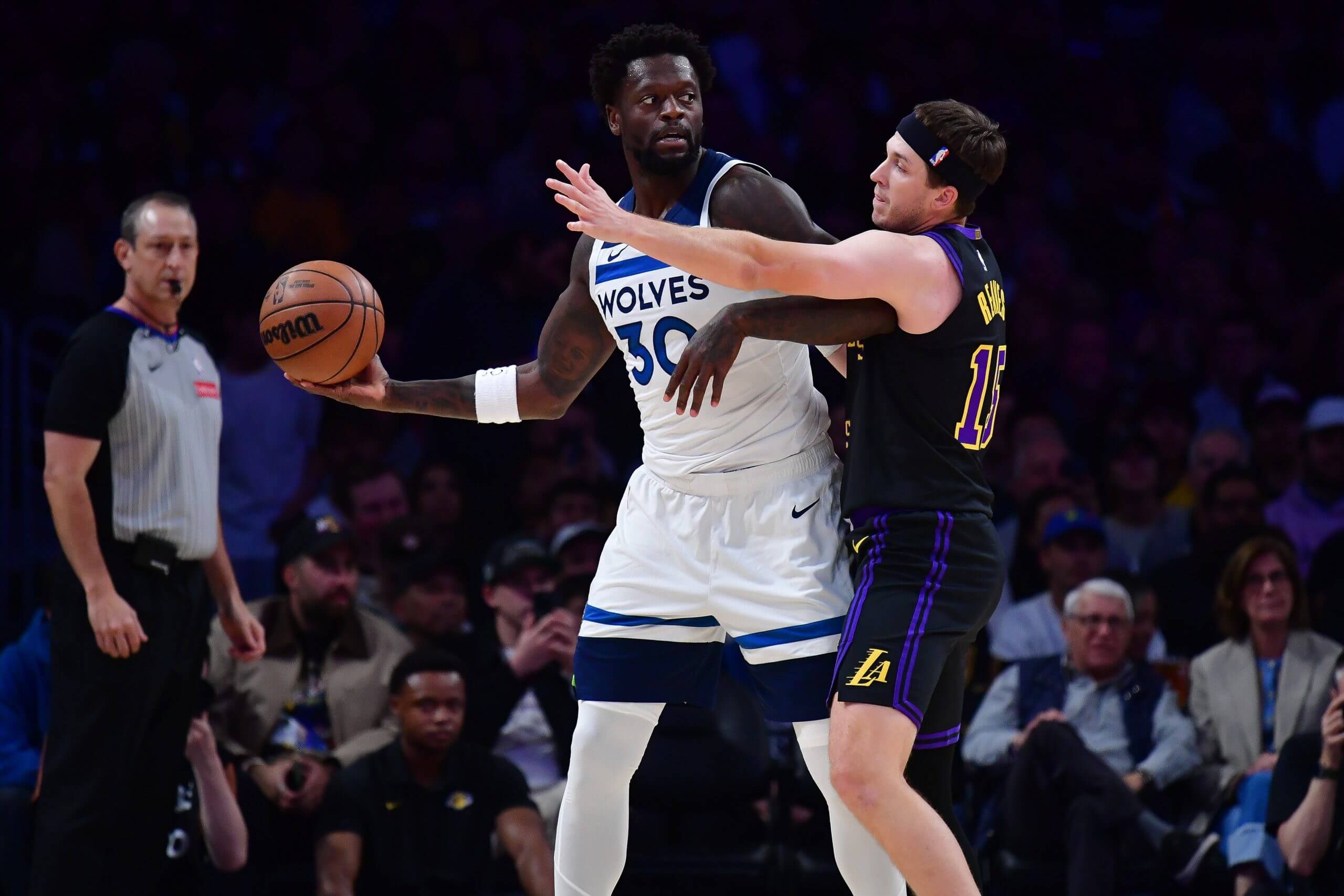
The Lakers baited Julius Randle and the Timberwolves into playing too much isolation ball. (Gary A. Vasquez / Imagn Images)
As rough as Edwards and Randle were Tuesday night, there was plenty of blame to go around.
Gobert, who has said all season long that he wants his fifth Defensive Player of the Year award, got worked over by Deandre Ayton, a mediocre center who has been a disappointment for most of his career. Ayton had a double-double early in the second quarter and finished with 14 points and 12 rebounds, five of which came on the offensive side.
“They just wanted it more than us, one through five,” Gobert said. “They weren’t making shots, but they were getting them back. That helps their confidence. And second half, they made shots.”
McDaniels went 3 of 9 from the floor and 0 of 5 from deep one game after going 0 of 9 from the floor in another embarrassing loss to the Orlando Magic. Ayo Dosunmu picked up his third foul less than four minutes into the second quarter, and the Wolves fouled the Lakers on 3-point attempts three times; twice, Reaves turned them into four-point plays.
Finch waited until there was 1:53 left in the 39-23 third quarter to take a timeout when the Lakers had spent the previous 10 minutes running circles around them. The Wolves couldn’t get any offense going all night, and there was nothing Finch could do to get the offense moving. Once the Lakers started hitting some shots, they ran away with the game.
“I didn’t think a timeout was going to solve any problems right there,” Finch said.
Instead, Finch said he should not have taken Gobert out with over eight minutes to play in the quarter. He was hoping to inject some more offense into the game with Reid on the floor, but Finch acknowledged after the game that the loss of defensive tenacity — the Wolves were tied with the Lakers, 45-45, at halftime — ended up hurting Minnesota more than the offensive punch received from the rotation change.
It all added up to one of the most embarrassing Timberwolves performances of the season, on national TV no less.
The Lakers are now 3-0 against the Wolves this season. That includes a victory at Target Center without Dončić or James and this one without James.
Wolves fans will recall the Phoenix Suns dominating the Wolves in the 2023-24 regular season, only to get swept in the first round of the playoffs. But this team would be wise to understand that it could be playing much better than it is.
“It’s all of us,” Gobert said. “It doesn’t start at game time. It starts the day before, it starts with our daily approach. Everything we do, on the court and off the court.”
The Wolves play the LA Clippers on Wednesday night before traveling to the Golden State Warriors on Friday and the Oklahoma City Thunder on Sunday. Their last three losses have been by 27, 27 and 16 points.
Inside the locker room, there was no panic, only belief that a team that has figured it out before will figure it out again. There is still more than a month left in the regular season, so there is plenty of time. But it would be nice to see them treat these games with the respect they deserve.
“We ain’t got no time to sit and sulk and pout because we’re not playing well,” Randle said. “We’ve gotta prepare ourselves, our body and mind, to get ready for tomorrow.”