
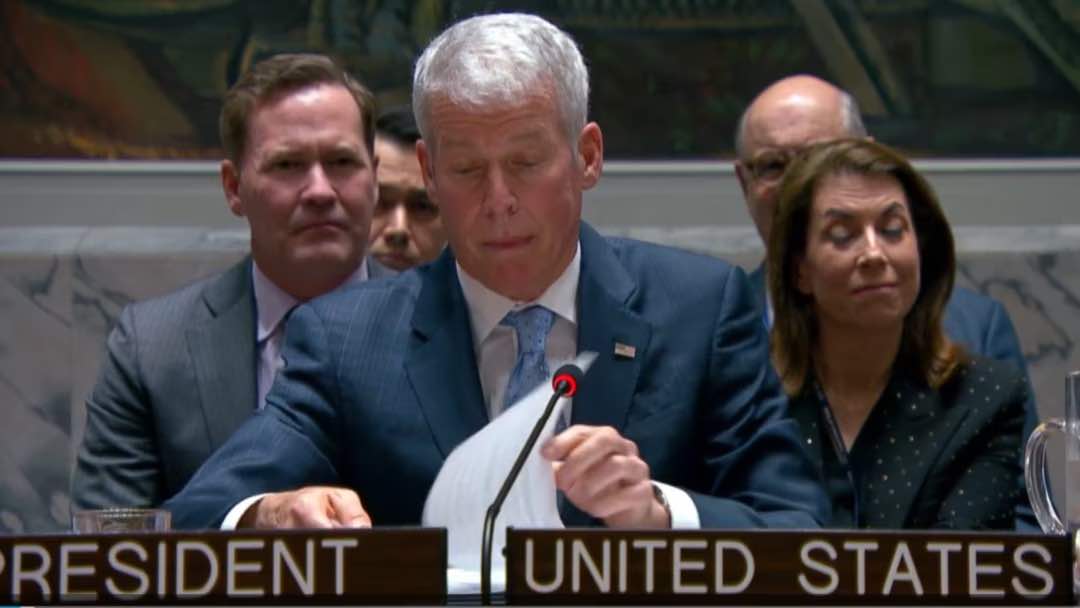
I want to begin by extending my appreciation and gratitude to the exceptional men and women of the American military. Their commitment and sacrifice safeguard our nation and uphold stability and security around the world.
I cannot sit before you today, without speaking about the challenges posed by the Iranian regime. For 47 years, this brutal dictatorship has spread chaos, death, and instability around the world, threatening international peace and economic opportunity for so many.
It is only fitting that the United States is chairing the Security Council at this moment, because confronting challenges like this requires real leadership. President Trump has been clear on Iran. Iran’s brutal regime will not prevail. Together, we have confronted it, and together we will defeat it.
Thank you, Ambassador Waltz for inviting me to lead today’s session of the United Nations Security Council. It is with great pleasure that the United States is leading this crucial conversation about critical minerals, energy, and resources.
This topic is not merely economic. It is fundamental to prosperity and peace. That’s why I’ve been clear. We need more energy, not less energy, and we need it now. Without affordable, reliable, and secure energy, nothing works.
Energy is life. The absence of energy is poverty, despair, and death.
It is how we grow our economies, it is how we innovate, power our daily lives, and secure our nations. Energy provides stability, competitiveness, and opportunities for a better future.
In recent years, many governments have adopted aggressive climate policies. These policies made in the name of climate change have been unrealistic and poorly planned. The energy delusions implicit in climate policies represent real and growing threats to nations and peoples around the world.
If I can elaborate. Only a billion people today live lives recognizable to anyone in this room. We wear nice clothes, we travel to meetings, we live in climate-controlled buildings, we have access to modern medicine. It’s the wonder of the modern world. Seven billion people aspire to the lives we have. The only road from here to there is massively more energy.
On the other end of the spectrum, two billion people, one-quarter of humanity today do not have access to clean cooking fuels. They cook and heat their homes the same way all of our ancestors did, burning wood, charcoal, dung, indoors. The indoor air pollution from this alone kills over two million people, as estimated by the United Nations health agency.
These are giant problems, and we can’t take our eyes off of them.
Ensuring energy abundance means keeping our country safe. Energy security is national security. Those who have restricted energy supply have, at the end of the day, increased their dependence on unfriendly sources beyond their borders, while displacing their own energy intensive industries outside of their own borders. We saw what happened four years ago when our European friends faced energy problems because they heavily relied on Russian oil and gas.
Energy is too important, too central to life to get wrong, and it is the same with critical minerals.
Open markets keep the global economy running and reduce the risk of conflict. It is in the security interest of the United States and our allies to not overly depend on any single country for materials critical to our economies and national security.
The work we’re doing today, especially on the strategic importance of critical minerals and energy, is directly tied to preventing conflict and building a world where countries can cooperate and move forward together.
Energy and critical minerals power every sector of our economy and underpin everything in our lives. If a device has a button, or it turns on and off, it requires magnets made from rare earth elements and the energy needed to produce them. That’s why we need to strengthen our supply chains and increase our access to energy.
The United States and our allies are working hard to keep the seas open and our major trade lanes from the Panama Canal to the Red Sea to the Strait of Hormuz, safe and flowing, because the world depends on the free movement of energy, minerals, and goods that power our economies and secure our nations.
Working together in this way, strengthens not only our economies, but our regional and global security, ensuring no nation is left vulnerable and our adversaries cannot take unfair advantage.
As President Trump has said, America’s foreign policy has two main goals: to ensure prosperity at home and peace abroad. We stand firmly with all nations that believe in and want to promote peace, freedom, democracy, and economic prosperity.
We urge every nation to stand with us and our allies, to safeguard the world’s energy and natural resource supply, keeping it secure, reliable, and affordable, so our shared prosperity cannot be threatened by malign adversaries.