
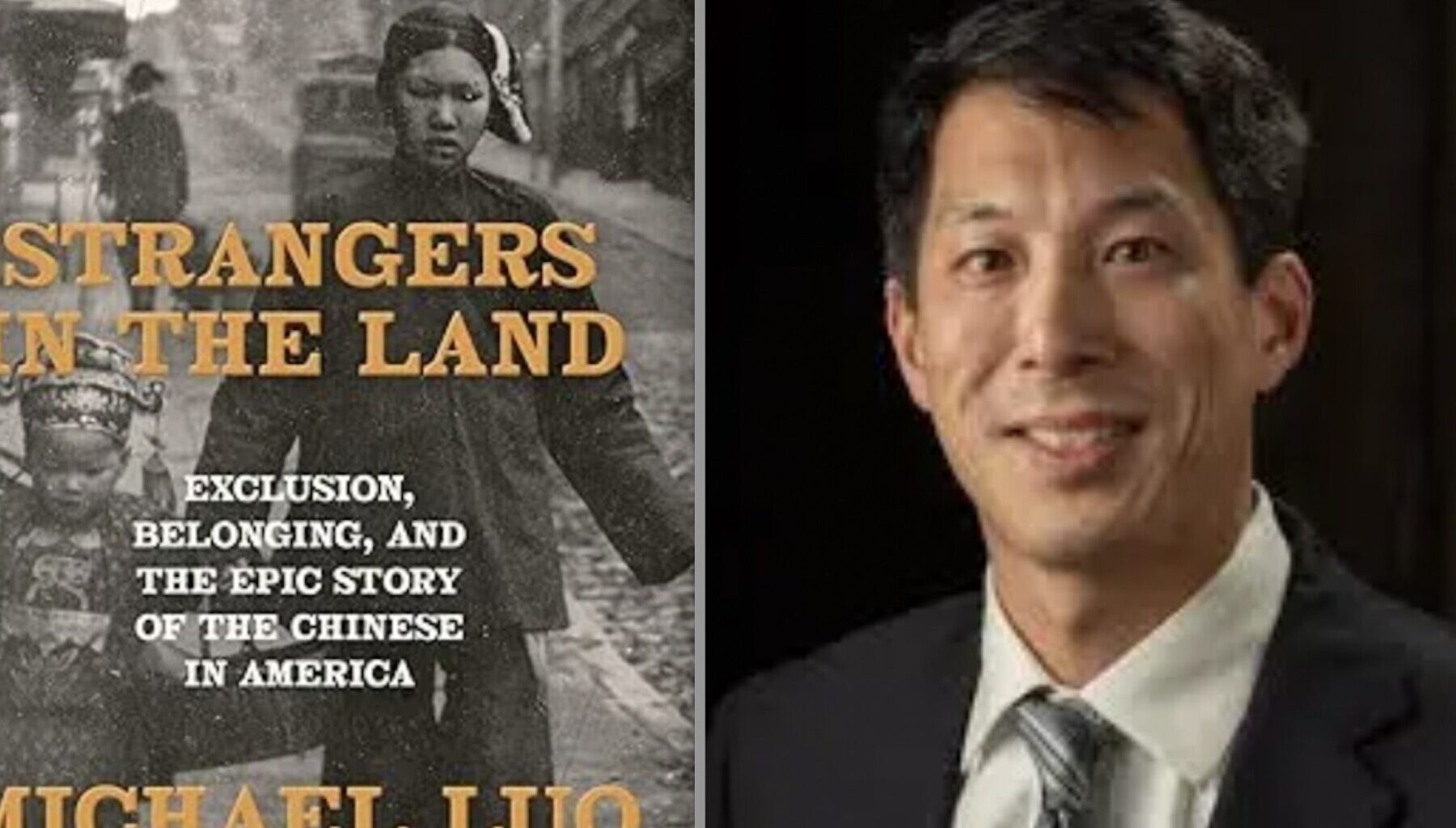
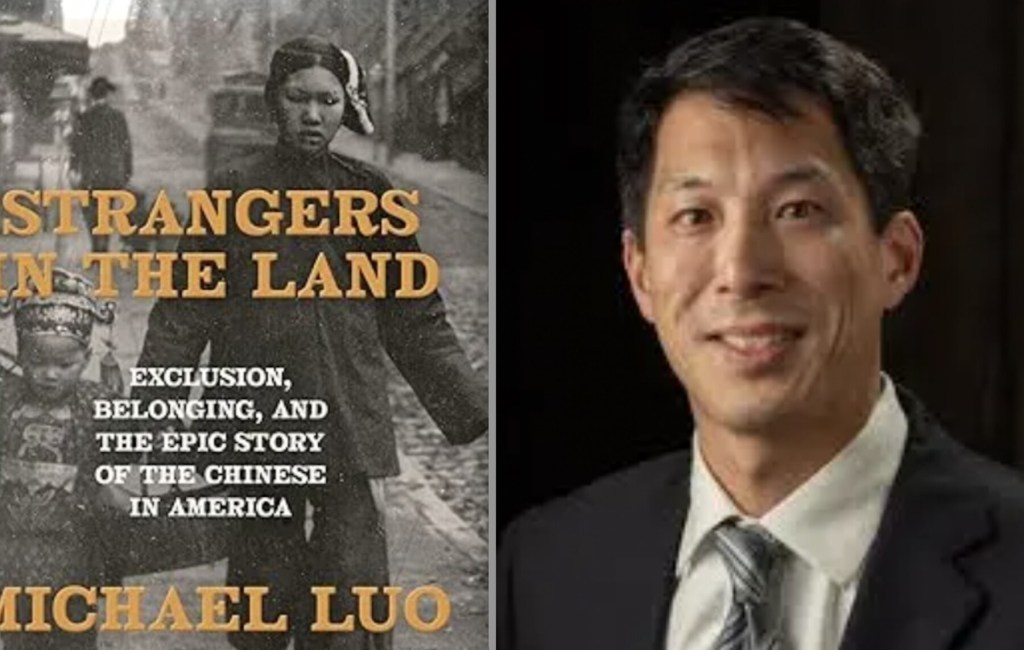
 Author Michael Luo and his book Strangers in the Land, which he discussed in Portland in the Oregon Historical Societty’s Mark O. Hatfield Lecture Series.
New Yorker magazine journalist Michael Luo gave a talk on the history of the Chinese in America on Tuesday, March 10 at the Arlene Schnitzer Concert Hall as part of the Oregon Historical Society’s Mark O. Hatfield Lecture Series.
Luo began the idea of a book on the Chinese in 2016 when he and his family were subjected to racial discrimination and verbal abuse by a woman on the streets of New York City. Shortly afterward, he began researching the archives of various libraries to find out more on Chinese history in the United States. What resulted is his book Strangers in the Land ($24 paperback, Doubleday) that vividly described the experiences of Chinese migrants in America.
In a spirited presentation, Luo began his talk by quoting from the 2020 National Book Award winning novel Interior Chinatown by Charles Yu, whose main protagonist is Willis Wu. Wu is unable to rise in a television program because he is Asian rather than Black or white. Yu believes that Chinese “keep falling out of the story.” Luo asked the question: “Who gets to be an American?”
Luo believed that his book is trying to change that narrative.
Luo’s presentation began in the 1840s on the West Coast. San Francisco was a dusty, windswept settlement. Gold was discovered in 1848 in the Sacramento Valley. This discovery set off an unprecedented mass movement of people from around the world who came to the United States. It is uncertain when the news of gold in the western part of the U.S. reached China.
In 1878, a reporter from the San Francisco Chronicle set out to investigate the advent of Chinese coming to America when he said in his article, “The Mongolian octopus developed and fastened its tentacles upon the city.”
One of the first places that new Chinese migrants went when they first came to the United States was the Sam Yup Company in San Francisco. It was a benevolent society that looked after the interests of Chinese immigrants. Word of the gold rush passed from person to person. Soon after, hundreds and later thousands of Chinese people would start looking for gold in the hills of the Sierra Nevada Mountains.

A ship carrying gold dust arrived in Hong Kong on Christmas Day in 1848 and the Hudson’s Bay Company investigated the gold. Word spread to the Pearl River Delta, a populous area in eastern China. Many of the gold-seeking migrants came to the United States during the 19th century from the Siyi (Four Counties) area. Many Chinese used their savings or put their land up as collateral to fund their trip to America to seek gold on “Gold Mountain.” Brothers asked brothers and fathers sent word to sons to join them.
By 1860, Chinese migrants made up just under 10% of California’s population. Other groups seeking gold in the area were Spanish-speaking settlers, Indigenous peoples, Black Americans, Hawaiians, Scottish, Irish, German and French. This was an experiment in a multiracial democracy that had no previous precedent in our nation’s history.
Luo did an excellent job during his presentation of being even-handed and not glossing over the past as he discussed the Chinese migration to the United States.
He pointed out during his talk that there were no federal laws in the United States during the first century of our history limiting or restricting immigration. The Founding Fathers encouraged immigration to secure the future of the United States. In the 1850s, Chinese immigrants were initially welcomed in San Francisco.
As Chinese migration continued, the sentiment of white Americans toward them — changed, and grew ugly. On the East Coast, the debate was over slavery. On the West Coast, a different kind of racial conflict broke out. The first incidents of racial violence occurred in the mine fields. Lawmakers passed laws targeting the Chinese. The highest court in California ruled that Chinese testimony was inadmissible in court against a white person.
Politicians saw an opportunity in the rising anti-Chinese sentiment and began calling for the removal of Chinese people, casting Chinese immigrants as a threat to Anglo-Saxon civilization.
These same politicians referred to Chinese migrants as “coolie laborers” and barred them from naturalized citizenship. In the 1870s, both political parties began a bipartisan effort to ban the Chinese. In 1882, Congress passed the Chinese Exclusion Act, which barred Chinese from entering the United States for 10 years. This was the first time the United States government had barred people from coming into the country based on race. Chinese people continued streaming into the United States and finding ways around the laws.
Luo skillfully gave examples during his talk that showed how white Americans’ attitudes toward Chinese immigrants started changing. In February 1885, an errant shot killed a white city councilman in Eureka, California. The result of this event was that white settlers were successful in driving 300 Chinese out of town. There were more than 200 communities on the West Coast of the United States that expelled their Chinese residents. In September 1885 in Rock Springs, Wyoming Territory, a group of white miners killed 28 Chinese and burned their homes. Several other cities, such as Cold Springs, California, and Tacoma and Seattle in Washington state, also experienced incidents against the Chinese.
Luo’s presentation would have been enhanced had it included some information about the Chinese in Portland, which had the second largest Chinese population on the West Coast in 1900.
In 1924, legislation (Immigration Act) was passed that barred Chinese from entering the United States based on race and set quotas on people from Eastern and Southern Europe. During World War II, China and the United States were allies, and Congress created some slots for Chinese immigration (105 slots per year).
It was not until 1965 that a sweeping change took place. Chinese and other groups were placed on an equal footing. The Immigration and Nationality Act of 1965, signed by President Lyndon Johnson, allowed all immigrants to be allowed to migrate to the United States.
Luo succinctly described the rise of Nativism that has been rearing its head during the Trump administration throughout the United States.
He described his concerns for his own children, who he believed would never feel that they belonged in this country because of their race. He believed the “stranger” label remains imprinted on Chinese Americans today. More than 24 million people of Asian descent live in the United States today.
Luo believes that, according to projections, by the middle of the 21st century Asians will be the largest immigrant group in the United States. Asians are considered the “model minority.” Luo stated that the status of Asian Americans has improved but their progress has not been a straight line.
According to Luo, what has hurt Asian Americans is poverty and racial discrimination. He said that Asian Americans have experienced a dual reality, with a few Asians being very successful, but many who live in poverty.
During the COVID-19 pandemic, violence against Chinese Americans increased. President Trump described COVID as the “China virus” and the “Kung Flu.” Luo mentioned that politicians of both parties have raised concerns and fears about China. Luo believed that every remark by politicians raises racial suspicion against Chinese Americans.
Luo mentioned that Chinese Americans do not easily fit into discussions of race in America. The surge in violence against Chinese Americans is a reflection of America’s exclusionary past. Luo would like to have Chinese Americans and other marginalized groups be part of inclusiveness in the future.
Luo stated that the purpose of his presentation was to furnish an accounting of this era in American history and render it in narrative form in all of its pathos and humanity for a modern audience.
He ended his talk discussing a ledger he found in the archives at the California Historical Society in San Francisco. The ledger was compiled by Constable John T. Mason in 1889, and was a catalog of Chinese residents in Downieville, California, one of the earliest mining camps. Mason’s son-in-law, Decatur Bailey, photographed the Chinese in Downieville in 1894.
It furnished a short summary of each resident, with an accompanying photograph. Luo maintained that Mason’s ledger is invaluable and powerful because it showed that many histories about the Chinese in America are lacking, and many stories are untold.