
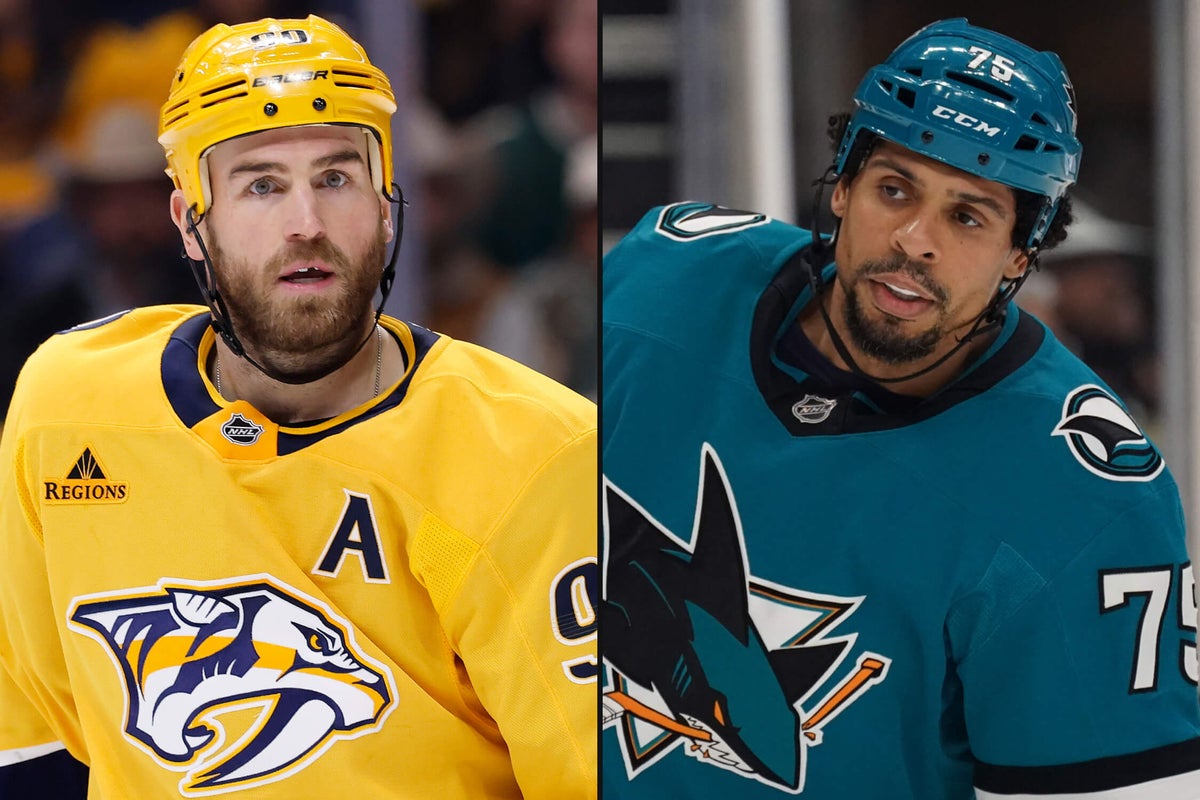
The cut was significant enough that Ryan O’Reilly needed multiple stitches just under his left eye after taking the blunt force of an opponent’s stick to the face.
However, it wasn’t enough to scare him straight.
O’Reilly briefly donned a visor after being knocked out of a March 3 game against the Columbus Blue Jackets by an accidental butt end from Charlie Coyle off a faceoff, but he’d already ditched the eye protection by the midway point of Tuesday’s visit to Seattle.
That’s basically standard operating procedure for the four visor-less players remaining in the NHL — O’Reilly, Minnesota Wild defenseman Zach Bogosian, San Jose Sharks tough guy Ryan Reaves and Dallas Stars captain Jamie Benn — each of whom has brushed aside pleas from loved ones and scary on-ice incidents to be among the final handful of skaters who will ever play in the league without one.
Consider that Benn missed three Stars games in January after suffering a broken nose when he smashed the left side of his face off the ice. The 36-year-old put on a visor for his Jan. 12 return in Los Angeles and hasn’t worn it again since.
“I think that’s probably it for me,” Benn told reporters. “Back to normal tomorrow.”
The Final Four earned the right to choose courtesy of NHL careers that extend back at least 14 years. When the league introduced a visor mandate in June 2013, it grandfathered in anyone with at least 25 games of experience on his resume.
By that point, the debate about the need for eye protection in hockey was already three decades old.
Today, it’s virtually forgotten.
O’Reilly, Benn, Reaves and Bogosian bring the NHL’s visor-less population to .0046 percent of current skaters. That number stood at 32 percent of players during the 2011-12 season and 27 percent in February 2013, according to numbers provided by the NHL Players’ Association at the time.
Reaves was a fifth-round draft pick of the St. Louis Blues in 2005 and remembers ditching his visor before his first preseason game at the urging of teammates Cam Janssen and David Backes.
“(They) said, ‘If you want to be a tough guy in this league, you’re not wearing a visor,’” Reaves said. “The visor came off that day. That was it.”
For Benn, O’Reilly and Bogosian, it was a personal choice laced with symbolism. They each made the jump directly to the NHL from the Canadian Hockey League, where visors were mandatory, and viewed it as a sign they’d truly made it.
“To me, that was just the NHL growing up,” said O’Reilly, who was 18 when he debuted with the Colorado Avalanche in 2009.
“I don’t know why,” said Bogosian, who broke in a year earlier with the Atlanta Thrashers after going No. 3 in the 2008 draft. “I think it’s something I always wanted to do. It was definitely obviously a lot of guys back then that didn’t have them on.”
Even though any perceived stigma about toughness that once came with wearing a visor has long since disappeared, some habits are difficult to break.
O’Reilly said he loves seeing the ice unimpeded and found it difficult to deal with the sweat and water that pools on his visor when required to wear one by international rules while representing Canada at multiple IIHF World Hockey Championships. Reaves was forced to put one on for three games with the Toronto Marlies in the AHL last season and found a comical workaround by tilting it so high that he could see clear underneath it.
Ryan Reaves’ interpretation of the AHL’s rule requiring use of visors on helmets with the Toronto Marlies in some school day hockey today vs Utica 😆
📸 from @TorontoMarlies Flickr page pic.twitter.com/fyE1TCl9WO
— Tony Androckitis* (@TonyAndrock) April 2, 2025
“I did it the first game, and then there were pictures everywhere,” Reaves said. “I was like, ‘OK, for sure they’re going to call me.’ The second game, nothing. The third game, I came to the locker room and the GM down there said, ‘The league called and said you’ve got to put the visor down.’ I said, ‘All right, we’ll test it out.’ So I went out there, but the visor was still pretty tilted.
“I didn’t hear anything until the third period and the ref came up to me and was like, ‘Hey, the league just called, and you’ve got to put that down.’ I was like, ‘How low do you want it?’ He’s like, ‘Well, I’m not telling you to do anything, but I’m just saying the league called.’”
After finding his way back to the NHL with the Sharks this season, Reaves is again playing visor-free.
The players all say they’ve heard complaints from their parents and partners about foregoing eye protection. Bogosian has had various near-misses over the years that forced him to briefly wear a visor, but just like the recent incidents with O’Reilly and Benn, he always abandoned it at the earliest opportunity.
“Yeah, my mom and my wife (have complained), for sure,” Bogosian said. “Probably more so my mom. But, yeah, I mean, I’m a pretty stubborn person. They probably know they’re probably fighting a losing battle.”
Like Craig MacTavish, the last NHL player to skate without a helmet in 1997, one of them will soon be the answer to a trivia question.
O’Reilly is the best bet to be the last visor-less man standing, as the only player among them signed beyond this season. He’s under contract to the Predators through 2026-27 and is currently producing just under a point per game as a top-line center, which suggests he’s got plenty of game remaining.
However, he’s a little sheepish about the possibility of becoming the last NHL player to skate without a shield.
“I think I’m kind of the odd-man out because of the toughness of these guys,” O’Reilly said. “All those guys are way tougher than I am.”
Bogosian, a bottom-pairing defenseman for a Wild team with legitimate Stanley Cup aspirations, isn’t motivated by the notoriety that could come with being the league’s last visor-less player.
“I don’t really look at it like that,” he said. “It’s just what I’m used to. I don’t really think, ‘Wow, look at me, I’m still not wearing a visor.’ I’m just so used to it by now. I don’t really look at it as that big of a deal as far as history.”
For his part, Reaves would gladly claim the title if he could.
He’s had to scratch and claw his way to 960 career NHL games by defending teammates and continually putting his body on the line.
“I would love to be the last one, but I know there’s some good players still playing that are a little younger than me,” Reaves said. “I don’t think that’s going to happen. To be one of the last ones and survive this long in the league is pretty cool.”
— Julian McKenzie and Michael Russo contributed to this story.