
I was born into a family of leftist intellectuals in Bogotá at the beginning of the 70s. My father worked in theatre and, in those years, political commitment was an inseparable part of being an artist. Although he always cultivated an essential skepticism—almost a rejection—of any dogmatism, at home we could not have any normal relationship with the United States. Learning English was never a priority, not even in a society that looked at English fluency as a guarantee for getting ahead professionally. On the other hand, my father insisted we learn French because France represented for him the cultural model to which to aspire: there one could be a writer or an artist, and the foundations of the Republic would continue to be one of the great intellectual and social conquests of the West.
Since we were little, my siblings and I heard about Paris as the world’s great city, the most beautiful, the most vibrant, the City of Light. Juggling their finances, our parents enrolled us in French-language schools and transmitted to us their love for the culture. In the Refous, a school in Bogotá’s countryside founded by a Swiss educator by the name of Roland Jeangros, I was molded in the old French humanist tradition; that is, I was educated in a spirit in antithesis to that of the pragmatic tradition of the United States.
Desiring to show us a rainbow of possibilities, Monsieur Jeangros offered challenging and varied options. Many of us owe him our passion for books—including our professional dedication to them—because he was not only a fervent promoter of reading, but also of writing in all its forms, without restruction of prior censorship. The school ingrained in us a typically French way of seeing the world because it brought together the school experience with the formation of a critical and creative viewpoint.
My First Trip Outside Colombia
Life, however, is much more complex than any dichotomy. Some of my family emigrated for professional reasons to the United States—one of my father’s younger brothers was a cardiologist who was offered a job in a Detroit hospital—and he settled there, forming a new life that, in his children, still continues. Thus, as a child, the United States for me was the airplanes: the people who came and went, the carefully planned trips of my grandmother, who would come back after months away brimming with gifts—toys and sweets (ah, ubi sunt Kraft caramels!)—, and the cousins who would visit us during vacations, bearing the latest records, clothes that fascinated us and Betamax cassettes.
My first great trip out of the country was precisely to my uncle’s house and to the homes of my cousins, now dispersed throughout the United States: Chicago, New York and Washington. Now that I think about it, it was a journey of discovery, because in more ways than one, it opened up a world beyond my parents’ influence.
My first big surprise was discovering how deeply rooted Latin culture was in all those cities: a lively, expressive and rich presence. But at the same time, I noticed that little of that vitality filtered beyond immigrant spaces—for example, salsa, that wonderfully hybrid genre born in 1960s New York night as a fusion of Latin rhythms with influence from jazz and Afro Caribbean rhythms. My cousins and I listened tirelessly to the records of Rubén Blades, Richie Ray, Bobby Cruz, Ismael Rivera and Willie Colón, but the music was only heard in our houses or at the parties of some Latin American friends.
At that time, I already wanted to be an editor, and everything I discovered on that trip sparked my curiosity. Why didn’t this energy of exchange so visible on the streets not have an equal presence in record or bookstores? In the latter, Spanish-language sections were modest and, above all, the presence of Spanish-language authors translated to English were practically non-existent, with some exceptions such as Latin American boom authors with the unchallenged protagonism of Gabriel García Márquez, Isabel Allende —who by then was living on the West Coast—, together with Sandra Cisneros and Julia Álvarez, authors who write in English and live in the United States. Very little of what was being produced in Latin America and Spain—I talk about the end of the 90s, when Spanish-language writing was vibrant—was reflected in the editorial offerings.
An Ambiguous Sensation
My father, such a Francophile in his literary tastes, was, however, a fan of classic U.S. movies, which one could buy in the stalls on Bogotá’s 19th Street or in trips out of the country. We all watched them as a family on our Betamax (a precursor to streaming). The fact that we could only vaguely understand these movies when they didn’t have subtitles—it was another era, another world—together with the increasingly urgent awareness that the editorial world revolved around English, led me to study that language at age 27.
To learn a language at that age is not as dramatic as in later life, but neither is it easy. Today, in spite of years of efforts, English is what Ana Lydia Vega calls, in a memorable essay, “wrestling with the difficult.” I read fluently, but to talk and write it still demand an almost physical concentration as if each word has to pass through a posture correcting aid.
I don’t exaggerate. English functions for me like an orthopedic device: it sustains me, it corrects my posture; it allows me to move with certain agility in an intellectual space dominated by that language, but it keeps reminding me that my center of gravity is elsewhere. It is a necessary prothesis, but an uncomfortable one. Thanks to English, I have access to conversations, books and intellectual trends that otherwise would remain inaccessible. It allows me to communicate with my English-speaking colleagues at the publishing house where I work—Penguin Random House is a global business like few others. However, the effort to remain upright within these constraints always makes me aware of my foreignness.
This ambiguous sensation —of belonging and at the same time not belonging—over time has transformed into a way of learning. In its artifice, there is a lesson of humbleness: to understand that no language is enough on its own, all new language that every new language invites us to shift our focus and take a fresh look at our own.
Two Awakenings
None of these advances —or whatever one wants to call them— would have been possible without two experiences that led me to reformulate many of the ideas I had about the United States: three months at Georgetown University in Washington and writer Susan Sontag’s visit to Bogotá in April 2003.
Georgetown was my first experience of total immersion in English and, at the same time, a lesson in human geography. I discovered, with surprise, that the country that had seemed somewhat self-centered on my first trip was, in reality, a mosaic of accents, coloors and places of origin. We shared our classrooms with Arabs, Italians, Turks and Latin Americans from practically every corner of the continent. This diversity, also noticeable on the coffee houses, parks and casual conversations on campus, gave the lie to the old prejudice that the United States was highly self-absorbed. It was a country capable of absorbing, reinterpreting and returning to the world a blend of cultural and religious traditions. Sometimes, in the midst of class discussions, I had the feeling of participating in a small summertime United Nations, where English was merely the common ground for a Babel of curious minds.
This experience did not erase the historical wounds of Colombia with the United States nor the hegemonic power the language represents, but it did temper the distrust of my adolescence. I saw that English could also be a bridge, a language that not only imposes its vision on the world, but also shares, questions or transforms. In these weeks at Georgetown, I began to perceive nuances that didn’t fit with the caricatures of propaganda nor with my inherited anti-Americanism. I understood that, in the very heart of the empire, forms of openness, hospitality and dialogue existed that were very rarely mentioned outside its border.
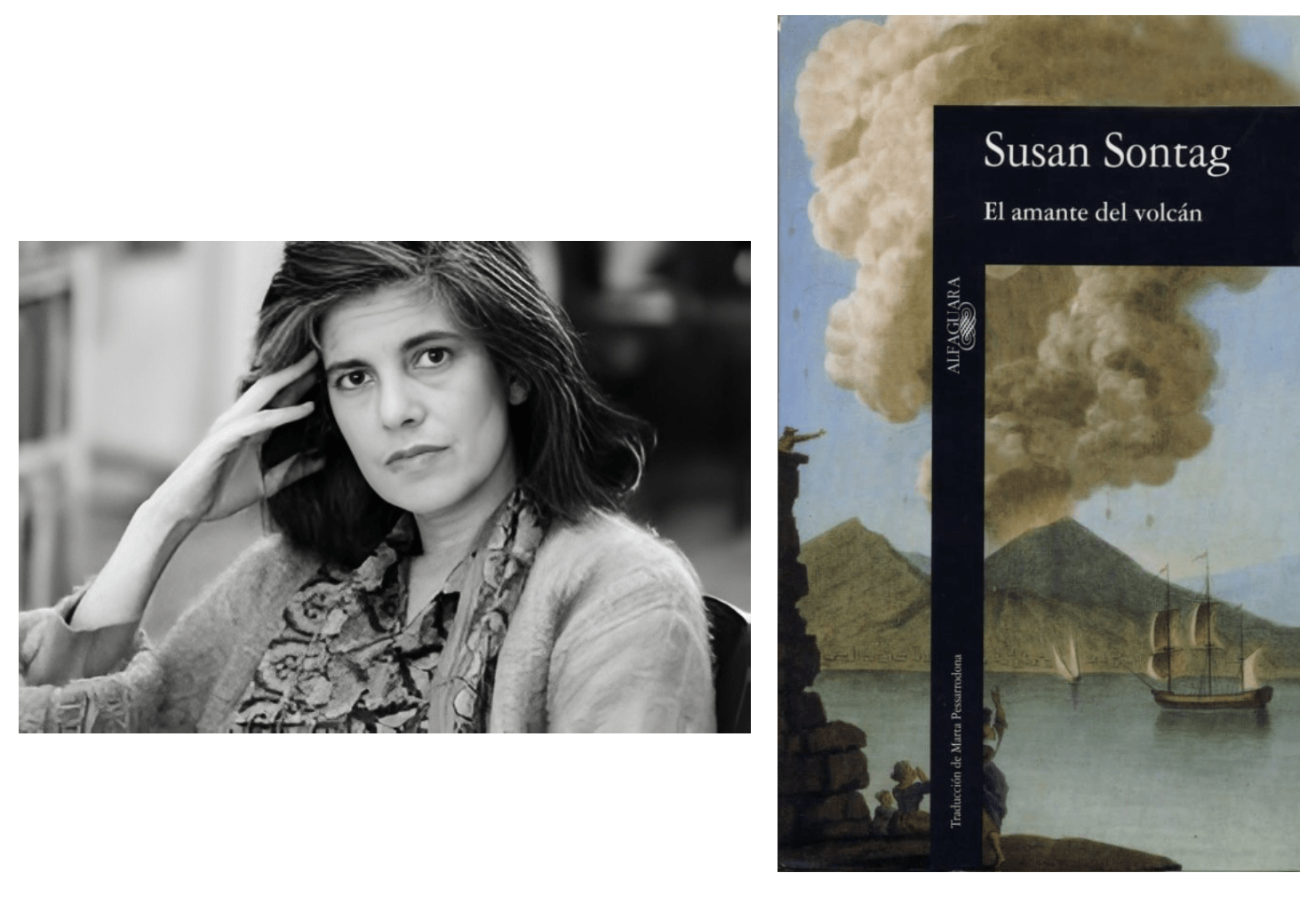
The second event happened years later, when Susan Sontag came to Bogotá to present the Spanish-language translation of the novel El amante del volcán (The Volcano Lover), which we had just published in Alfaguara. Her presence was, for me, an epiphany. Her curiosity was infinite and voracious; she was interested in everything: the arepas—corn pancakes—at breakfast, young writers, local politics, the music that was playing in bars. She was fascinated by the brick architecture of Rogelio Salmona, and more than once praised his celebrated Torres del Parque apartment complex. Her curiosity was contagious and her attention, radical: she looked without prejudice, listened without patronizing.
This impression was reaffirmed months later, when I announced that I would be passing through New York and, to my surprise, she invited me to her apartment in Chelsea. In her library, I saw books by many authors in other languages that she read, confirming what I had already sensed in Bogotá and learned at Georgetown: that self-absorption is not a historical inevitability. Within the U.S. tradition are authors like Sontag who have known how to look beyond the country’s borders and to pay genuine attention to what is happening beyond the English language.
Respice polum, respice gallum
When Woodrow Wilson was elected U.S. president, many Colombians saw in him an opportunity to repair what the separation of Panama (this significant occurance that marked part of our historical wounds) had broken. During his campaign, Wilson had declared that, if he won, the country would comply with the principles enshrined in its Constitution and never again seek to take “an additional foot of territory” by conquest, neither in Panama or elsewhere.
On reading these words, Colombian Congressman Marco Fidel Suárez perceived the necessity of turning the page. Although he maintained his critical opinion of the U.S. role in the loss of Panama, he was aware that in the ten years since the secession of the isthmus, the United States had become a hegemonic power in the Western hemisphere. Because of this, he proposed a formula that combined saving political pride and the limitations imposed by political realism. “The North of our foreign policy—said Suárez— should be there in this powerful nation, the one that more than any other, emanates decisive attraction in regards to all other nations in America. If our conduct could have a motto that encapsulates both desire and vigilance, it would be respice polum.”
No one could have imagined that this “look towards the North Star” would mark a more lasting guideline than it seemed. In its immediate context, the expression refers only to diplomacy, not to culture. Among the intellectuals and artists of that period—and with more force than even in my adolescence—the idea predominated that the force of the American Union was political and economic, but not cultural. Thus, no one, not even Suárez himself, extended the formula of respice polum to the cultural sphere. There, Colombia obeyed another principle, paraphrasing the congressman, that could be called respice gallum: if its foreign policy should point towards the United States, its cultural policy would keep pointing, inevitably, toward la France.
In spite of the resistance it aroused, Suárez’ proposal resulted, over time, prophetic. The next year, the treaty Urrutia-Thomson was signed, with the U.S. paying Colombia $25 million for its recognition of Panamanian independence and offering an apology. Since then, U.S. academics, writers, artists and scientists began to visit Colombia, understanding the relationship between the countries as a form of mutual enrichment and, in a decisive way, transforming the perception of the U.S. government. Its influence ended up imposing itself even in those spaces where the French had previously dominated.
Many of these men and women came with specific missions—sent by the government in Washington, by the oil companies, banana exporters, the military industry or the universities— but no one treated their tasks as a mere job. In addition to forging deep ties with the coutry and its people, they went even further: they made maps, explored jungles, drew landscapes, took photos, filmed movies, recorded music and published books. In every case, they left a testimony of respect, curiosity and passion for the world in front of them. And their productions also modified our own way of understanding ourselves.
A Luminous Crack
Knowledge of another culture comes through translation and through contact. A foreign language is not only a means of communication, but also a vehicle that shows us a different sensibility, a way of thinking and seeing the world. Learning a language permits us to discover what lies beyond our domestic horizon and, at the same time, to recognize that understanding others requires more than critical distance or inherited mistrust: it requires—oh, that poor, overused word—empathy. Mastering a foreign language—or even dipping our toes into it—is an exercise in openness that allows us to cross the symbolic borders that separate us from others or to welcome, with genuine willingness, those who cross them toward us.
Self-absorption is not fatal: it can be reversed by learning a language and connecting with its culture. These are the ties that many Latin American and Spanish publishers—the “people of Cervantes,” as Spanish linguist José Ramón Lodares called them—would like to strengthen with the English-speaking world. I have been working in publishing for more than thirty years and I regret to say that the figures have hardly changed. The famous 3% still stands: of all the books published annually in the United States—the most powerful publishing market in the world—only 3% are translations. Of that percentage, Spanish ranks first, with 20% of titles, closely followed by French. In fiction and poetry, we are talking about some 80 translated titles, which represents only 0.7 % of the total.
These statistics continue to worry me. I frequently ask myself how much it would help to see others with nuances—and in the final instance, ourselves—if we translated more novels. In many of her essays, Susan Sontag reflected on the moral and aesthetic function of literature, and although she never wrote a systematic treatise on the subject, she left what I consider to be a central idea: to read fiction is training in the capacity to imagine who we are not.
This capacity, precisely, is what literary translation amplifies and propagates. Each book that travels from one language to another opens a luminous crack in the world’s uniformity; each translated voice, as Israeli writer Amos Oz said on receiving the Prince of Asturias Award, is an invitation to enter the living room, the playroom or the bedroom of other lives, so translating is like extending a bridge so we can cross this threshold.
Because of this, I believe—like Oz—that curiosity has a moral dimension and that the imagination of others is the best defense against fanaticism. Translation in this sense not only enriches languages; it also humanizes the world. One cannot know this when, at age 20, I traveled for the first time to the United States. But I do know it now, after having read and published so many books originally written in English; in every foreign language, in some way, the promise of reconciliation resonates.