
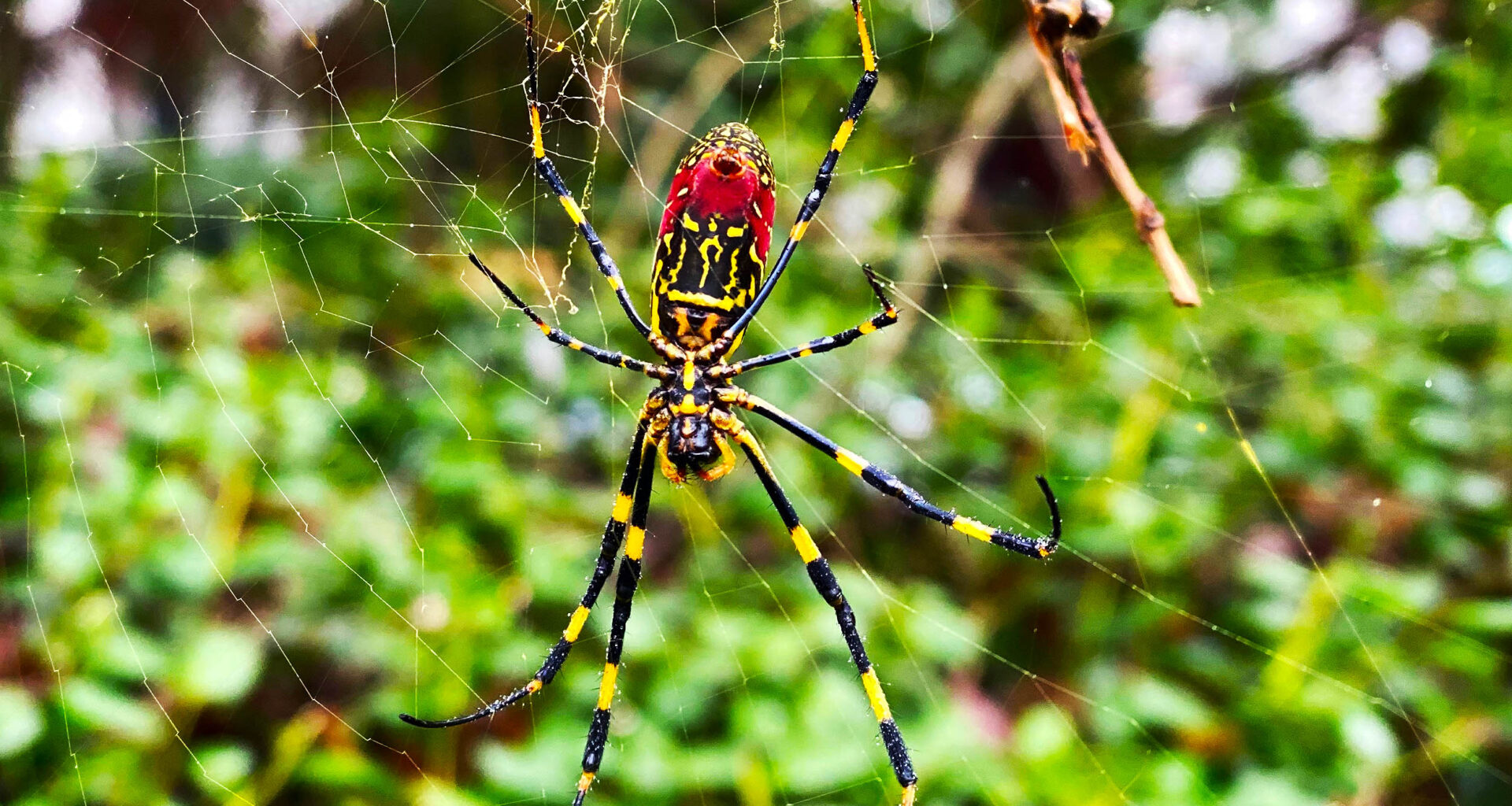
The Joro spider, a bright yellow species that can grow as large as a human hand, has now pushed across Mississippi as it continues spreading across the United States.
Native to Asia, this spider has expanded across the Southeast, and so far, no one has found an easy way to stop it.

Since its first sighting in the U.S. around 2013, this invasive species has not only adapted but thrived, raising questions about its success in urban environments.
Recent research from the University of Georgia sheds light on this phenomenon, revealing the spider’s remarkable resilience and ability to tolerate urban stressors.
Understanding Joro spiders – the basics
The Joro spider is a beautiful orb-weaver from East Asia that is known for its vivid colors and impressive web-spinning skills.
Characterized by a bright yellow and blue body, with distinctive red markings, the Joro spider is an engineering genius.
Females, significantly larger than males, can weave webs that span up to three feet in diameter. These webs are not only traps for prey but also serve as a testament to the spider’s intricate architectural abilities.
As predators, Joro spiders play a crucial role in controlling insect populations. They primarily feed on small insects caught in their resilient webs, which are known for their strength and durability.
The spiders’ predation habits contribute to the ecological balance by regulating pest populations, showcasing their integral role in their new ecosystems.
How Joro spiders deal with cities
The study focused on the Joro spider’s surprising tolerance for vibrations and noise, common elements in urban landscapes that typically stress many animals.
Researchers found that despite living near busy roads, Joro spiders maintain their health and body mass, comparable to their counterparts in quieter areas.
This adaptability suggests that the Joro spider can compensate for the challenges of a human-dominated environment.
Andy Davis, a research scientist at UGA’s Odum School of Ecology and the corresponding author of the study, emphasized the importance of vibrations for spiders, a key sensory input for detecting prey.
“But these Joro webs are everywhere in the fall, including right next to busy roads, and the spiders seem to be able to make a living there. For some reason, these spiders seem urban tolerant,” Davis explained.
Surviving and thriving
Joro spiders are frequently found in places where native spiders are absent, constructing their distinctive golden webs in high-traffic areas such as between power lines, atop stoplights, and over gas station pumps.
This prompted Davis and his team to investigate their behavior near roadsides using a tuning fork to simulate prey vibrations.
The findings showed that Joro spiders attacked simulated prey 59% of the time, with a slight decrease in attack frequency near busier roads compared to quieter areas. However, this did not affect their overall health or body mass.
Alexa Schultz, a third-year ecology student at UGA and co-author of the study, noted, “It looks like Joro spiders are not going to shy away from building a web under a stoplight or an area where you wouldn’t imagine a spider to be. I don’t know how happy people are going to be about it, but I think the spiders are here to stay.”
Cultural and ecological impact
In their native Japan, Joro spiders are woven into the cultural fabric, often celebrated for their diligent web-weaving.
In the U.S., while they have stirred some concern due to their menacing size and invasive status, researchers emphasize their potential benefits, particularly in pest control.
The Joro spider’s presence challenges us to consider the delicate balance between native and non-native species, and the potential for symbiotic relationships within ecosystems.
Joro spiders in concrete jungles
The Joro spider’s native habitat in Japan shares a similar climate and latitude with the U.S., suggesting a predisposition for adaptation.
Previous research from Davis’ lab highlighted the spider’s high metabolism, heart rate, and cold tolerance as factors contributing to its rapid population growth in the U.S.
The current study adds urban vibration and sound tolerance to the list of traits facilitating the Joro spider’s expansion.
Despite their proliferation and the unease they may cause, researchers assure that the spiders are relatively timid and pose no significant threat.
Ecological lessons from Joro spiders
The Joro spider’s successful colonization of urban environments underscores a remarkable example of nature’s adaptability in the face of human expansion.
Through resilience and an uncanny ability to tolerate urban stressors like noise and vibrations, these spiders not only survive but thrive, creating new ecosystems within our bustling cities.
This research from the University of Georgia illuminates the unexpected ways in which wildlife can adapt to urban landscapes.
The full study was published in the journal Arthropoda.
—–
Like what you read? Subscribe to our newsletter for engaging articles, exclusive content, and the latest updates.
Check us out on EarthSnap, a free app brought to you by Eric Ralls and Earth.com.
—–