
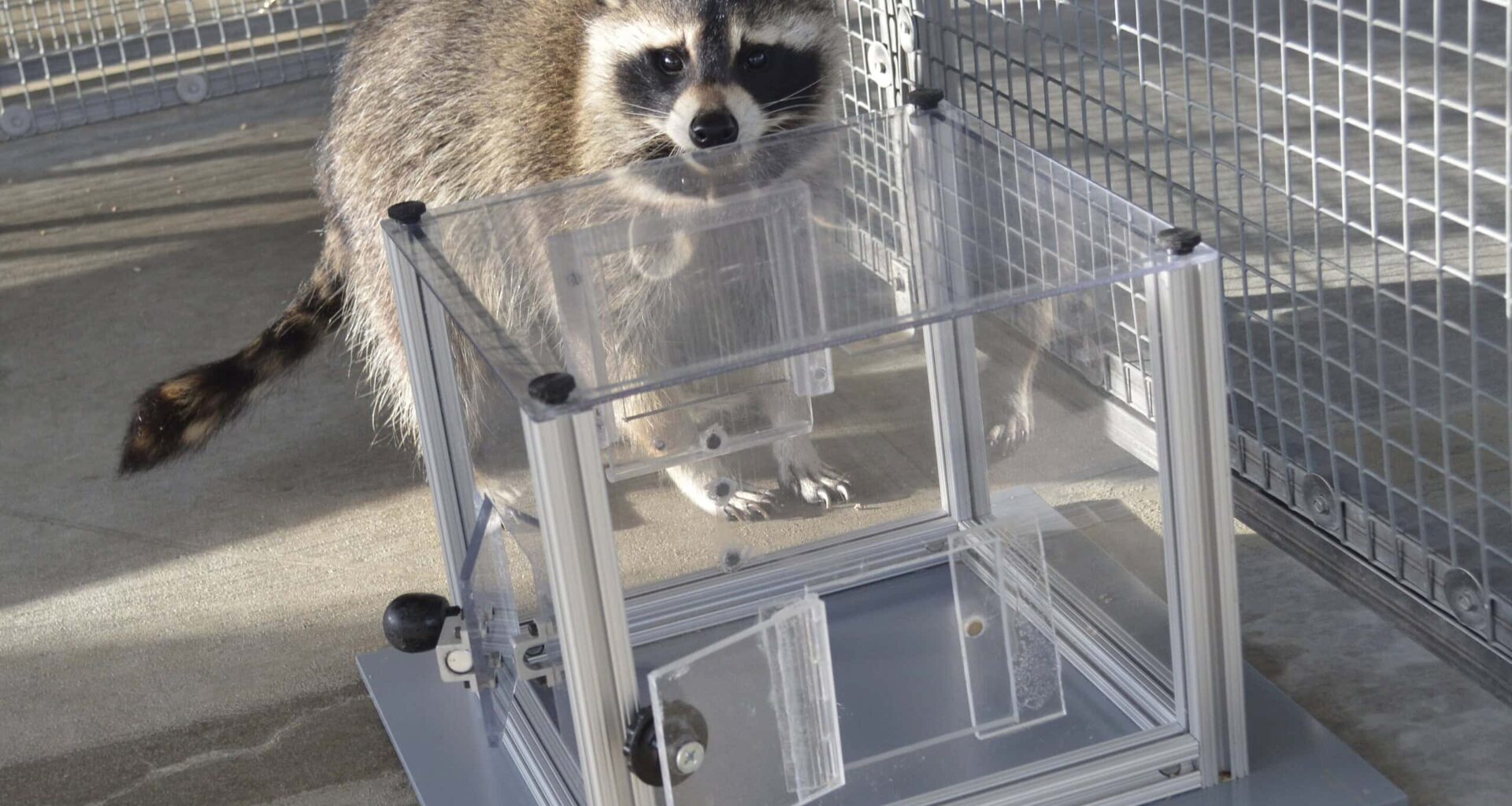
 A raccoon and puzzlebox from the experiment. Credit: Hannah Griebling
The marshmallow was gone, but the trash pandas kept going.
In a new experiment, raccoons continued opening fresh doors and latches on a puzzle box even after they had claimed the food reward inside. That persistence is a bit perplexing. Researchers think the raccoons may keep exploring to gather useful information, even when no immediate reward remains.
Scientists call this behavior information foraging: spending time and energy not for an immediate payoff, but to learn something useful for later. In the case of raccoons, that habit may help explain why they thrive in cities built by humans.
A Mind Built for Busy Environments
Researchers led by Hannah Griebling and Sarah Benson-Amram of the University of British Columbia tested 16 adult raccoons living at a research facility in Colorado. The animals were presented with a clear multi-access puzzle box that could be opened in nine different ways, divided into easy, medium and hard challenges. Some openings required a simple action, like moving a door or latch. Others demanded a sequence of actions, such as removing a lock and then lifting a hasp.
Before the experiments began, the researchers established that marshmallows were the raccoons’ favorite reward. Then, during each trial, they placed just one treat inside the box and gave the animals up to 20 minutes to investigate.
“We weren’t expecting them to open all three solutions in a single trial,” Griebling said in a university release. “They kept problem-solving even when there was no marshmallow at the end.”
 Gosh, I love these creatures! Credit: Wikimedia Commons
The study adds evidence to the familiar image of raccoons as clever, hands-on troublemakers. Previous research suggested that raccoons can master locks, remember solutions and adapt quickly when a familiar route stops working. In older puzzle-box experiments, they learned a variety of latches and bolts with striking speed. In more recent work, they have shown a talent for repeated innovation: when one method fails, they often try another.
Their bodies help. A raccoon’s forepaws are highly sensitive, helping it gather detailed tactile information while manipulating objects. Long before one breaks into a compost bin, it is feeling edges, testing resistance, and collecting information through touch. Earlier neuroanatomical studies have also suggested that raccoons pack an unusually large number of cortical neurons into their brains for a carnivoran of their size—a trait associated with behavioral flexibility.
×
Thank you! One more thing…
Please check your inbox and confirm your subscription.
In the new study, that flexibility showed up clearly. When the puzzle box was easy, raccoons explored widely, trying different openings and changing the order in which they tackled them. When the box became harder, they grew more conservative, relying more often on methods that had already worked.
Griebling used a restaurant metaphor to describe the pattern: “It’s a pattern familiar to anyone ordering at a restaurant. Do you order your favorite dish or try something new? If the risk is high—an expensive meal you might not like—you choose the safe option. Raccoons explore when the cost is low and quickly decide to play it safe when the stakes are higher.”
Curiosity has benefits, but it also has costs. Time spent exploring means time not spent cashing in on a known reward. The raccoons appeared to manage that trade-off rather than simply poking at random.
Urban Fauna
This kind of intelligence makes special sense in an urban landscape. A city is full of low-competition food, but much of it is hidden behind “puzzles.” Yesterday’s easy meal may be sealed behind a new mechanism tomorrow. An animal that forages for information has an edge.
That may be why raccoons have become such durable city dwellers in places like Vancouver and Toronto. Their success is often described as opportunism, which is true as far as it goes. But opportunism can sound passive, as if raccoons simply stumble into human leftovers. The new findings suggest something more active: they may probe, test and memorize the workings of their environment even when no immediate payoff appears.
The study also hints at why raccoon conflicts with people can feel like a small arms race. Humans redesign bins and latches to keep them out. Raccoons return to inspect the redesign.
There are limits to what the new work can say. These were captive animals, not wild raccoons roaming alleys and creek beds. The researchers themselves were careful on that point. Captivity can shape behavior, and a puzzle box is not the same as a row of green bins on garbage night.
“Raccoon intelligence has long featured in folklore, yet scientific research on their cognition remains limited,” Dr. Benson-Amram said in the release. “Studies like this provide empirical evidence to support that reputation.”
You can try to keep raccoons out of your bins. Just don’t assume a new latch will stop them for long.
The study appears in Animal Behaviour.