
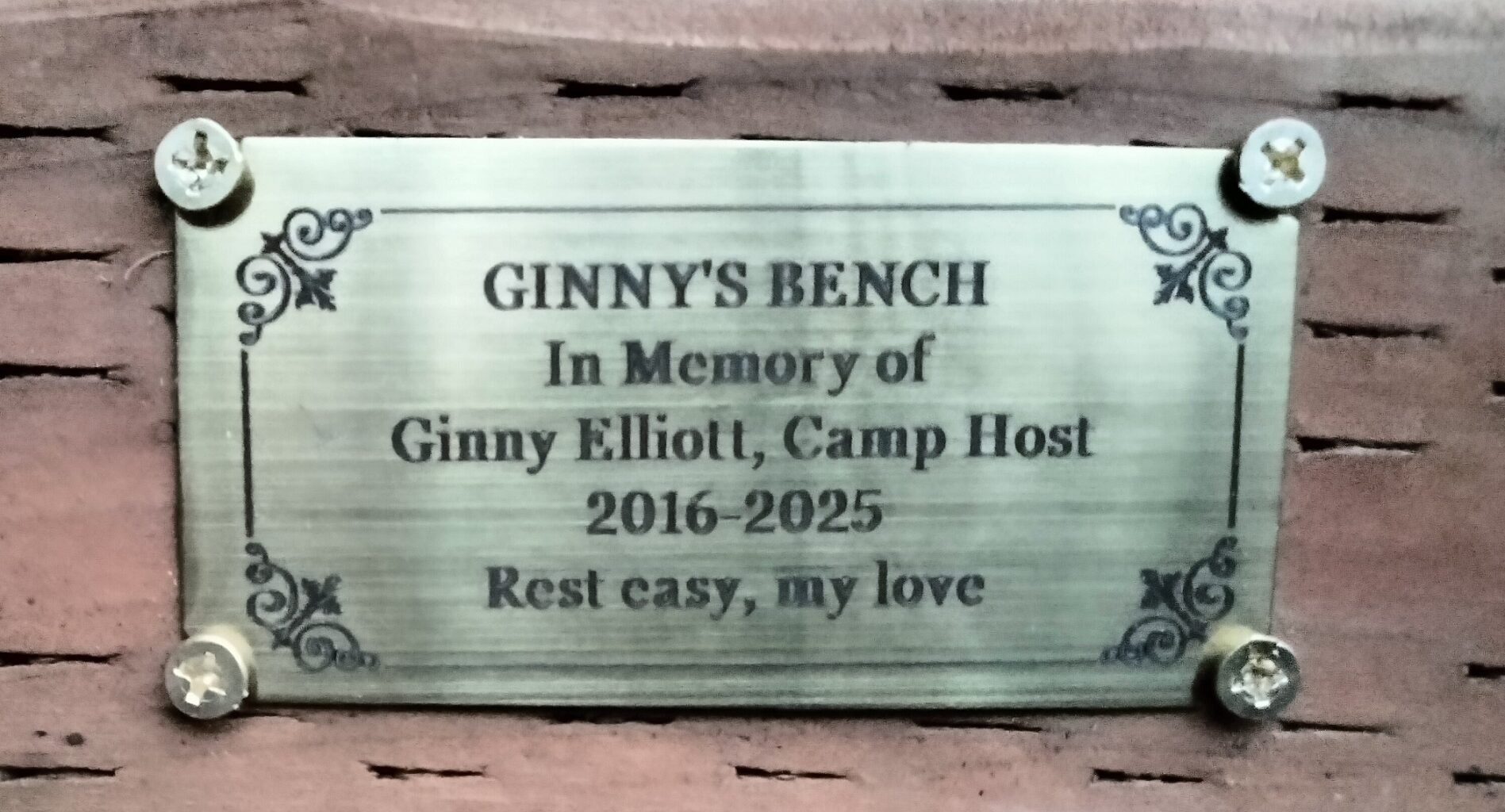
I wrote this poem five months after Ginny’s passing:
Waking Up
Every day
I wake up
And remember she’s not there
5 times a night
I wake up
And lose her yet again
Sometimes
In my dreams
She comes to me
It seems so real
And I rejoice
Until I wake up
And lose her yet again
Joy becomes pain
Yet I still want her to come
Even if it’s just a dream
She still loves me
Like she always has
Until I wake up
And remember.
My wife, Ginny, died last April. Ten months ago.

I still cry almost every day. I often wish she were still here. I have dreams about her. I sometimes talk to her as if she can hear me. Things remind me of her, all the time, and when it gets to me, I cry again. It’s hard to get out of bed some mornings. I feel unmotivated, forgetful, and unable to think straight. I’m frequently tired but wake up multiple times a night and have trouble going back to sleep. I move and think much more slowly than normal for me.
I have sometimes wished I were dead. No plans to do anything, more the feeling that my life no longer seems worth living.
It would appear I have a “mental disorder.”
I meet the criteria for “Major Depressive Disorder”: depressed mood, sleep disturbance, loss of energy, cognitive impairment, and thoughts of death. Five of nine criteria for more than two weeks. I’m ill!
In another two months, unless things radically change, I will have a new mental disorder: “Prolonged Grief Disorder”! Here is the description: “A distinct mental disorder where the intensity and duration of grief symptoms are disabling and exceed social, cultural, or religious norms.”
According to the DSM, the “social, cultural or religious norm” for grieving in the USA is a year. Twelve months. Oh, only six months if you’re a child. I guess kids are supposed to “get over it” more quickly. Because they’re resilient, right?
Who decided that and how? We will find out a little later in this piece.
My Love Story
I grew up with a very hard-working, very emotionally distant mother, four brothers close in age, and a father who was away at work most of the time. I learned early on that love and affection were scarce commodities and that I’d better get used to fending for myself. I spent a lot of my early childhood alone, and pretended I liked it that way. But I was miserable and hated myself. I was incredibly shy and terrified of talking to a girl I liked, let alone asking her on a date!
Ginny and I met on our second day of college on a bike ride. It took me five more weeks to figure out she liked me and ask her out. She had to make it pretty obvious. I was pretty dumb about girls!
 Ginny changed all that. She loved me for who I was. She was my safe place, my true love, the person I could count on. We were together for 49 years. Married for 44. Raised three boys, went camping, backpacking, biking, played tennis, ping pong, card games, board games, watched movies together, laughed a lot, cried a lot, snuggled a lot, sometimes argued but always sorted it out by bedtime. We said we loved each other probably five times a day or more. When I needed love and support, I went to Ginny. She did the same with me.
Ginny taught me to have fun. She taught me to love myself. She made it safe for me to love others fully. She was my life.
She died of cancer at age 66.
To say that I miss Ginny is the grossest of understatements. We used to talk all the time about being like her Auntie Til and Uncle Al — riding our bikes around into our 80s, seeing our grandkids have kids of their own, driving our RV around the country, visiting Canyonlands, Yellowstone and other parks around the country, and visiting our relatives on the East Coast (we lived in Olympia, WA). To lose her not only meant losing our companionship. It meant losing our vision of what our future would look like. It meant losing a huge part of my identity. It meant losing a big part of my purpose in being alive.
We never expected that Ginny would be the one to die first. We talked about it often. All the men in my family, both sides, died in their 60s or sooner of heart attacks, except my dad, who survived a heart attack at 40 and changed his lifestyle, and managed to make it to 85. But notwithstanding his amazing recovery story, we both figured I’d die first. On the other hand, the women in her family all lived into their 90s. There was no cancer on either side of the family. I was completely unprepared to still be here when she was gone. That was not how the story was supposed to go!
When Ginny died, I also lost my safe haven. I thought I had dealt with the attachment difficulties I noted above, but apparently, I had set them aside with the idea that I’d never have to deal with them, because I’d always have Ginny, and she’d always love me! When she died, a huge rush of these feelings unexpectedly came back on me with a vengeance. Now I was alone again, just like I was as a child. Fortunately, I’ve learned a lot of skills since then and have a pretty good network of genuine friends who have helped me move through this very painful time. And I was fortunate to find a very compassionate and competent grief counselor who has been seeing me for the better part of eight months now. But I am still alone much of the time, and it is very, very hard. I feel sad, angry, frightened, lonely, and sometimes wonder why I am still here and what it is I’m supposed to be doing. And I get tired. Existentially tired. Exhausted.
So does this make me “mentally ill?” Or am I just a person who misses someone they loved very much, and has to deal with the sadness of moving on alone? And how long am I permitted to take with that? When am I supposed to be “done” with grieving? How long is “too long”?

What is “Normal?”
So what is “normal grieving?” Let’s take a look at some social, cultural and religious norms for grieving around the world.
Here are some examples of what is considered normal grieving in different cultures:
In Egypt, tearfully grieving after seven years would still be seen as healthy and normal.
In traditional Vietnamese culture, mourning lasts two years, reflecting the deep respect for the deceased. During this time, family members may wear white or subdued clothing, avoid celebratory events, and offer daily prayers. A special ceremony is held after the two-year mark to signify the end of the mourning period.
In Jewish tradition, shiva lasts seven days — an intensive mourning period where the community supports the bereaved. This transitions to shloshim (30 days) and eventually a year of saying Kaddish for close relatives. This graduated approach acknowledges that grief changes rather than simply ends.
Chinese mourning traditions historically prescribed 100 days of intensive grief followed by a three-year mourning period for immediate family members.
In Victorian England, widows were expected to observe strict mourning for two years, with specific clothing requirements that gradually relaxed as time passed.
In Greek Orthodox tradition, a service is held on the first day after the funeral, the third day, the 9th day, the 40th day, every three months for the first year, and annually thereafter.
Many Indigenous American tribes view grief as an ongoing relationship with the deceased rather than a process with a definitive endpoint.
Similarly, in Mexican Day of the Dead celebrations, grief transforms into an annual reconnection with departed loved ones, suggesting that grief doesn’t end but evolves into meaningful connections that continue throughout life.
As we can see, expected grieving periods and rituals vary dramatically by cultural tradition. These expectations can vary from months to years to forever! So if you come from Egypt, does “Prolonged Grief Disorder” ensue at the one-year point? Or do you have to exceed seven years before you qualify?
How Long is “Too Long”?
Given this wide range of cultural practices and expectations, which is explicitly identified in the definition of Prolonged Grief Disorder above, how did they come up with the supposed norm of one year (and six months for those resilient little kids)? They held a “consensus conference.”
They couldn’t agree on the criteria, so they got together in a big committee, and then they reached a consensus. In other words, one year (and six months for children) is an agreement reached by a group of “mental health professionals” sharing their opinions and arguing about it until they agreed. Kind of like figuring out what movie we’re going to see or where we’re going to go for pizza tonight. Consensus. They might have voted on it.
I also have to wonder who the “stakeholders” were that were invited to the “consensus conference.” I’d bet my life savings there was no one there representing actual human beings who were going through this grieving process themselves.
So as far as I can make out, in two months, if things continue as they are, I will have a new “mental disorder,” because a bunch of psychiatrists got together at a conference in New York and decided, “OK, we’ve decided a year is long enough to grieve. A year? Everyone good with that? Any objections? OK, all in favor, say ‘Aye!’”
I shared this issue with my good friend Laurie, and she brought up an interesting question:
“If it’s a leap year, do you get an extra day?”
This question points out the utter absurdity of these “criteria.” Why would I suddenly stop missing Ginny or wishing she were here at the magical one-year mark? Why don’t people just get to be sad as long as they need to? And these poor kids! Their mom dies, or their dad or their sister, and they’re supposed to be substantially “over it” in six months?
Psychiatry’s explanation for this comes down to “being able to provide treatment” — in other words, to satisfy insurance companies that they ought to pay for services to help these people. From Miriam Solomon’s critique of “Prolonged Grief Disorder” being added to the DSM:
“… prolonged grief has symptoms (yearning for and preoccupation with the deceased) that are not shared by other disorders AND there is a new, targeted, grief therapy, developed by Katherine Shear (2005; 2014) that offers superior relief to those dealing specifically with prolonged grief.”
But why shouldn’t we just provide the necessary services, if desired, and bill the insurance company for an “adjustment disorder” or something more benign that doesn’t stigmatize the grieving process? Or better yet, change the whole approach so that a DSM code is not a requirement to receive “targeted grief therapy” or other forms of assistance?
Drs. Joanne Cacciatore and Allen Frances appear to agree with me:
“It would be preferable if US-based insurers did not predicate payment for supportive grief counselling on a medical code; this would be much more respectful of grievers. Many people, recognising that bereavement can be an intense exogenous stressor, want to leave grief, and grievers, safely out of the reach of well-meaning but intrusive doctors and treatments. Grief warrants strong social support and compassionate connection, not medicalisation.” [Emphasis added.]
The other thing to keep in mind is that most people are not offered Katherine Shear’s “new, focused grief therapy” once they are diagnosed. They are most commonly offered psychiatric drugs to “take the edge off” or “help them cope.” This, to me, adds insult to injury — not only are you telling me my feelings are abnormal and unacceptable, you’re telling me that there’s nothing I can do about them other than to take drugs to make me feel better. (Because that is the goal — to feel better! Not to find a new way to live your life, but to make those “bad feelings” go away. Talk about toxic positivity!) And we also know that such interventions often have unintended consequences that the grieving person has not been prepared for.
What is the US Cultural Norm?
The DSM is mainly used in the USA, so the assertion of one year as the “cultural norm” on which “Prolonged Grief Disorder” is based should be the US standard. But what do people in the USA regard as a normal course of grieving?
According to a recent Mad in America article, a study of grieving people stated that “Nearly every participant (98%) believed their response to loss was normal and understandable.”
I belong to several online support groups, including two Facebook groups for widows and widowers. There was a post recently on one of them about Prolonged Grief Disorder, entitled “Some people get stuck in grief — now scientists think they know why.” The reception from the grieving widows/widowers toward this posting was not very warm!
Some comments included:
Almost 6 years since I lost my wife, so I guess I must have their disorder. I call it love…
Grief has three stages…
1. The beginning.
2. The middle part.
3. The rest of your life.
Your person may be gone, but not the love. As long as you love your person, so long will you grieve. Period. Nothing strange, no disorder, just reality.
Prolonged grief happens when someone very close to you passes that you interacted with on a daily or routine basis. That’s why… deep love means deep grief.
Grief has no expiration date. I’ve never thought “I can’t wait until I no longer grieve for my son or my parents.” I grieve because I love them and I’ll forever miss them being present in my life.
Grief is the price of love.
Grief is not a disorder. It’s not getting stuck in grief, we carry grief with us. It becomes part of our lives. We learn to live with it and it’s different for everyone.
I wonder if any of the scientists doing this research have ever experienced grief! Based on my own grief and all of these comments, seems we all feel like our grief is “normal.”
These commenters were mostly in the United States. This is what our cultural and social norms really are, at least among people who are actually grieving! Not a few weeks, not a few months, not a year — grieving takes however long it takes for that person, and for some, it is a lifetime. It’s not something you get over or move past, like losing that car you really loved or having to move to a new house. A part of you is gone, and you have to learn to create a new life for yourself that includes the fact that they are no longer there. As a wise young man recently said to me, “If your arm were amputated, other people could hand you things. But they can’t give you back your arm.” The grieving person cannot “return to normal.” A part of them is missing that can’t be replaced.
While the Facebook groups of people who are actually experiencing grieving seem to show a complete willingness to accept that grieving is an ongoing process that may take years or never be “done,” the general population in the USA has increasingly been inundated with the message from the mental health system that grieving is a “mental health issue” (hence not something they are qualified to deal with), and that people really should “recover” from grief in a “reasonable” timeframe. Additionally, as there is no formal grieving process generally recognized in the USA, there is a lot of uncertainty as to what IS normal. This often leads to discomfort discussing the subject, and it’s a very human tendency to avoid uncomfortable discussions, because they are, well, uncomfortable! This unfortunately dovetails all too well with recent efforts to market the concept of “Prolonged Grief Disorder” and is making it harder for folks to have simple and honest discussions about what grieving is really like, especially when the grieving person continues to struggle months or even years into the process.
In the next section, we’re going to take a look at how to challenge some of these assumptions and to become more in tune with what is actually helpful to a person who has experienced a major loss in their life.
Grief Education
We all should do our best to provide what love and support we can to a grieving person, knowing that however much we give, it won’t be enough to make it all better. But this support is very much needed and will still be appreciated.
Here are some things we can do that might really help:
Listen, ask questions, and connect with them. You can’t fix it, but you don’t need to and shouldn’t try. Efforts to “help them feel better” generally come off as invalidation or “toxic positivity” (the need for them to be “positive” in order to make you feel better). Instead, let them tell you how the experience has been for them, and acknowledge them for having the courage to share their feelings with you.
Expect a wide range of emotions. We all expect sadness, but some unexpected emotions are anger (at their partner for leaving, at themselves, at the world, at God), relief (usually if someone was suffering, but sometimes because of a conflicted relationship), guilt (especially for being angry and/or feeling relieved!), or confusion (Why did this happen? Did I cause it? Could I have prevented it? Did I deserve it?). Really, any human emotion can come up, and all are OK for a person to experience.
It is also very common for mourners to think about dying as a way to escape the pain or to rejoin their loved one in the afterlife. This is normal and not a cause for alarm! Make it safe for them to tell you about what they are experiencing, and do your best to let them know how totally understandable their feelings are.
In almost every case of serious grieving I’ve seen, including my own, an interesting phenomenon occurs. At first, everyone wants to offer their help: “What can I do?” “Call me any time!” “You know I’m there for you!” But as time goes along, the mourner’s support network gradually shrinks. Not because people don’t care, but because people’s lives get in the way, and compassion fatigue takes over, and sometimes it’s just hard to keep hearing that this person you care about continues to suffer and what you have done doesn’t seem to be enough. There is a tendency to stop checking in, to drift away assuming or hoping things are “better,” or to move again into toxic positivity, because it would feel so much better if the person you care about would just be happy again! And this often happens just as the hard reality of the permanency of this loss is beginning to truly sink in. Don’t drift away after six months — they may need more support now than they did immediately afterwards! Take some extra time to check in with them now that the initial outpouring of support has passed.
As time has gone along, I have sometimes gotten subtle spoken and unspoken messages from some people that this topic is making them uncomfortable and that I need to “be more positive” or “give my pain to God” or “find a way to be happy.” This has led me to be more cautious about sharing what’s going on, as I am beginning to have the expectation that my actual answer to “How are you doing today” is not going to be welcome! So the grieving person, when asked, might say, “I’m doing OK” or “I’m fine,” even if they are struggling mightily, because our culture seems to be telling us that it’s time to be done or at least handle this stuff by yourself now — people are getting tired of it! Don’t accept this kind of answer at face value. If someone says, “I’m doing OK,” please invite them to expand on that. “What’s OK looking like for you right now?” or “I can imagine things are still rough for you sometimes. I’m here to listen if you want to share.” Make it easy for the person to hear that you are OK with them continuing to feel sad or angry or whatever is going on, and that you don’t expect them to be OK!
Be affectionate, to the degree that the person is comfortable with it. One question often raised on the Facebook support groups is, “Where do you go to get a hug?” If the person was in a very affectionate relationship (as I was), this lack of contact can be very painful, and a well-timed hug or a holding of hands or a firm shoulder grab can show solidarity in a way no words can convey. Of course, some people are uncomfortable with affection from other people for various reasons, and that has to be respected, but for many, the more hugs, the better!
This is a time when new spiritual realities may awaken in a person. I have had several lucid dreams (where I know that I am dreaming but don’t awaken) where Ginny has come to visit me. Before this, I experienced lucid dreaming once every five to ten years or so. After her death, I experienced lucid dreaming with Ginny five to six times in a few months! In one such dream, I asked her what it was like. She said it was really nice, they had groups and classes and everyone ate meals together, but the best part was that everyone seemed to get along, no one was ever upset with each other.
I truly believe it was her visiting me from whatever afterlife she was experiencing. This has dramatically altered my view of what we are as spiritual entities.
Some might say I’m psychotic for believing this. But it’s common for people to have visitations in one form or another. And it’s very common for people who have lost someone important to need spiritual guidance to make sense of the situation. Don’t be afraid to get into this area of discussion with them, and don’t be surprised if they put forward some new beliefs or difficult questions that they may not have concerned themselves with before. It can be challenging to incorporate the implications of this kind of loss into our spiritual worldview.
And for God’s sake, don’t diagnose them or tell them “you should get some help!” By no means should you expect them to be “done grieving” at a year, or at any given time. Their loss will be with them for the rest of their lives, and there is nothing “mentally ill” about it. It’s certainly OK and sometimes very helpful to get some more formal support, such as a support group or a grief counselor, but everyone is different, and let’s be honest, not all counselors are equipped to really provide the kind of support I’m describing here. So don’t prescribe solutions — ask them what they think will be helpful, and listen carefully to the answers!
Bottom line: it is not reasonable or rational to expect a grieving person to “return to normal.” Normal is no longer possible. The best we can do is to start to develop a new “normal” that includes the painful knowledge that the person we loved so much is no longer going to be present in the same way.
Remember also that grief occurs for many, many reasons besides the death of a life partner. Any time someone appears to be in distress, don’t be afraid to ask and find out what is going on, and keep in mind that grief and loss are often at the bottom of many “mental disorder” manifestations. It’s a big part of what makes us human.
I wrote this poem nine months after Ginny’s death. I think it communicates how regardless of the support one might receive from friends and community, the personal experience of loss remains excruciatingly painful.
Leftovers
You get to have the stuff
Nobody else wants
The bones, the gristle
The skin, the fat
No one wants the chicken’s neck
Or the cow’s hoof
Or the ox’s tail
(maybe in some soup)
You can have what no one has a use for
Your life is leftovers
Just enough to live on
Enough to keep you alive
Though why, no one can say
So you wait for crumbs of love to
Fall from the table
Gobble them up hungrily,
Knowing it’s all you get
You used to have big
Sumptuous meals
All the love you can eat
The good stuff every day
But one day
Somehow
It was taken away from you
Now you are supposed to be happy
With the leftovers
I’m hungry!!!
***
Mad in America hosts blogs by a diverse group of writers. These posts are designed to serve as a public forum for a discussion—broadly speaking—of psychiatry and its treatments. The opinions expressed are the writers’ own.