
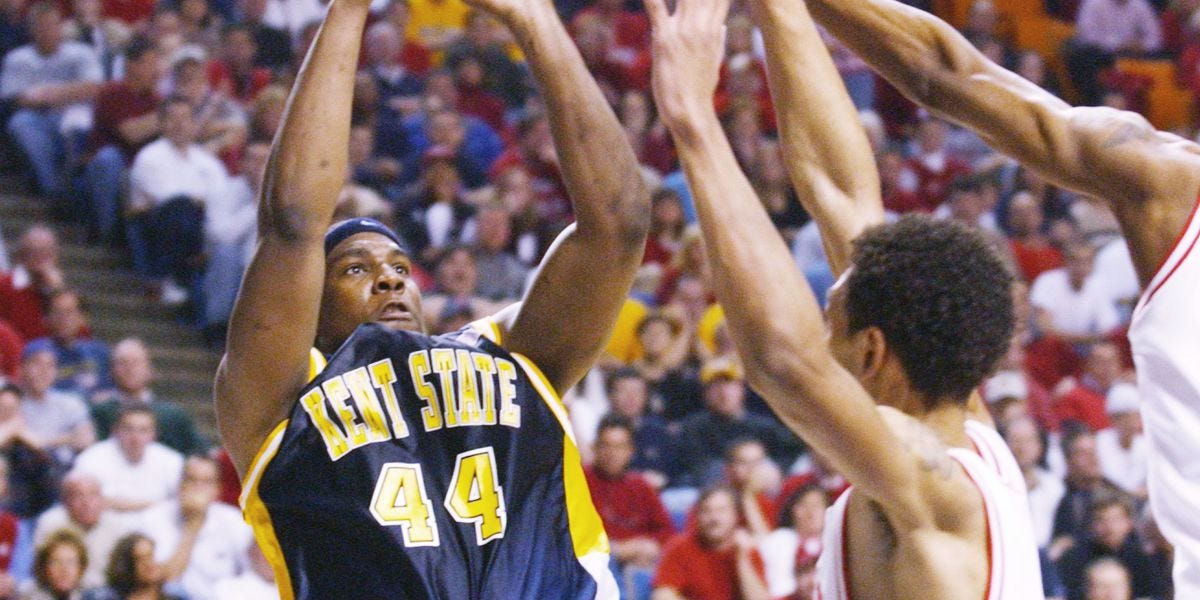
Most anyone with even a cursory knowledge of 21st century pro football knows Antonio Gates played college basketball. It’s a fun tidbit that came up repeatedly throughout Gates’ 16-year NFL career, culminating with his induction into the Pro Football Hall of Fame.
But just how good Antonio Gates was on the hardwood, starting at power forward for Kent State, deserves further examination coinciding with Gates’ entry into Canton.
If you rank the five greatest tight ends in NFL history, Gates probably comes to mind along with Ozzie Newsome, Rob Gronkowski, his Chargers predecessor Kellen Winslow Sr., and Tony Gonzalez. Assuming you’re someone who includes Gates and Gonzalez both in that group, you probably find it interesting two of the five played high-level college basketball. I certainly do.
Having grown up on Pac-10 basketball, I remember that Gonzalez was a problem for the Cal Golden Bears. Though not a starter, Gonzalez played a key part in Cal teams that reached the NCAA Tournament in both 1996 and 1997. His physicality in the paint was unmatched, making for a devastating thunder-and-lightning frontcourt combination when he was paired with the silky-smooth Shareef Abdur-Rahim in the ‘95-’96 campaign.
Gonzalez’s signature touchdown celebration, dunking the football over the goal-post crossbar, was a fitting homage to his basketball career.
Any time I saw Gonzalez throw it down, it took me back to late Thursday nights staying up for marquee Pac-10 matchups — and, when emanating from Haas Pavilion, watching games broadcast from the worst camera angle in college basketball.
As good as Gonzalez was for Cal, Antonio Gates is the greatest hooper to play tight end in the NFL. He’s best known as the star of Kent State’s deep NCAA Tournament run in 2002, when the 10th-seeded Golden Flashes reached the final of the South Regional.
Kent State advancing to the Elite Eight was a surprise, sure, but certainly not in the way that Saint Peter’s advancing to the Regional final two decades later was. And while the Golden Flashes were comparably seeded to the George Mason Final Four team of 2006, had Antonio Gates and Co. beat Indiana to advance to Atlanta, I don’t know if that would have been nearly as stunning as Jim Larranaga’s Patriots.
Before its MACtion branding and Jolly Roger flown after upsets in football had taken off, the Mid-American Conference established its as a threat on the hardwood. I’ll spare you going back as far as the days of Nate Thurmond at Bowling Green, instead focusing on the decade preceding the 2002 Big Dance.
Shortly after expansion of the field to 64 teams, the MAC enjoyed plenty of March success: Rick Majerus-coached Ball State capped a season with AP Top 25 billing advancing to the 2nd Round, while successor Dick Hunsaker over a Sweet 16 RedHawks bunch.
Miami U. teams advanced past the 1st Round in both 1995 and 1999, and in ‘99, advanced to the Sweet 16 behind one of the greatest opening-weekend performances of my lifetime. More on that in a moment.
Eastern Michigan advanced to the Sweet 16 in 1991, and in 1996, spoiled Mike Krzyzewski’s return to March Madness after a hiatus behind the electric play of 5-foot-5 Earl Boykins.
Eastern Michigan is actually where Antonio Gates’ MAC basketball story starts — by way of Michigan State, anyway. In an alternate reality, the Detroit high school product Gates is another local standout on Tom Izzo’s “Flintstones,” the national championship-winning team that featured Flint, Michigan, sensations Charlie Bell, Mateen Cleaves and Morris Peterson.
Said alternate reality has Gates joining the basketball Spartans after playing for Nick Saban’s gridiron Spartans in the fall. But in this version of the Multiverse, Gates isn’t the legendary tight end he became; this 2016 column from Tom Krasovic at the San Diego Union-Tribune explains.
Beyond altering the trajectory of Antonio Gates’ football career, his aspirations of two-sport stardom at Michigan State fizzling led him to transfer to Eastern Michigan. It’s worth noting that Eastern Michigan football was dreadful in this period, doomed to a run of consistent losing — and losing big — that only ended with Chris Creighton’s hire as head coach in the mid-2010s.
I’m only assuming, but I have to imagine then-Eagles coach Rick Rasnick would have welcomed Antonio Gates with open arms, and let him play basketball, and let him play his desired position. But it’s a situation that feels a bit comparable to if Allen Iverson had gone the two-sport route at Georgetown a few years prior.
Gates only played 18 games in his lone season at EMU, 1999-2000, but put up more than 10 points and seven rebounds per game. The foundation for his breakout at Kent State was apparent.
And indeed, after sitting out a transfer redshirt season — remember those?! — Antonio Gates reemerged as an immediate difference-maker on a Kent State team coming off of a 77-73 upset of Indiana the season prior.
Yes, the Golden Flashes were good in 2000-01, but elevated to excellent with Gates in the frontcourt and Trevor Huffman on the perimeter.
The tandem shined in 2001-02, as Kent State ran away with the MAC regular-season championship before cementing a return to the Big Dance in the conference tournament.
While Gates was only 2nd Team All-MAC, his NCAA Tournament performance put him at the forefront of Kent State’s season from a national perspective. And what a Tournament it was. Spoilers, but I have been working for some time on a Best Players of the NCAA Tournament bracket-style project and the selection committee is strongly considering Antonio Gates for an at-large selection. Stay tuned.
Although Indiana scored a measure of revenge in the Elite Eight, Gates was excellent in what would be his final NCAA Tournament contest: 22 points, eight rebounds, a pair of steals and a couple of assists. That also essentially set the standard for his per-game production throughout the 2002-03 season.
While it was Gates’ part in Kent State’s Elite Eight that is most commonly cited when his basketball career comes up, he was a monster in his senior season.
Mid-American basketball produced some of the best forwards in the game through the latter half of the ‘90s, with scoring machine Bonzi Wells at Ball State, Devin Davis as the forerunner to Wally Szczerbiak ascending to superstardom at Miami U., and Ohio’s “Shaq of the MAC” Gary Trent.
Szczerbiak delivered the aforementioned otherworldly opening weekend in 1999, the closest thing to one man willing his team to the Sweet 16 I’d seen before Steph Curry’s 2008 March at Davidson. I wouldn’t say Antonio Gates’ 2002 NCAA Tournament was better than Szczerbiak’s, but it is among the most impressive individual showings from a mid-major standout in the last 30 years.
And, while Kent State did not return to March Madness in 2003, Gates did solidify himself in the same pantheon of those great turn-of-the-millennium MAC forwards. His game was most comparable to Trent, with Gates flourishing as an undersized post presence more than capable of making up for what he lacked in height with unmatched physicality.