

It’s hard to believe, but we’re already one week past the NHL trade deadline. In at least one market, however, the conversation hasn’t stopped — and it’s all focused on a trade that didn’t happen.
Toronto Maple Leafs talented power forward Matthew Knies’ name has been out there in trade talks, and that fact has given the rumor mill plenty of fodder over the past seven days. Sources from other teams confirmed that Knies’ name was circulating in the lead-up to the deadline, as first mentioned by Elliotte Friedman.
Chris Johnston doesn’t believe anything was particularly close on Knies, but it’s fascinating that a Leafs team that currently sits in the Eastern Conference basement would even contemplate moving a 6-foot-3, 232-pound 23-year-old left winger who had 29 goals last season.
The big question is why?
Even including a four-point game Thursday, Knies has been having a down year, with only 17 goals through 63 games and a lot more pucks entering his own net when he’s on the ice. But he’s a young player who has played through a knee injury, on a team where almost everyone is struggling, and his skill set is such that few doubt his long-term potential.
There are two main reasons the Leafs floated his name out there last week, and neither has to do with how much they value Knies.
One: This is an organization that lacks many assets to trade — as evidenced by our latest prospect pool rankings — and other teams weren’t exactly enamored with their other offerings. That was why Nicolas Roy ended up being dealt to the Avalanche for a first-round pick, why Bobby McMann and Scott Laughton brought in mediocre returns, and why Oliver Ekman-Larsson and Brandon Carlo (among others) didn’t go anywhere on deadline week.
Other than for Roy, no one was willing to give up first-rounders or other prized returns for what GM Brad Treliving had on offer. So in order to do something big, which they clearly need right now, introducing higher-value assets into trade talks was necessary to get into more conversations and see what’s out there.
Two: The things the Leafs need to add if they’re going to pull off a retool in the offseason are in high demand around the league and incredibly hard to get.
If you’ve listened to our recent podcast, I’m on the record already that I think turning this around in short order is going to be very difficult. Maybe even impossible. Free agency is incredibly low on talent — and it took another hit with Nick Schmaltz re-signing in Utah earlier this week — especially at the positions the Leafs need to improve at.
The No. 1 priority for whoever is running the Leafs this summer is going to have to be fixing the team’s blue line, which has conceded scoring chances at an alarming rate this season. Changing coaches should help in that regard, but it’s unmistakable, too, how old, slow and ineffective at moving the puck Toronto’s top six has been, even going back to last year.
The Leafs entire D core, save for pending UFA Troy Stecher, is locked in for next season, with Ekman-Larsson signed another two seasons and greybeards Morgan Rielly, Chris Tanev and Jake McCabe all under contract until 2030. Tanev’s future is hard to discern, given he was limited to just 11 games this season due to multiple injuries, but even if he is healthy, Toronto needs to turn over some of this aging cast and inject more finesse and speed into its top four.
The other biggest need for improvement is going to be up front. John Tavares turns 36 in September, and he’s produced at just a 22-goal, 51-point pace over the past 40 games. He shouldn’t be a mainstay on PP1 or as the team’s second-line center, at least if this organization has dreams of contending. Add in the fact that the Leafs dealt away all three of Roy, Laughton and Fraser Minten over the last 12 months, and they’re clearly going to need reinforcements down the middle.
As with the blue line, impact additions at center are incredibly hard to come by in free agency this year. So how do they get better at those two positions in the next six months? Can they?
Below is the Leafs’ projected lineup for 2026-27, without any free agents (including RFAs Matias Maccelli and Nicholas Robertson) given new contracts.
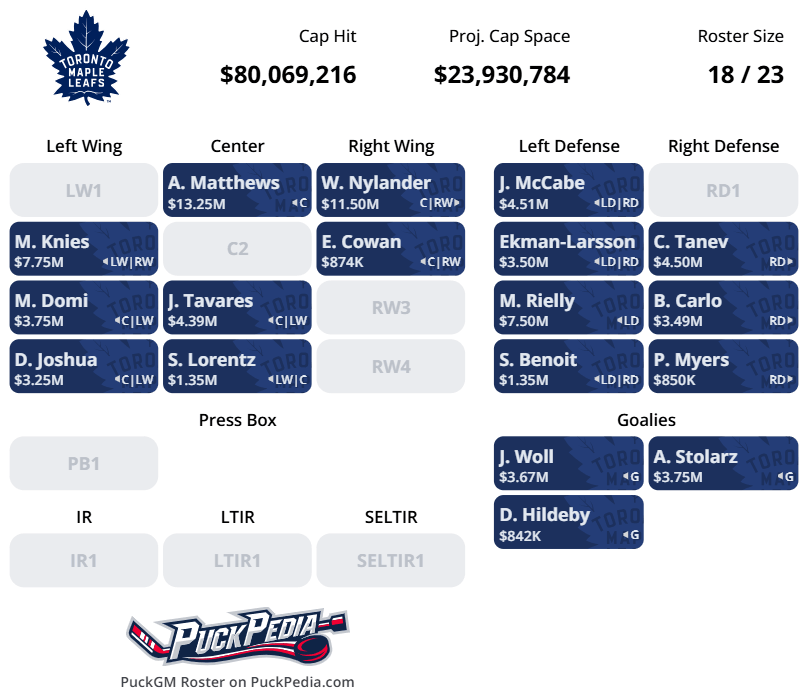
Auston Matthews and William Nylander have no-movement clauses, so those weren’t going to be conversations worth having at the deadline. If you’re retooling instead of rebuilding, which appears to be the direction ownership is going to favor, it feels unlikely you try to move either of them in the offseason, either.
The only other players on the roster who might get you into the trade conversation for a top-two center or first-pair D? It’s Knies and Easton Cowan.
As you can see above, the Leafs are projected to have acres of cap space in the offseason ($24 million). But we’re entering a world in the NHL now where cap room is abundant and the new scarcity is being able to freely add high-end talent. Depth players are about to become way overpriced, as they’re the only ones making it to UFA, and pre-existing contracts signed under the flat-cap environment are suddenly the value plays.
So if there’s an elite center (i.e., Robert Thomas) or an excellent defenseman (?) available in the coming months, the Leafs are going to have to try and be players in those trade talks. Without picks, without prospects, without many stars, they can move wherever they want; there simply aren’t a lot of options to get them there.
If the Leafs are hellbent on a retool versus a rebuild, they’re going to have to start winning more trades and finding some undervalued stars from around the league. Knies offers them one of the only opportunities to do so, but it would be a deal that obviously comes with significant potential downside given the blend of size, strength and skill he brings and the player he could still become.
That risk, however, would be worth it if they could upgrade with a true difference maker at their two biggest positions of need.
It may well be the only way they can do so.