
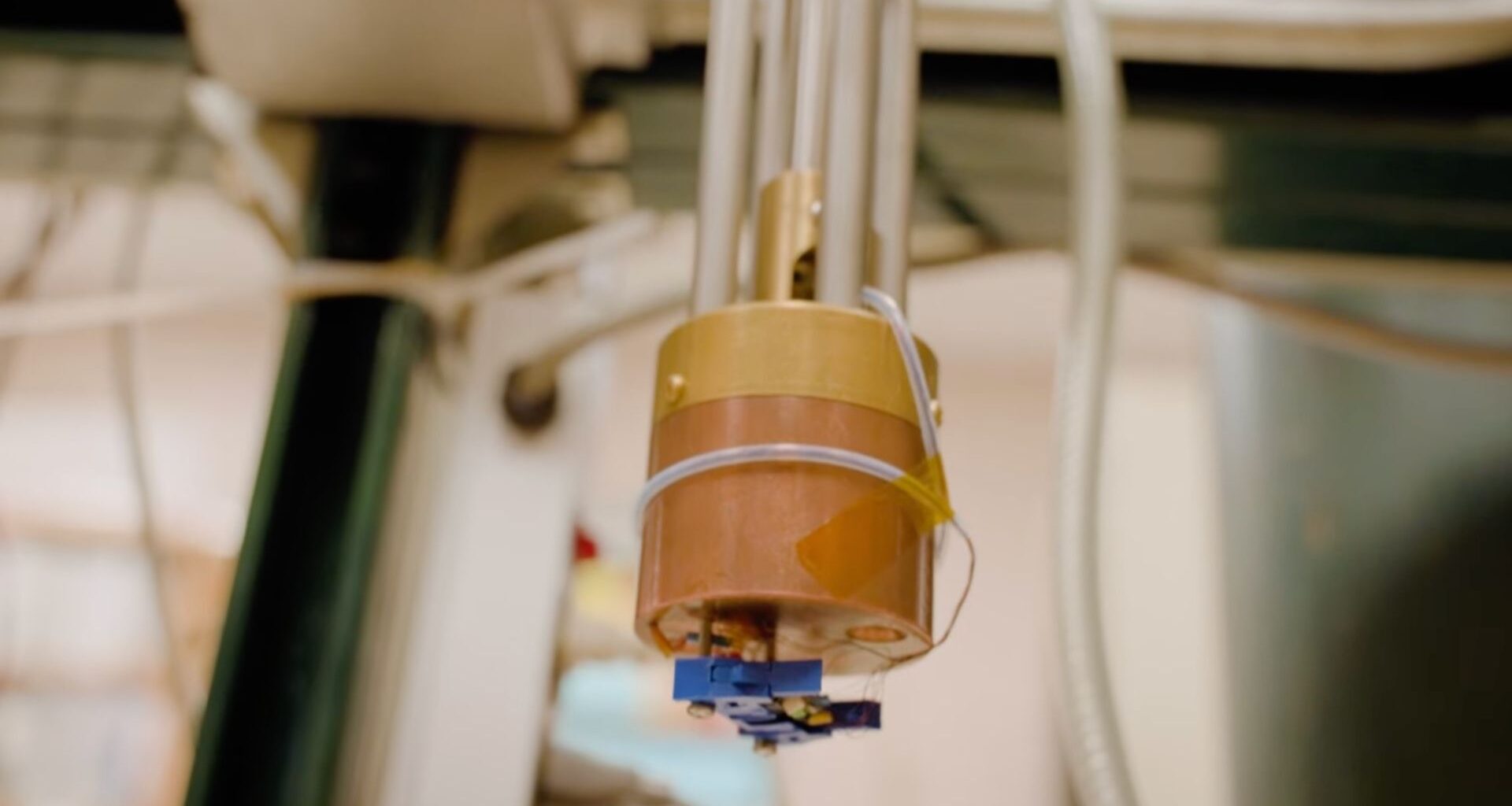
Researchers from the Texas Center for Superconductivity (TcSUH) and the University of Houston (UH) have achieved a breakthrough that could lead to newer ways of generating, transmitting, and storing energy.
The UH team has recorded a transition temperature of −251°F (151 Kelvin) under ambient pressure. It is the highest transition temperature ever recorded since the phenomenon was first reported in 1911. It beat the previous record of -356∘F (133 K), set by a material called Hg1223, discovered in 1993.
The transition temperature is the temperature below which a material can conduct electricity without resistance. Raising this temperature has been of paramount importance to researchers.
Pushing this threshold closer to room temperature makes it more practical and affordable to develop practical, affordable superconducting technologies.
The project has been funded by Intellectual Ventures, a global invention and investment company, the state of Texas, and other foundations.
The issue with superconductors
Electricity can pass through superconductors without resistance, making it vital for improving electrical grids, building advanced medical imaging systems, enabling fusion energy technologies, and developing faster electronics.
However, superconductors need to hit extremely low temperatures, and the process of achieving that threshold is expensive and difficult to use.
“Once we bring the material to ambient pressure, it becomes much more accessible for scientists to use well-developed instrumentation to investigate it and further develop technologies for ambient condition operations,” said Liangzi Deng, assistant professor of physics at the TcSUH.
The technique that made it possible
The scientists used a technique called pressure quenching to achieve this feat. A new approach to superconductors has been widely used in other areas, such as diamond synthesis.
The process involves applying intense pressure to enhance its superconducting properties and raising its transition temperature.
The material is first cooled under pressure and then rapidly decompressed, a process that “locks in” its enhanced superconducting properties. This allows the higher transition temperature (Tc) to persist even after the pressure is removed, keeping the material stable under normal conditions.
“Other researchers have shown that reaching superconductivity at room temperature under pressure is achievable. Our method shows that it is possible to retain that state without maintaining pressure,” Professor Paul Ching-Wu Chu said, highlighting the difference in approach.
The dream milestone to achieve
Researchers are targeting a transition temperature threshold of 80.33∘F (300 K). he current discovery represents an important step in that direction.
“This finding has great potential. We believe, with enough people working on it and given enough time, we should be able to realize the potential,” Chu said.
“Room-temperature superconductivity has been seen as a ‘holy grail’ by scientists for over a century,” said Rohit Prasankumar, director of superconductivity research at Intellectual Ventures.
“The UH team’s result shows that this goal is closer than ever before. Closing this gap will require concerted, intentional efforts by the broader scientific community, including materials scientists, chemists, and engineers, as well as physicists,” he continued.
The findings were published in a paper titled “The path to room-temperature superconductivity: A programmatic approach” in PNAS.