
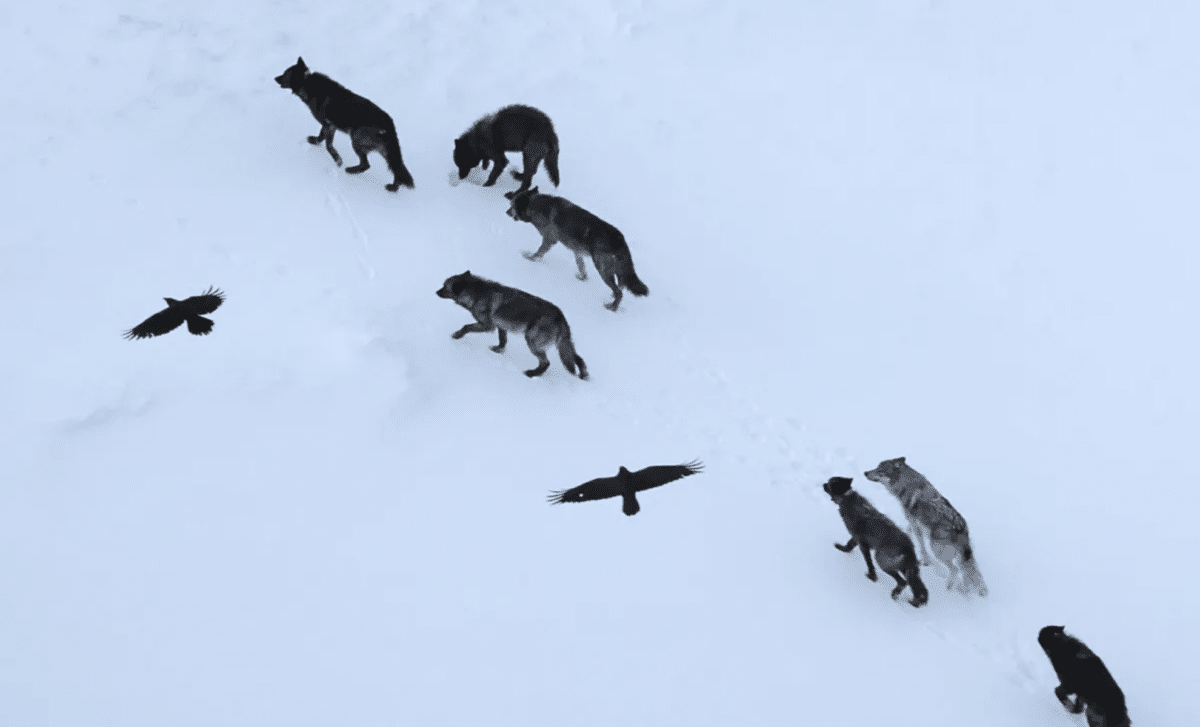
In the vast wilderness of Yellowstone National Park, ravens have long been observed circling over the landscape, seemingly drawn to the aftermath of wolf kills. But for years, the exact nature of this relationship remained a mystery. How did these birds, known for their intelligence and adaptability, find their way to the carcasses left behind by wolves? Were they simply following the pack or was there something more to their behavior? Recently, a team of scientists set out to answer this question by tracking 69 ravens as they moved across the park, uncovering unexpected patterns that have changed our understanding of how these birds interact with their environment. What they discovered challenges what we thought we knew about ravens and their role in the Yellowstone ecosystem.
Unraveling the Mystery of Ravens and Wolves
For years, it was assumed that ravens followed wolves to be the first to benefit from their kills. But this theory was based on speculation, as no one had actually tracked the birds’ movements in relation to wolves with precision. To change that, a team of international researchers, including lead investigator Matthias Loretto, attached GPS trackers to 69 individual ravens. They compared these movements with wolves that were also equipped with tracking devices, hoping to uncover the truth behind the ravens’ scavenging habits.
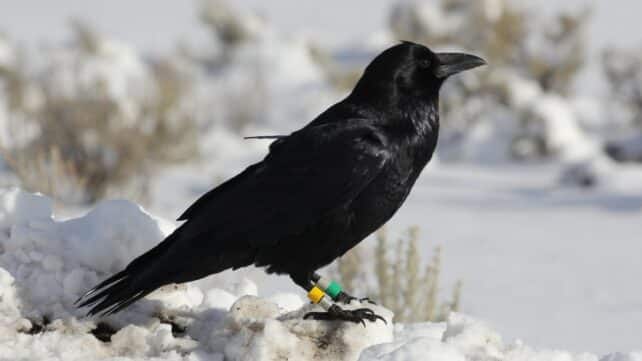 The team fitted ravens with GPS backpacks, seen here with an antenna protruding. (© Matthias Loretto)
The results were surprising. Rather than simply trailing wolves, ravens appeared to be selecting specific areas to visit, regions where wolves were known to kill. These areas weren’t random; they followed a predictable pattern. It was almost as if the ravens had learned over time that some parts of the park were more likely to yield wolf kills than others. As Loretto explains,
“A single kill is unpredictable but over time, some parts of the landscape are more productive than others – and ravens appear to use that pattern to their advantage.”
This insight reveals an intricate relationship between the ravens and their environment, demonstrating not only their intelligence but their ability to adapt and use spatial memory for food acquisition. The ravens’ approach was not reactive but strategic, highlighting their problem-solving skills and their capacity to find food in even the most challenging conditions.
Social Factors and the Search for Quality Food
Despite the discoveries, the exact reasons why ravens choose one location over another remain somewhat elusive. The study raised questions about the social dynamics of raven groups and the role these factors might play in their decision-making process. Loretto suggests that the birds’ behavior might be influenced by social factors, such as interactions within local groups.
“We do not understand what makes them stay or leave – perhaps social factors such as integration into a local group,” he says.
In some cases, the ravens’ food search seemed to coincide with the need for higher-quality meals. This was evidenced when one raven flew over 150 kilometers from a landfill to an area frequented by wolves. The study does not yet explain why the raven made such a dramatic change in its feeding behavior, but it indicates that food quality, rather than sheer availability, might have played a role.
This insight is key to understanding the broader ecological relationships in Yellowstone, where ravens, wolves, and other species coexist in a delicate balance. Understanding the ravens’ tactics could also inform the management of wolf populations and their prey in the park, influencing how researchers and conservationists view the park’s ecosystem.
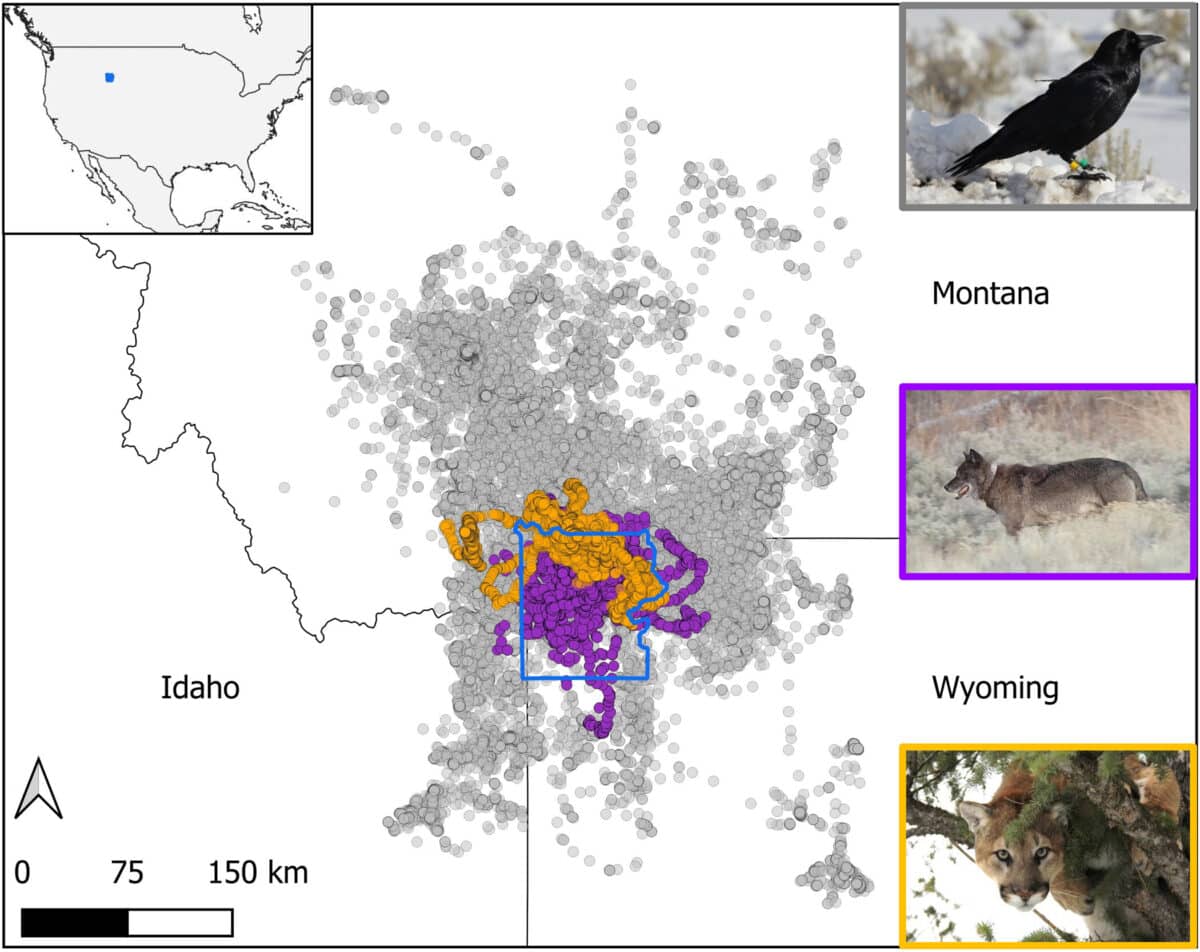 Movements of GPS-tracked ravens, wolves, and cougars in MT, WY, and ID, USA.
From October 2019 through March 2022, all locations of ravens (gray), wolves (purple), and cougars (orange) are shown, except for the GPS positions of two ravens after dispersing more than 350 km from all carnivores. The blue polygons in the large map and inset represent the boundaries of Yellowstone National Park and the black lines refer to state borders.
Photo credit: M.-C.L.
Ravens’ Intelligence and Adaptability
What this study ultimately highlights is the incredible intelligence and adaptability of ravens. The birds are often regarded as one of the most intelligent species, capable of advanced problem-solving, tool use, and complex social interactions. This new research provides further evidence of their cognitive abilities, suggesting that ravens are not merely opportunistic scavengers but are actively using their intelligence to navigate a challenging environment.
These findings, published in Science, have profound implications not only for our understanding of ravens but for the study of animal cognition more generally. Ravens’ ability to remember and revisit productive locations, to make decisions based on unpredictable events like wolf kills, and to adapt their behavior based on social dynamics shows the sophisticated mental processes these birds engage in daily. Their success in such a competitive ecosystem speaks to a level of environmental awareness that was once thought to be exclusive to more highly studied mammals.