
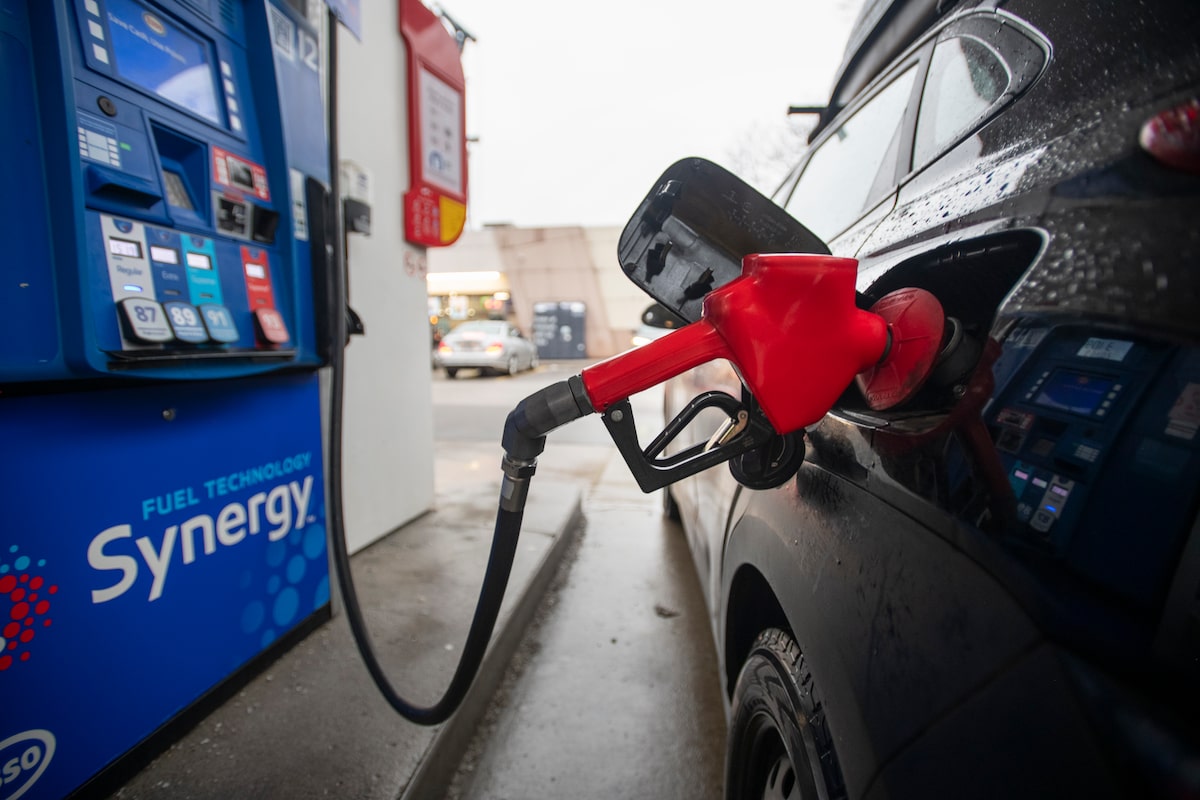
Inflation-sensitive consumers and businesses in North America have faced sticker shock at the pumps.Fred Lum/The Globe and Mail
In November, 1973, just weeks into the Arab oil embargo that had already sent fuel prices skyrocketing and triggered global panic, a Greek tanker named the MS Kimon moored in Vancouver to fill its vast hull with Canadian crude destined for a desperate, energy-starved populace: Canadians on the other side of the country.
With no direct link from Alberta’s rich oil fields to Eastern Canada, the crude had been pumped through the Trans Mountain Pipeline to the West Coast. Once loaded, the Kimon embarked on a 14,000-km journey through the Panama Canal to ultimately deliver its bounty back to the same country it left from.
Half a century later, as the world faces yet another oil crisis, a lot has changed for Canada, even if we still lack an east-west pipeline linking the country. We’re an energy powerhouse now. As the world’s fourth-largest oil producer and exporter, we send most of our crude south to the United States – itself now the world’s largest oil producer – to be refined and brought back home to power our economy.
Oil tankers and cargo ships line up in the Strait of Hormuz as seen from Khor Fakkan, UAE, on Wednesday.Altaf Qadri/The Associated Press
As panic spreads about rising prices, and energy security is once again top of mind, the telltale signs of crisis behaviour are here, including rationing and hoarding that, so far, is mostly confined to other parts of the world. And as the situation drags on, the more likely it is that triple-digit oil prices will deliver a blow to Canadian consumers and force more drastic measures.
The roughly two-week-old war launched by the U.S. and Israel against Iran, and that country’s response to bomb its neighbours and vessels in the critical Strait of Hormuz, has triggered the “largest supply disruption in history,” the International Energy Agency, or IEA, said this week. The waterway carries roughly one-fifth of global oil supplies on a daily basis, most of it to Asia.
But even here in North America, inflation-sensitive consumers and businesses have faced sticker shock at the pumps and when buying airline tickets. And the fallout could extend more widely depending on how long the crisis lasts.
“In Western economies, there’s an entitlement to the reliability of energy we just take for granted, but behind the scenes there’s a fragility and oil holds a particular place in that fragility,” said Peter Tertzakian, a veteran Calgary-based energy analyst and historian who detailed the tale of the Kimon’s journey in a 2020 anthology of energy stories.
Calgary-based energy analyst and historian Peter Tertzakian.Chris Bolin/The Globe and Mail
“It’s not just something you burn for transportation. It flows through the veins of the global economy, in plastics, chemicals, pharmaceuticals, makeup and as a vital part of supply chains across the manufacturing world.”
The past week has delivered a string of shocking reminders of that reality to energy markets, consumers, businesses and governments. As the war widened and it became clear the Iranian regime had not been toppled, global oil prices spiked to around US$120, the highest level since 2022.
Throughout the week, U.S. President Donald Trump attempted to close the door on the crisis as oil prices see-sawed wildly. On Monday, he declared the war “very complete.” By Wednesday, he said “most people say it’s already been won,” even as images circulated of oil tankers engulfed in flames in the Strait of Hormuz.
An oil tanker burns after being hit by an Iranian strike in the ship-to-ship transfer zone at Khor al-Zubair port near Basra, Iraq, late Wednesday.The Associated Press
Policy makers sought to ease the strain. On Wednesday, the IEA authorized its 32 member countries to release 400 million barrels of oil from their reserves. But prices have only inched higher since then.
With the White House failing to contain oil prices, the Trump administration on Thursday eased sanctions on Russian oil shipments to boost global supplies, just days after several U.S. media outlets reported Russia had provided intelligence to Iran on the locations of U.S. military targets. On Friday, Mr. Trump even acknowledged Russian President Vladimir Putin “might be helping [Iran] a little bit.”
Given the scale of that disruption, with the Strait’s 20 million barrels a day of crude all but halted, there’s a “nightmare scenario” where oil pushes higher to US$200 a barrel, said Rory Johnston, an oil-market analyst and founder of Toronto-based Commodity Context.
Unless that supply gets flowing again, the world will need “widespread demand destruction” on the scale of what occurred during the peak COVID-19 lockdowns in April and May of 2020 in order to prevent inventories from being drained, he said.
In advanced economies, such as wealthy countries in Asia, Europe and North America, that would be achieved through “excruciatingly” high prices that sap disposable income and cause recessionary concerns, he said. For the Global South and poorer countries, many consumers would not be able to afford the much higher fuel prices that would be caused by outright shortages.
It can be hard to reconcile a scenario like that with oil markets that, despite the chaos, have so far been restrained compared with what many would have expected from the closing of the world’s busiest oil artery.
“I’m not saying the move hasn’t been dramatic, but keep in mind this is a more global threat to oil supplies than what we saw during the Russia-Ukraine war, when we saw prices go up a lot faster,” said Phil Flynn, a market strategist and analyst at the Price Futures Group in Chicago. Many are looking beyond the short-term price gyrations and uncertainty to the question of how long the war lasts.
Global oil disruption grows as Iran, U.S. defiant on end of war
Opinion: Iran oil shock may get Trump a Democrat Congress in 2027
One reason for the relative calm, if you can call it that, is that there are still a lot of barrels already on the water heading to refineries in Asia, while refiners also had high inventories going into the war, said Sarah Emerson, president of Energy Security Analysis, Inc. in Boston. As such, most refiners have yet to face outright shortfalls in crude.
“Right now, it’s the anticipation of crisis. In the next couple of weeks it’s going to become a crisis,” she said, adding that investors always knew there was a risk the Strait of Hormuz could one day be blocked. What makes this moment so much more precarious is the added “risk of bad leadership,” she said, pointing to the Trump administration. “We have the risk of a leader not quite understanding the region. And to me that’s a very scary risk.”
Two weeks into the war, fault lines are showing in predictable ways. As in past energy crises, there are emerging signs of rationing, panic buying and hoarding – behaviours that stem from the powerful grip energy supplies have on human psychology.
Motorists queue to fill their tanks at a gas station in Hanoi, Vietnam, amid fears of shortages and price hikes caused by the US-Israeli war with Iran.NHAC NGUYEN/AFP/Getty Images
Trucks are parked in front of a petrol station of an Inland Container Depot terminal in Uiwang, South Korea, on Friday.JUNG YEON-JE/AFP/Getty Images
Not surprisingly, the hardest hit countries are in Asia, where roughly 85 per cent of the oil that passes through the Strait of Hormuz ends up. Nepal has begun rationing cooking gas. Myanmar has enforced alternating driving days based on licence plate numbers. Likewise, Bangladesh has put fuel purchase caps on drivers.
Meanwhile, in another worrying sign, China on Wednesday ordered its state-owned energy companies to suspend fuel exports in order to conserve supplies. Hoarding can quickly escalate an energy crisis if other countries in turn try to stockpile resources.
As a long-time net exporter of oil, Canada is in a different position than most countries. The jump in prices cuts two ways for Canada’s economy. While consumers get squeezed, leaving them with less money to spend on other things, more expensive oil boosts oil company profits, generates royalty and tax revenue for governments and provides a lift to Canada’s exports.
What would $100 oil mean for Canada?
“How positive it is is a function of how long the price increase goes up,” said Lawrence Schembri, a former deputy governor at the Bank of Canada and a senior fellow at the Fraser Institute. “My instinct would be, you would have to really go for at least three months to have knock-on effects on the rest of the economy.”
It would also take more than a two-week jump in prices before producers responded by investing in more production, said Bryan Gould, executive chairman of Aspenleaf Energy Ltd., a private Calgary-based producer of roughly 25,000 barrels a day of mostly light crude.
The company has no plans to change its capital spending plans, especially with futures markets pricing oil for delivery in October at close to US$20-a-barrel cheaper than the current price, while for delivery one year from now the futures price is less than US$5 higher than before the U.S.-Israeli attacks began. “You don’t get despondent with the trough, and you don’t get euphoric with the crest, because this too shall pass,” he said.
None of this means Canada is immune. Central and Eastern Canada remain overwhelmingly dependent on oil imports to run their economies, with most of that fuel flowing up from the U.S.
A gas station in downtown Toronto on March 3. Central and Eastern Canada are dependent on oil imports to run their economies, with much of the fuel coming from the U.S.Fred Lum/The Globe and Mail
That puts those regions at risk should Mr. Trump toy with export restrictions of his own. The idea seems far fetched, but the President’s extreme populist tendencies mean nothing can be ruled out.
Which means depending on how long this crisis drags on, Canada could be forced to once again contemplate elaborate schemes to get fuel to its largest provinces, said Mr. Tertzakian, the energy analyst, who added that as recently as during the early pandemic, Cenovus Energy Inc. ran a tanker from B.C. through the Panama Canal to New Brunswick’s Irving Oil refinery to serve the eastern market.
“How absurd is it we’re the fourth-largest producer of oil and gas in the world but we’re not self-secure,” he said. “Anyone from the outside looking in would say, ‘What’s wrong with you people?’”