
The California Department of Fish and Wildlife said Friday that commercial and recreational Dungeness crab fishers can no longer use conventional traps in parts of the California coast.The video above explains ropless fishing gear. CDFW said the ban takes effect March 27 in waters south of Pigeon Point past Morro Bay in state fishing zones 4 and 5, including Monterey Bay.CDFW said commercial Dungeness crab fishing may continue for the rest of the season through June 30 using newly approved “pop-up” gear beginning in April. Recreational crab fishers may continue using hoop gear, which does not use vertical lines in the water column, in the closure areas after March 27. Oceana said the newly authorized “on-demand” gear is intended to reduce whale entanglements by keeping lines and buoys on the seafloor with a string of crab traps until a fishing vessel returns to retrieve them. Oceana said whale entanglements have risen in recent years, raising concerns about the recovery of threatened and endangered populations.“For the first time in years, crabbers will be able to keep fishing into the spring and early summer while at the same time whales can safely swim and feed off California’s shores without risk of becoming entangled in crab gear,” said Geoff Shester, Oceana’s senior scientist and fishery innovation director and a member of the California Dungeness Crab Working Group.CDFW said four humpback whales were confirmed entangled in California commercial Dungeness crab gear in 2025. CDFW said another 10 humpbacks were entangled in unidentified fishing gear that may have been California Dungeness crab gear.NOAA Fisheries said three humpback whales and an orca have been entangled in fishing gear off California so far in 2026. NOAA Fisheries said two of the humpbacks may have been entangled in California Dungeness crab gear.Areas north of Pigeon Point remain open to conventional gear, and CDFW will continue monitoring entanglement risk and conducting additional whale surveys. The next risk assessment is scheduled for April 1 to determine whether more areas will be closed to conventional traps.
MONTEREY, Calif. —
The California Department of Fish and Wildlife said Friday that commercial and recreational Dungeness crab fishers can no longer use conventional traps in parts of the California coast.
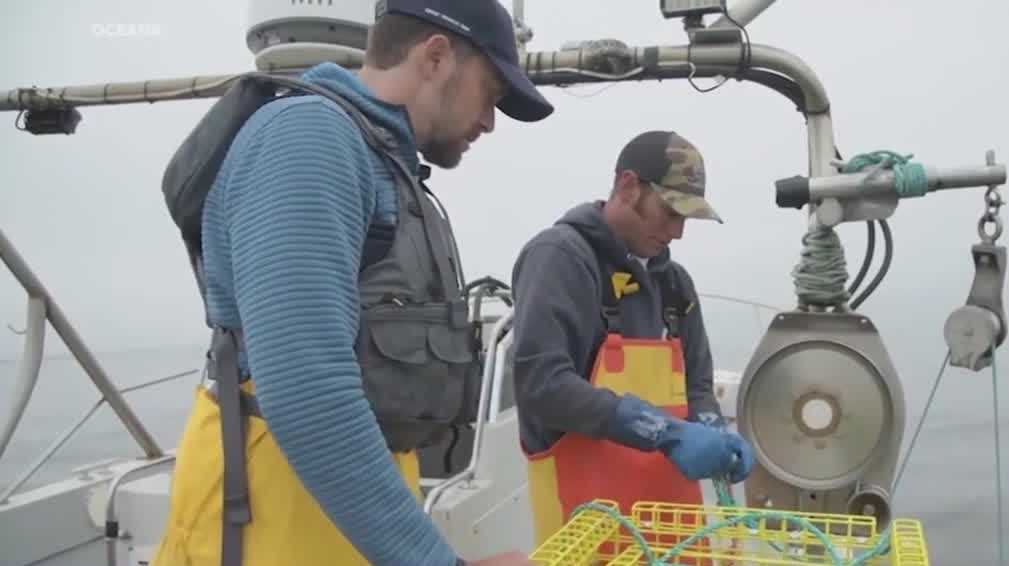
The video above explains ropless fishing gear.
CDFW said the ban takes effect March 27 in waters south of Pigeon Point past Morro Bay in state fishing zones 4 and 5, including Monterey Bay.
CDFW said commercial Dungeness crab fishing may continue for the rest of the season through June 30 using newly approved “pop-up” gear beginning in April.
Recreational crab fishers may continue using hoop gear, which does not use vertical lines in the water column, in the closure areas after March 27.
Oceana said the newly authorized “on-demand” gear is intended to reduce whale entanglements by keeping lines and buoys on the seafloor with a string of crab traps until a fishing vessel returns to retrieve them.
Oceana said whale entanglements have risen in recent years, raising concerns about the recovery of threatened and endangered populations.
“For the first time in years, crabbers will be able to keep fishing into the spring and early summer while at the same time whales can safely swim and feed off California’s shores without risk of becoming entangled in crab gear,” said Geoff Shester, Oceana’s senior scientist and fishery innovation director and a member of the California Dungeness Crab Working Group.
CDFW said four humpback whales were confirmed entangled in California commercial Dungeness crab gear in 2025. CDFW said another 10 humpbacks were entangled in unidentified fishing gear that may have been California Dungeness crab gear.
NOAA Fisheries said three humpback whales and an orca have been entangled in fishing gear off California so far in 2026. NOAA Fisheries said two of the humpbacks may have been entangled in California Dungeness crab gear.
Areas north of Pigeon Point remain open to conventional gear, and CDFW will continue monitoring entanglement risk and conducting additional whale surveys.
The next risk assessment is scheduled for April 1 to determine whether more areas will be closed to conventional traps.