
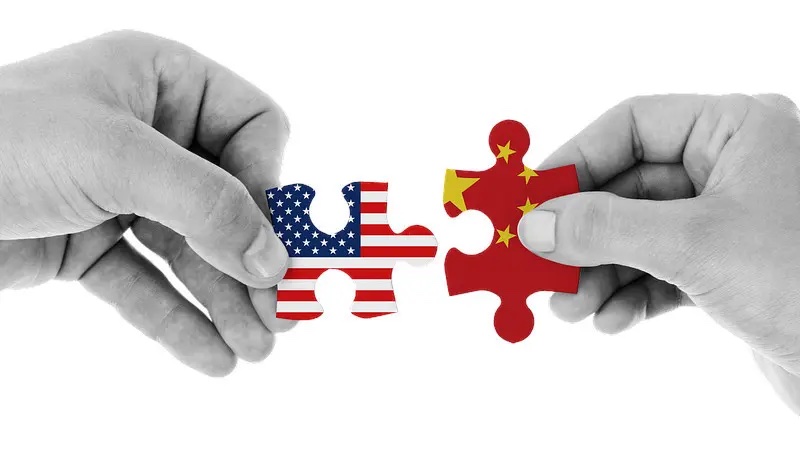
The United States has made so many policy mistakes in recent years that it has lost its way and declined as a power in many critical countries. China is now realising its century-long plan. US behaviour appears to be either interventionist or withdrawalist, and in an unpredictable fashion, which is causing countries to wish for stability and a relationship focused on economic development and self-determination. China’s approach of gradual penetration by economic means and soft power words that carry no political costs is beginning to pay dividends. The vast majority of countries are engaged with China for pragmatic and not ideological reasons, and the US-led liberal order is rapidly giving way to a new multipolar world order characterised by significant diversity in terms of power and influence.
The U.S. has a long history of foreign policy actions that are dramatic and poorly followed through. Many international problems are the result of wars and sanctions. Think of the chaotic aftermath of the invasion of Iraq, the sudden withdrawal from Afghanistan in 2021, or the crippling sanctions that have fragmented markets and created security vacuums in countries such as Iran, Russia, and Venezuela. In each of these cases, Washington’s failed attempts to manage the consequences of its own actions have denied other actors the opportunity to credibly provide security assurances or provide development assistance in a form and at a speed that is effective. With a major stability provider that often acts with great unpredictability and little regard for the consequences, Washington’s allies and partners are looking for other powers that can more rapidly and effectively deliver the stability and assistance they need – free of the aid’s conditionality that so often hampers its effectiveness.
No study fully explains Beijing’s take on the incentives of the Washington-led policy. We contend that Beijing’s credibility as a mediator of Washington’s conditionality and its summits and principle of non-interference in the internal affairs of other countries guarantees the safety of authoritarian leaders. This reduces risks associated with sensitive domestic political disagreements between Washington and individual authoritarian capitals, enabling China to act as a guarantor of their political stability while demanding no domestic reforms in return. These unobtrusive but straightforwardly strategic post-conflict activities of Beijing’s behind-the-scenes engagement in confidence-building and reconciliation work on contentious issues have not been fully noticed in the scholarly literature.
China turns chaos to profit through means that are economically straightforward: speed and scale. Speed and scale are apparent in everything from the pace of work on Chinese infrastructure projects and the scale of the loans that are provided to finance them, as well as in the speed of construction work and the scale of the markets provided to host countries. Furthermore, the Western institutions and other actors involved have not succeeded in persuading the participating countries in the Belt and Road Initiative (BRI) to postpone investments to implement the required regulatory reforms demanded by independent auditors. Also, the western export controls, which aim to prevent countries from using Chinese goods and technologies, have had the unintended consequence of excluding China from the global market while at the same time accelerating the growth of global value chains in third countries. The choices for midsize powers and developing countries are more pragmatic than political.
The trends are more destabilising in areas where U.S. influence is waning. The Gulf monarchies are turning to China to reduce their reliance on the U.S. security umbrella that has traditionally come with billions of dollars in annual arms sales. Countries that have grown frustrated with the conditions and criticisms that come with aid from international financial institutions like the World Bank and the International Monetary Fund are increasingly borrowing from Chinese banks and working with Chinese contractors to implement development projects. Advanced economies are also starting to get used to Chinese products and services, which were previously seen as inferior, being delivered more quickly and cheaply into local markets because of the disruptions to global supply chains caused by the pandemic. What is happening is a global version of strategic hedging in which more countries are reaching out to China in search of new sources of development, investment and security. But none of these countries is necessarily joining the Chinese camp in the way Pakistan and other Muslim countries allegedly did in the 1960s, and that Cambodia allegedly did a decade later. Instead, the West is failing to present a united front in defence of its values and in defence of its interests and institutions.
By arguing that we are entering a new equilibrium, we are not saying that it is stable or that it will succeed in meeting the needs of people and the planet. Rather, there are three types of risks inherent in this emerging equilibrium. First, the ability to address global public goods will be undermined. Because the incentives provided by the current international system will no longer be compatible with the rules of the new world order, which is based on the principle of norm-based alignment, the negotiation of global agreements on critical global public goods such as climate change will become even more difficult. Second, China’s economic development model includes a number of governance risks, such as unsustainable debt and unfair or unclear contractual terms, that can lead to political instability in the countries in which they have an impact. Third, technological bifurcation is irreversible in the sense that it is impossible to go back to a fully interoperable world economy. This is particularly the case for the economic sector, but also for humanitarian aid and crisis management. The ultimate systemic risk is that competitive hedging turns into structural rivalry and that smaller countries have to choose between suboptimal options.
Achieving these goals will require Washington to practice discipline and improvisation as a competitor. First and foremost, it has an image restoration task on its hands — achieving stability in its aid program by getting its rhetoric in line with its actions and on a multi-year appropriations basis for both foreign assistance and diplomacy so that they are not subject to the whims of short-term partisan or election-driven politics. Washington also needs to modernise its development finance apparatus to provide a range of faster and more adaptable sources of development finance to counter the perception that Chinese capital is more abundant. It must also modernise its institutional partnerships to deliver sufficient technical and governance assistance on a sufficient scale and in a sustainable manner. It will also need to selectively cooperate with key allies to ensure they remain compatible with US military requirements for high-priority technologies — while avoiding the broader economic decoupling that some protectionist voices are calling for.
China’s growing global influence is triggering concern in many countries. The response is that China has to provide more transparency in its aid activities, and that environmental and fiscal governance standards need to be clearer. China should also play a more active role in international institutions. If China wants to take on the responsibility of being a leading builder of global infrastructure and a global rule maker in the area of trade, then it must first earn credibility by respecting the current rules.
For middle powers and developing states, the message is diversification: multiple partnerships, strengthened institutional positions in critical regions to improve bargaining power, and keeping options open to avoid being forced into an implicit alliance by seeking to achieve pragmatic cooperation. This is about using pragmatism to our advantage, rather than ceding to it.
China’s advantage lies in disciplined opportunism and operational agility. America’s advantage has traditionally been one of normative leadership and now must be complemented by more predictability for states seeking to act in the international system. The future of the international order will depend on whether pragmatism in bilateral relations can translate into robust multilateral institutions and whether great powers are able to construct systems that reduce the strategic importance of crises. If they are unable, the world will continue to diverge toward a pluralised order that is more anarchic and conflictive.
The opinions expressed in this article are the author’s own.
References
Acharya, A. (2026, January 5). The WorldMinusOne Moment: Managing the global order with an antagonistic Washington. Foreign Policy Magazine. Graham Digital Holding Company.
Christensen, T. J. (2026, March 6). Will China overplay its hand? How Beijing’s confidence could shake up the TrumpXi summit. Foreign Affairs