
When the Seahawks last won a Super Bowl, they lost Golden Tate and Breno Giacomini in free agency. They also cut Chris Clemons, creating a spot in the defensive line rotation. Facing the prospect of having to pay a number of young core players, they had to make calculated decisions. They weren’t active in free agency and they had to use the draft to replenish.
Sounds familiar.
Their first three picks were Paul Richardson, Justin Britt and Cassius Marsh.
This is a strong indicator as to how they might approach the 2026 draft. They lost Ken Walker, Boye Mafe and Riq Woolen in free agency. They’ve protected comp picks by avoiding the veteran market and have had to make decisions knowing they’ll be paying out big guarantees on new contracts over the next 12-24 months.
The chances are they will now set about replenishing in the draft — targeting running back, pass rush and cornerback.
That’s hardly a revelation — but acknowledging this allows us to look at the options the Seahawks have and how they might go about things.
Running back
Of the three positions we’re discussing, this is the thinnest in the draft.
The Seahawks have typically done a good job identifying the positional shelves in previous draft classes. The one at running back this year will be the steepest in terms of talent drop-off. This is worth noting before discussing anything else.
It’s time to embrace the possibility they take a running back early, knowing there will be good options at cornerback and pass rush on day two.
The Seahawks have a recent history of drafting running backs early:
2013 — Christine Michael — 62nd pick
2016 — CJ Prosise — 90th pick
2018 — Rashaad Penny — 27th pick
2022 — Ken Walker — 42nd pick
2023 — Zach Charbonnet — 52nd pick
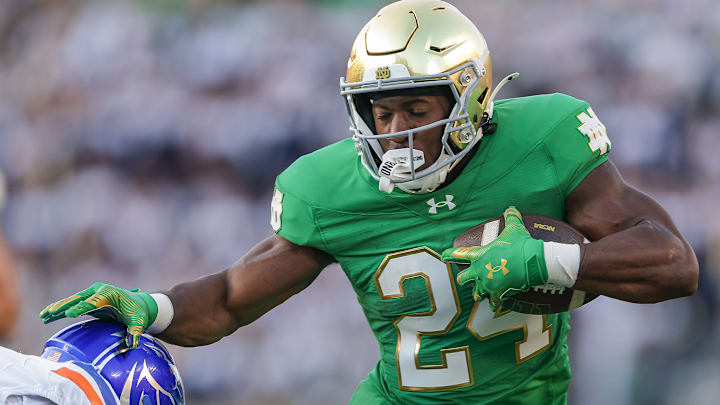
If they think a player such as Jadarian Price can come in and provide an immediate impact, they will probably consider him at #32. A lot of fans won’t like it. Yet if Price comes in, picks up the slack from Walker and helps the Seahawks continue to thrive in the running game — it’d be an understandable decision.
Price is currently Lance Zierlein’s 30th ranked player on his list. He is Daniel Jeremiah’s 40th ranked player. It shouldn’t be seen as a reach to take him at #32.
They might do it. As we’ll discuss in a moment, he fits their typical profile in terms of explosive testing. He’s a strong character fit. Despite being spelled next to Jeremiyah Love, he had a +20 yard run in eight games last season.
If they rate the player it’s quite easy to imagine how they look at $14-15m to keep Ken Walker vs taking Price at #32 and paying him $2.6m as a rookie and only $4.6m in his fourth year in the NFL. With the Penny, Walker and Charbonnet selections, they appear to be showing they appreciate the cost-effective value you can get at the running back position in the draft.
The big question mark will be Mike Washington Jr. A big blog favourite during the season, his stock has caught fire after running a 4.33 at 223lbs. There are not many people capable of that kind of speed at that size. When you combine it with outstanding explosive traits and a tough, physical running style — Washington Jr has become one of the tougher evaluations. How early could he go? And will a team like the Seahawks see star potential with this physical profile?
Either way, you can’t be confident he will last to #64.
Aside from these first two names, you might be able to justify taking Emmett Johnson in the first three rounds. Depending on how you view Nick Singleton’s health and drop-off during the 2025 season, he could be another option.
After that, I think you basically have a bunch of lower-level, unlikely-to-start role players. There aren’t runners in this class, aside from those already named, that I think can pick up the slack left by Walker.
So while you can address cornerback and pass rush on day two, you might not be able to do the same at running back. The options on the veteran market also appear to have been exhausted. Fail to address this position in the draft and you might be relying on Charbonnet returning, Emmanuel Wilson and George Holani as your running attack.
The Seahawks treat their running game as a priority. I think it’s entirely possible they will view addressing this position as a ‘must-do’ after losing Walker. So like I said, be prepared for this to be addressed with a high pick, just as they replaced Golden Tate with Paul Richardson in 2014.
What do they typically look for in the position? Explosive traits have been important as has running style. As we noted in our combine preview, we’ve been able to do a good job identifying potential Seahawks targets year-to-year by looking at size and explosive testing.
Price, Washington Jr and Johnson are all on the potential target list for 2026:
Jardarian Price — 35 inch vertical, 10-4 broad
Mike Washington Jr — 39 inch vertical, 10-8 broad
Emmett Johnson — 35.5 inch vertical, 10-0 broad
The Seahawks have typically in the Schneider era selected runners who can break through contact. They’ve also targeted big production.
Here’s data on their recent high picks at the position to explain what I mean:
Rashaad Penny’s final season at San Diego State
Yards after contact — 1297
Yards after contact per attempt — 4.47
Rushing touchdowns — 23
Fumbles — 2
Ken Walker’s final season at Michigan State
Yards after contact — 1168
Yards after contact per attempt — 4.46
Rushing touchdowns — 18
Fumbles — 1
Zach Charbonnet’s final season at UCLA
Yards after contact — 806
Yards after contact per attempt — 4.15
Rushing touchdowns — 14
Fumbles — 1
The 2026 running back class is not particularly strong when it comes to yards after contact:
Jeremiyah Love — 896
Kaytron Allen — 792
Emmett Johnson — 741
Mike Washington Jr — 644
Jonah Coleman — 562
Demond Claiborne — 544
Darius Taylor — 534
Adam Randall — 526
Jadarian Price — 443
Nicholas Singleton — 334
Jam Miller — 318
Now, obviously Price acted as backup to Jeremiyah Love so this impacted his reps and opportunities to produce. Even so, his yards after contact per attempt was still 3.92 — below Penny, Walker and Charbonnet who all averaged +4. I suppose with more opportunities, he could’ve got that number above four. But if he’d had 43% more carries in 2025 to match Love’s touches, based on the production he had, he only would’ve ended up with 633 yards after contact.
Of the three runners we’re focusing on, Emmett Johnson had the most yards after contact and also had the best production (12 touchdowns) and fewest fumbles (1). His yards after contact per attempt though was only 2.95. On tape, I’d say he’s the least suited to Seattle’s zone system.
If you’re wondering about pass-protection, Price (55.5), Johnson (42.6) and Washington Jr (28.4) all have grades that are nothing to write home about.
You might say at this point that they should just wait until later on and roll the dice on one of the day three runners. The problem is, the late third round is too early for Kaytron Allen, Adam Randall, Jonah Coleman and Jam Miller — yet they’re unlikely to last until the sixth. You could theoretically move around and try to add picks but that might not be possible in a thinner draft, just as we saw in 2021 when the Seahawks had only three selections and didn’t add to their total.
It’s a dilemma for the Seahawks. The running back options could run out very quickly if they don’t strike early. They’re not going to force a running back pick early for the sake of it. If they do like Price (or Washington Jr/Johnson for that matter) they might be really tempted to address this position quickly.
I’d also add that all three players fit the personality type the Seahawks look for. They are mature individuals. I think they’ll particularly like that Price stuck it out at Notre Dame to help his team, rather than transfer for a greater role somewhere else — probably for good money too.
Smart/tough/reliable is something we need to be aware of with potential targets. On the reliable side of things, it is worth noting that both Price and Washington Jr fumbled three times in 2025. Johnson only fumbled once. They would need to decide if this is misfortune, technique that is fixable or a killer problem you’ll struggle to solve. You need to be able to trust your back to hold onto the ball.
Cornerback
This is the position with the most overall talent available in the class alongside receiver. There are likely to be appealing options at #32, #64 and #96 — offering flexibility for the Seahawks as they try to address different areas of the team.
It’s worth noting that in recent years cornerbacks have not been grabbed off the board. Travis Hunter was a unique player a year ago as he played both receiver and cornerback. Jahdae Barron was a hybrid safety/corner. The first true cornerback taken was Maxwell Hairston at #30.
The year prior, Quinyon Mitchell was the first cornerback drafted with the 22nd pick. In 2023, Christian Gonzalez was the first cornerback taken after Devon Witherspoon and he surprisingly lasted to #17. In 2022 Sauce Gardner was taken fourth overall but there wasn’t another cornerback selected until #21 (Trent McDuffie). Finally, in 2021, there was a lot of expectation that Patrick Surtain would be a top-five pick. He lasted to #9 and was actually the second cornerback taken after Jaycee Horn at #8. After this pair, Greg Newsome was the next off the board at #26.
On top of this, don’t be surprised if a run on receivers happens in round one — pushing other positions down. The cost of an above-average receiver on the open market these days is eye-watering, especially compared to other positions. There are also multiple teams in need of receiver help. It won’t be a surprise if as many as seven receivers are taken in the first frame.
The point I’m making here is we do see cornerbacks stick on the board. It won’t be a surprise if some well known names are still there in the 20’s. As a consequence, a really good cornerback could slip through the cracks to #32. If that happens, I think you have to capitalise and not look a gift-horse in the mouth.
Assuming the top cornerbacks are gone — and many see the main three as Mansoor Delane, Avieon Terrell and Jermod McCoy — you will then be left with the next crop which should include Colton Hood, Chris Johnson and Brandon Cisse.
I think all present good options. It’s just whether you are prepared to wait until #64 or #96 and capitalise on the depth available.
For example, there is legit starting potential with Hezekiah Masses, Chandler Rivers, Keith Abney, Daylen Everette, Julian Neal, Devin Moore and Malik Muhammad. I’m not as convinced by Davison Igbinosun but others are. There are other names I could mention.
I also like Keionte Scott and Jadon Canady but both seem likely to stick in the slot or make a switch to safety like Coby Bryant. I think D’Angelo Ponds might face a similar fate at his size.
This is a lot of cornerbacks. You are not going to miss out. So ultimately you’ve got a call to make. Is a Chris Johnson or Brandon Cisse so good at #32 that you just feel you need to take them? Or do you address another position and let the depth come to you?
Either is fine by me. But it’s worth noting that if, for example, Johnson and Cisse are graded similarly to Price and some of the pass rushers — and then they look at their board and see cornerbacks graded on day two who are way ahead of their running back and pass rusher alternatives, that might shape their thinking.
The Seahawks appear very prepared to take a cornerback early. They used the #5 overall pick on Devon Witherspoon. A year later, the belief is that if Byron Murphy was off the board, they would’ve considered Quinyon Mitchell instead.
Some people really like Chris Johnson. He is Brian Baldinger’s top rated cornerback, for example. Steve Muench, on Todd McShay’s draft show, has been praising him for months. Others are more sceptical. The feeling was there might be questions about his long speed but he ran a 4.40 at the combine.
Both Johnson and Hood feel like very solid players who could compete quickly at a reasonable level (or at least pick things up quickly). Cisse has tremendous upside but needs major work on how he processes.
All of these options make sense. It’s just hard to know that there’s so much depth at this position and other players, who will be available later, are also very intriguing. I think you could even stretch into day three for options. Take former Husky, UNC transfer corner Thaddeus Dixon. I really enjoyed watching his tape and Senior Bowl performance. He could be a player you plug in and develop. there’s a lot of talent here. I’m just not sure he falls into the ‘smart, tough, reliable’ category given the number of speeding citations he had in 2025 alone (eight).
If the draft is like a puzzle, the cornerback piece can wait until later — unless you become so convinced one of this group is a must-take at #32. It’s a distinct possibility that in the coming weeks, they’ll end up feeling that way about at least one cornerback.
Pass rusher
I really think the main thing the Seahawks lack is speed off the edge. They spent most of the season talking about finding quick wins. The hope was that Boye Mafe would provide those as a situational rusher but it never really happened.
They don’t need another big, physical rusher. They need electricity — someone who can complement the players already on the roster and provide the production Mafe could not offer.
There weren’t many rushers at the combine who showed off genuine suddenness, which I’d define by running a 10-yard split in the 1.5’s. Cashius Howell and Malachi Lawrence were the only two to achieve this other than top-five pick Arvell Reese.
Howell could be an option for them. His personality is a fit. He is highly focused, driven and plays with great intensity. You do see plenty of quickness, dip and bend on tape. His arms are sub-31 inches though and it shows. He often rushes like an armless man, not engaging and just trying to dip around the tackle without any contact.
You’re not going to task him with setting an edge or playing on early downs. His role will be to get after the quarterback on 2nd and 3rd down. You draft him to get you off the field against Matthew Stafford.
I can easily imagine him being a productive player who can’t nail down a complete role, thus he might bounce around the league as a hired sack-specialist like Yannick Ngakoue. I think that would be OK for the Seahawks. This is a draft class full of probable one-contract types. This isn’t the year to expect you’re going to nail 8-10 year core additions. Maxing out value on a four or five year basis is fine.
Lawrence is an intriguing player. I know his max GPS speed during the season was faster than the other big names in this draft. He’s quick, long and explosive. There is some stiffness to his change of direction though that you see when he tries to bend the arc. It leads to him losing balance and when that happens, the rep’s over. I think you would struggle to justify taking him at #32 but he’ll likely be gone by #64. He is quick, which is what they need.
I am intrigued by pass rush win percentages. It seemed to be a selling point a year ago with Rylie Mills and Jared Ivey. Mills’ 14.3% was third among defensive tackles behind only Derrick Harmon and Omarr Norman-Lott. He was ahead of Mason Graham, TJ Sanders and Walter Nolan. Ivey’s 16.8% topped all inside/out rushers apart from Aeneas Peebles.
Byron Murphy’s win percentage of 19.6% was tops among available defensive tackles the year prior.
There’s a slight contrast when you look at Boye Mafe and Derick Hall. Mafe’s win-rate was only 15.8%. However, it’s believed the Seahawks circled Mafe and Arnold Ebiketie with their pick at the top of round two. Ebiketie’s win percentage was 22% and among the best in the class.
Hall’s win percentage was even weaker than Mafe’s at 14%. I think the thing to remember though is how physically ideal both players were. They had outstanding length, testing results in terms of speed, agility and explosive traits. The Seahawks likely felt both had incredible upside. There are very few players like that in the 2026 draft where you might be willing to overlook a lack of pure production to gamble on traits.
Here’s the win-percentages for this class:
Nadame Tucker — 28.4
Rueben Bain Jr — 23.5
Romello Height — 21.8
David Bailey — 21.6
Joshua Josephs — 21.2
Akheem Mesidor — 20.8
R Mason Thomas — 20.3
Cashius Howell — 19.9
Derrick Moore — 19.8
Malachi Lawrence — 19.2
Keyton Crawford — 18.3
Zion Young — 17.4
Max Llewellyn — 17.2
Mason Reiger — 15.9
Dani Dennis-Sutton — 15.8
Logan Fano — 15.6
TJ Parker — 15.5
Gabe Jacas — 15.2
Caden Curry — 13.6
Jaishawn Barham — 13.1
Anthony Lucas — 12.4
Keldric Faulk — 11.6
LT Overton 8.8%
If you don’t have the ideal traits, there’s still a lot of very productive players here. For example, let’s say you don’t want to take Howell at #32, or he isn’t available. Romello Height could be a fantastic alternative at #63 with his 21.8% win percentage. Joshua Josephs, R Mason Thomas and Derrick Moore also show well in this category.
Nadame Tucker excels at the top of the list but played at a lower level of college football for Western Michigan. He could be a possibility at #96.
It would be good to get some testing results for Gabe Jacas, another potential option at #64. He is preparing to do a personal workout after injury kept him out of the combine and Illinois’ pro-day. It would also be good to see the results for Tennessee’s Joseph. Dani Dennis-Sutton’s testing performance was interesting enough to be a consideration at #64 too. Jaishawn Barham, as a convert from linebacker, could be a development type.
Akheem Mesidor has great production and could be an option at #32 but his age (25) and injury history could be off-putting (surgery on both feet). He hasn’t tested pre-draft and has jumped between being bigger at West Virginia and lighter at Miami. If you’re looking at one-contract types, as long as you’re comfortable with the medicals, you might consider him. I think you need at least some testing data though. The age, injury history, lack of length and limited physical information could see him last to day two.
Zion Young to me is a big question mark. His GPS testing for speed at the Senior Bowl was slower than LJ Collier’s. He undoubtedly plays with a high level of power and intensity but I find his personality to be odd in multiple interviews. Getting arrested for DWI and speeding right before draft season began also doesn’t speak to ‘smart, tough, reliable’ either.
Clearly they have options. This might be the position though that they’re most inclined to show discipline. If the likes of Von Miller are still available by draft day, you can try to sign them for a year of specialist rushing (just as they intended 12 months ago with Miller) without losing a comp pick.
Wildcard options
I don’t think the Seahawks see a desperate need to add competition at right guard, yet they’re probably open-minded about it. Anthony Bradford’s tape, clearly, is up-and-down. He is out of contract in a year. He isn’t an ideal scheme fit at his size either.
There are some intriguing offensive linemen in this draft and not just at guard. Remember, Grey Zabel played left tackle for North Dakota State and moved inside for the Seahawks. Could they move someone like Blake Miller inside from right tackle? Or Gennings Dunker? Quite possibly. They might also like the cut of Keylan Rutledge’s jib enough to take him in round two.
They have internal options too if they want to open up the competition at right guard. I wouldn’t completely rule out an O-line pick in the first three rounds.
Another position could be the spot vacated by Coby Bryant. We all assume it’s Ty Okada’s gig now — and that could easily be the case. Yet there are some very intriguing options in this draft, the best arguably being Arizona’s excellent Treydan Stukes (who, as it happens, would fit Seattle’s roster personality perfectly). Zakee Wheatley and Bud Clark are also interesting, while cornerbacks like Keionte Scott, Chandler Rivers, Jadon Canady and D’Angelo Ponds could also convert to safety just as Bryant did.
Final thoughts
I still have a lot of work to do on the draft, including hopefully speaking to people in the next couple of weeks who will challenge and develop some of my thoughts. I do think there’s a somewhat realistic prospect though that the following is true:
— They will seek to fill the holes at running back, cornerback and EDGE
— The draft being thicker at cornerback and EDGE could mean they end up prioritising running back, if they like a player such as Jadarian Price enough to take early
— They might feel less pressure to draft a situational replacement for Boye Mafe, given the veteran options that might be available post-draft (eg Von Miller)
— There is still the prospect for O-line or safety to come into the mix if the board dictates, especially if they’re comfortable not taking a pass rusher
I discussed this topic in detail on yesterday’s live stream. If you missed it, check out below — and don’t forget to subscribe to my YouTube channel: