
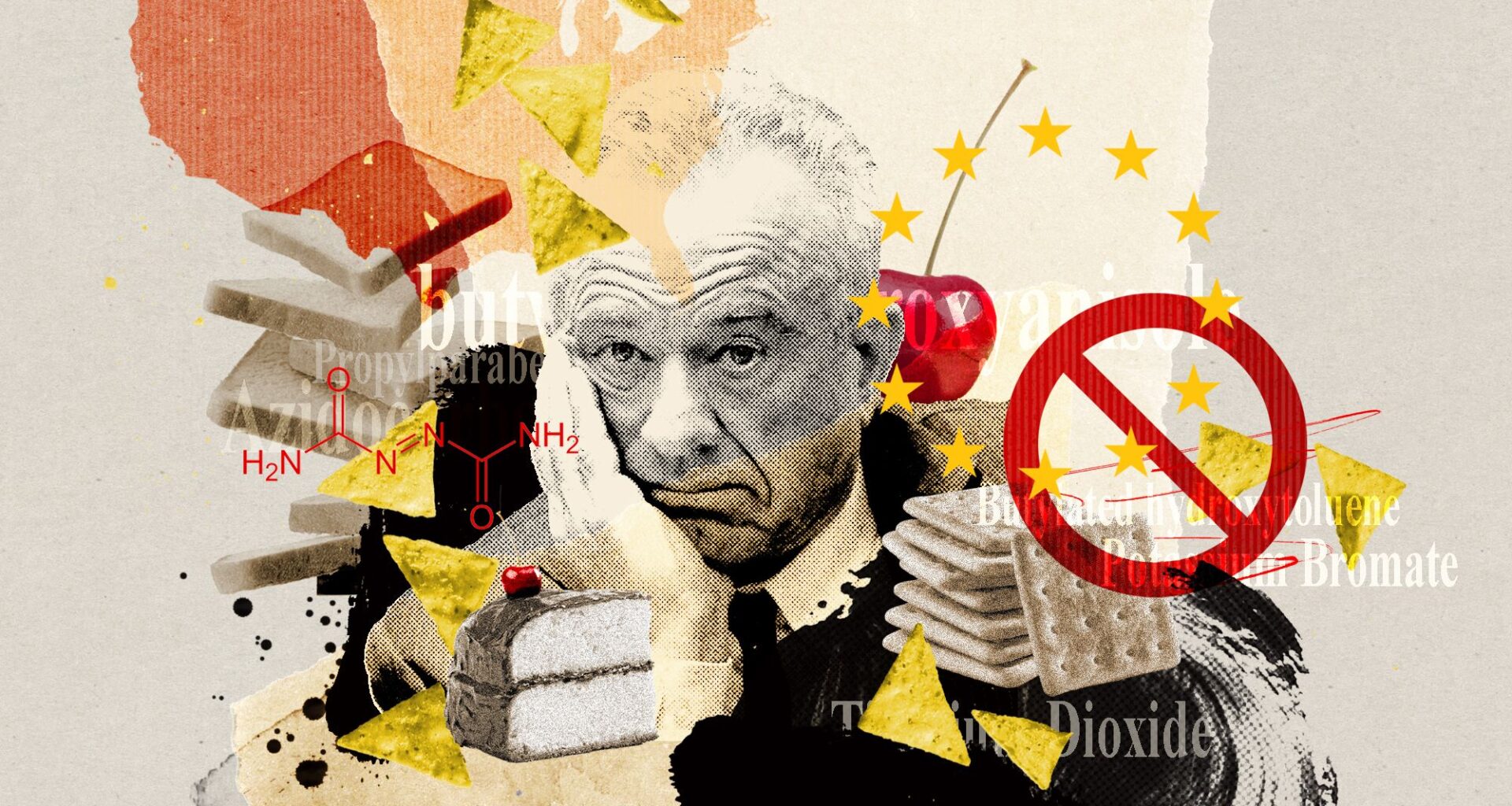
The United States has generally had a more forgiving set of regulations governing the use of additives, preservatives and other chemicals in food and drinks than the European Union (EU). The difference has begun to narrow, however, both because some U.S. states are banning ingredients that the federal government allows, and because the Health and Human Services Secretary, Robert F. Kennedy Jr., pledged to more aggressively prohibit some of these substances as part of his Make American Healthy Again (MAHA) movement.
Other substances that were once legal to use in foods in the U.S. but not in Europe, like partially hydrogenated oils as well as brominated vegetable oil (BVO), were banned in the United States prior to the second Trump administration. They included a food dye called Red No. 3, which was banned by the Food and Drug Administration (FDA) on January 15, 2025. In April 2025, Secretary Kennedy announced plans to work with the food industry to voluntarily phase out six other petroleum-based food dyes, all of which are already banned for use in foods in the EU.
Azodicarbonamide (ADA)
ADA is used in the U.S. to “whiten cereal flour and improve baking bread dough,” said CBS News, but is banned for use in food by the EU, which considers it a carcinogen. ADA has become increasingly controversial, however, and some companies have rolled back its inclusion in certain products.
Article continues below
You may like
The Week
Escape your echo chamber. Get the facts behind the news, plus analysis from multiple perspectives.
SUBSCRIBE & SAVE
Sign up for The Week’s Free Newsletters
From our morning news briefing to a weekly Good News Newsletter, get the best of The Week delivered directly to your inbox.
From our morning news briefing to a weekly Good News Newsletter, get the best of The Week delivered directly to your inbox.
In 2014, for example, Subway announced that it would no longer use ADA in its bread products, which turned out to be the leading edge of a trend. The American Bakers Association announced in 2026 that most of its members had already phased out the use of ADA, with the remainder doing so by the end of the year. The FDA is currently reviewing information about ADA, the first step in the agency’s review process.
Butylated hydroxyanisole (BHA)
BHA “is a preservative used in cured meats and other foods,” said the Environmental Working Group, a U.S.-based nonprofit. It is “subject to severe restrictions in Europe” but continues to be added to American food products under the FDA’s GRAS (Generally Regarded as Safe) principle, said The New York Times. The National Toxicology Program deemed it a likely human carcinogen decades ago. In February 2026, the FDA ordered a new safety review of BHA, “pointing to long-standing concerns that the food additive might cause cancer in humans,” said NBC News.
Butylated hydroxytoluene (BHT)
BHT is an “antioxidant that helps stabilize vegetable oils so they stay fresh longer and is often used in crackers and cereals to extend their shelf life,” said Tasting Table. The antioxidant’s presence in the popular cracker Wheat Thins, for example, is the reason you won’t be able to find them in Europe. Due to “concerns related to potential endocrine-disrupting properties,” BHT is banned for use in foods in the EU, said the European Commission. In August 2025, the FDA launched a “postmarket assessment of the safety of BHT as used in food and food contact materials,” said the FDA.
Potassium bromate
Potassium bromate is a substance that is found “usually in the form of fine crystals or powder, to strengthen dough” in more than 100 products sold in the United States, said CBS News. It has been used for more than a century in breadmaking, but the European Union, the United Kingdom, Canada and most other countries in the world consider it a human carcinogen.
While Secretary Kennedy’s HHS has not taken any direct action against potassium bromate, he has stated that he wants to eliminate the program under which it is used in the U.S., under the FDA’s GRAS designation. Critics say that GRAS allows companies to include ingredients that were ”greenlit for use not by the FDA but by the food and chemical industry,” said CNN.
Propylparaben
The chemical is deployed in more than “50 products in U.S. grocery stores,” said Consumer Reports, “including many packaged corn tortillas, baked desserts and cake icing.” Propylparaben helps “stop the growth of microorganisms in most packaged foods,” said The Cleveland Clinic, but may “interfere with your endocrine system, which includes glands and the hormones they send out to tell organs and tissues what to do.” The EU banned the inclusion of propylparabens in food in 2006. A 2024 FDA review did not lead to any new regulatory action.
Titanium dioxide
The “naturally occurring oxide of titanium,” titanium dioxide “has been used for decades to impart white color to many foods, from baked goods and sandwich spreads to soups, broths, sauces, salad dressing and food supplements,” said the European Commission. The EU banned its use in food products in 2022, citing the “possibility that the use of titanium dioxide as a food additive might cause DNA or chromosomal damage.” In the U.S., the “chemical seems to be largely surviving the food-dye purge” spearheaded by Kennedy, said The Atlantic, although some companies, including the maker of Skittles, are phasing it out voluntarily in expectation of future regulatory action.