
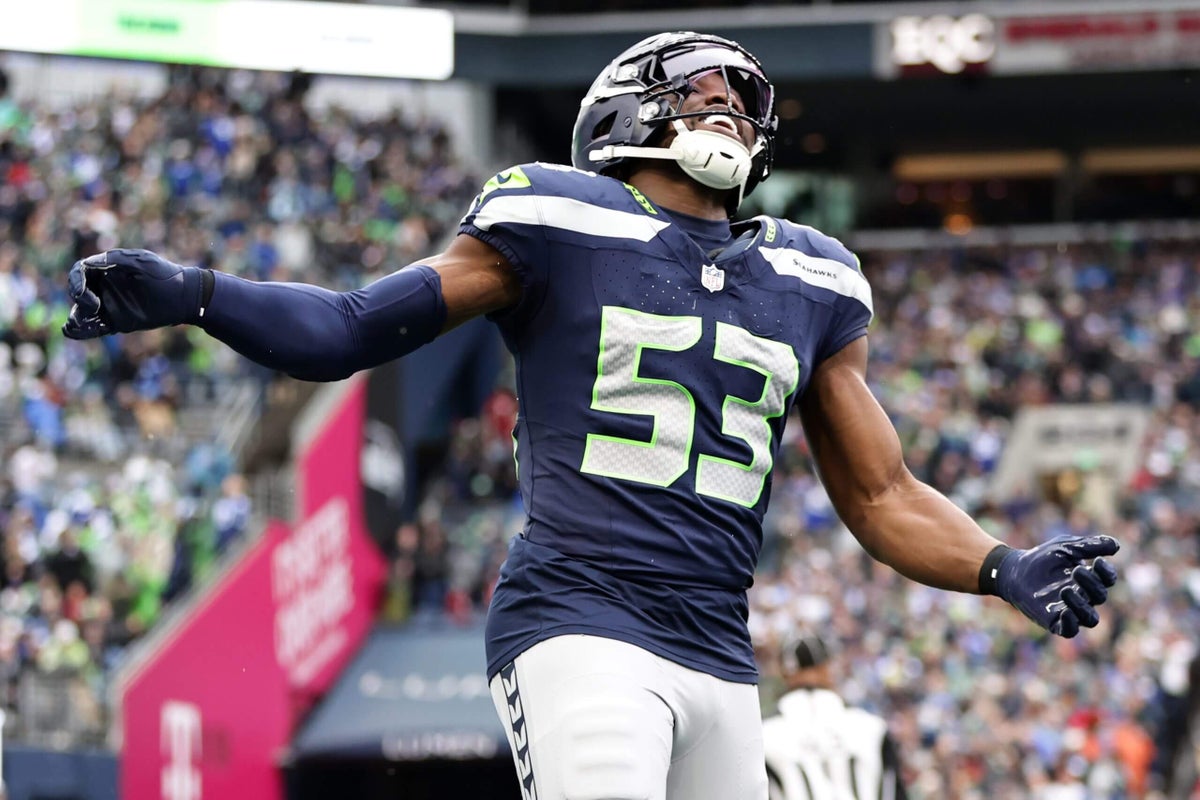
The Cincinnati Bengals took three big swings last week at adding to a defense in desperate need of playmakers. They landed Boye Mafe and Jonathan Allen on the defensive line, as well as Bryan Cook at safety.
The three deals totaled $126 million, with Mafe and Cook collecting $33 million in guarantees.
They are left to hope those additions, along with a big bet on a contingent of young players who ascended in the second half of the season under coordinator Al Golden, will be enough to propel the Bengals back into contender status for Joe Burrow.
The draft will obviously bring help, and a handful of small signings can still fill out depth. There’s always potential for this year’s Dalton Risner or Noah Fant to arrive over the summer. Yet, the Bengals are largely done with significant veteran additions for this offseason.
A week dubbed “paramount” by Burrow at the end of the season did bring impact players to Cincinnati, but it still leaves concerning holes on the roster. There were no cap-clearing contract structures or asks of Burrow to restructure his contract to clear space.
They have between $24 million and $18 million in effective cap space left before Allen’s contract hits the books, depending on which NFL contract service you trust. That deal, plus draft picks and small signings, they have decided will take them to the end of their current player-acquisition stage.
The Bengals prioritized pass rush, as promised, but didn’t fill out all three levels, which felt like the baseline. It again places pressure on a draft that now puts linebacker and cornerback into focus before discussing luxury choices and important depth needs.
During a free-agency week of signings, conversations, revealing of plans, news conferences and negotiations, we learned quite a bit about the club’s priorities, direction and outlook.
Here’s a collection of things learned and heard regarding the Bengals over the last seven days.
The disregard for linebacker
Somewhere between the specific messaging delivered at the NFL Scouting Combine and the execution of the free-agent plan last week, a line of communication got broken. The Bengals said they were searching for a linebacker to help Demetrius Knight Jr. and Barrett Carter with both leadership and a presence capable of dropping down along the defensive line. The Bengals never delivered on that in an impactful fashion, which puts more onus on linebackers coach Mike Hodges and the 2025 draft picks to build off the development shown during the second half of last season.
Hodges spoke in January about the nearly unprecedented challenge of two rookies starting next to each other. He wasn’t making excuses. Knight and Carter weren’t, either, but both essentially admitted their heads were spinning until the latter portion of the season. Hodges plotted an aggressive offseason program for the two to take significant steps to playing with more confidence and understanding in 2026.
“They’re not throwaways, as some people want to say,” Hodges said. “They’re far from that. This organization is going to be proud of this room going forward, I really believe that.”
He also expected to see additions. Everyone we talked to did. Alas, a big investment never came. Two names that lived near the top of the list of many, Kaden Elliss and Leo Chenal, didn’t draw as much attention internally. Elliss’ money got driven up above their value ($11 million per year), while Chenal wasn’t a top target.
Development would be a necessity even if the front office made aggressive additions at linebacker, but this becomes critical now. Barring a trade, Knight and Carter will be counted on to be the answer at the weakest position on the 2025 team. Or, if another linebacker is added in the draft, be responsible for helping another rookie linebacker along, which might be the worst possible plan to ease their growth.
That’s not an impossible development, but a risk the Bengals accepted by not signing any of the top available linebackers in free agency.
Orlando Brown Jr. and the next extension
Brown added two years to his contract. This served as a show of faith negotiated by Brown with the team as he looked for security entering his final season. The Bengals gave him that, and while it adds two years to his contract through 2028, the structure serves as an investment through 2027 and then becomes the equivalent of a team option in ‘28. It’s a win-win for both sides. Brown’s average annual value is 17th among left tackles, and the Bengals aren’t forced to think about his replacement in this year’s draft.
In fact, the most significant fallout of the extension is that you probably can take the offensive tackle pick off the board at No. 10. A left tackle could come later, but adding a top-10 pick with Brown and Amarius Mims locked in for two years is extremely unlikely.
Brown’s extension also got the conversation going about the next extensions for the Bengals. They have no shortage of candidates with the 2023 draft class extension-eligible for the first time.
At the top are corners DJ Turner and Dax Hill. Those extensions aren’t at the top of the priority list for the Bengals. They have time. Expectations are that they will follow a standard path of negotiations through the summer and reach an agreement between the draft and training camp.
One wrinkle — that Ja’Marr Chase and Tee Higgins can attest to be notable — is that Hill and Turner have the same agent, Andrew Kessler of CAA. What will that mean for their negotiations? Too early to make any statements on that for the starting corners, but it’s worth noting once conversations heat up.
Cincinnati would love to keep both Turner and Hill, successful defensive draft picks, as pillars for the future. Getting deals done with both will become one of the top agenda items once the dust clears on player-acquisition season.
Down on the corner?
It would be very interesting to see what a cornerback selection at No. 10 would do for the state of those negotiations. That’s an important tangent of the Hill-Turner conversation after no movement there during free agency.
If looking for a spot with increased attention on the Bengals’ draft board, look no further. At the very least, there’s uncertainty on the long-term future of Turner and Hill, and those are the only two known components at the position.
Jalen Davis sits as the starting nickel corner, but there will need to be another notable player in the mix. There’s also not a fourth cornerback on the roster with the Bengals passing on a collection of veterans available for depth.
Could they make a third-wave addition in the coming weeks? A familiar name like Cam Taylor-Britt still sits unsigned, along with a host of bargain free agents who will likely be subjected to small, one-year deals.
More than likely, the additions come in the draft, where the Bengals have traditionally been regular investors with top picks.
Compensatory picks mattered
For all the talk of the tag-and-trade approach with Trey Hendrickson, the Bengals ensured they would end up with a third-round pick upon his departure. By signing Allen, released last week by Minnesota, as their last big addition, they end up in the positive of the projected comp-pick formula, according to comp pick wizard Nick Korte at Over The Cap.
Korte has the Bengals slotted to receive a third and seventh next year.
If Cincinnati would have, say, signed John Franklin-Myers, whose contract expired with Denver, instead of the released Allen, it would have nullified the Hendrickson pick. Those decisions don’t necessarily drive major decisions, but they do factor in. Fair to surmise they did here.
Backup quarterback strategy
When the Bengals signed 14-team NFL legend Josh Johnson (for the third time) on Saturday, it sent a clear message about their approach to backing up Burrow: They plan on waiting for Joe Flacco.
Flacco stated he wants to find a job where he can compete to start. He’s also said that if he can’t find that, he’d be interested in returning to Cincinnati, where he posted some of the best individual games of his storied career.
The starting positions and even those open to competition you can count on one hand, with fingers left over.
Cleveland could be one, but it’s difficult to imagine Flacco going back, considering what went down there last year. The Raiders could need a starter while presumed No. 1 pick Fernando Mendoza learns in the wings, but Kirk Cousins might end up the guy there. The Steelers are waiting on Aaron Rodgers to potentially reunite with Mike McCarthy. The Jets traded for Geno Smith, and the Cardinals added Gardner Minshew.
If Flacco looks around and doesn’t see a path to playing, he could pick up the phone and call the Bengals to come back. Johnson puts the Bengals in a position to say yes. He is the ideal quarterback to run an offense during the offseason, knows what he’s looking at defensively and distributes the ball to playmakers. He’s seen it all more than any player in this league, making 22 stops and now in this third stop in Cincinnati. He started two games and won one last year for Washington.
The moment Flacco says yes, though, Johnson moves aside. With this move, the Bengals buy time to wait him out.
Allen a penalty for the Jenkins miss
The Bengals made their boldest attempt to solidify the defensive tackle position in signing Allen. The arrival of the 31-year-old on a $26 million, two-year deal could be viewed as a penalty for whiffing on Kris Jenkins.
If Jenkins had developed as expected through his first two seasons, there would have been no reason to sign Allen. Maybe he comes along this year and finally makes good on his draft pedigree, but the Bengals weren’t willing to take that chance. They might say nice things about Jenkins, but they spoke loudly with their checkbook.
I also don’t expect Cincinnati to be done adding pass rushers from any spot, interior or edge, in the draft. They want to come in waves, and if Jenkins ends up inactive because he couldn’t tread water with increased competition, his Bengals career will sink.
Buying Mafe
It’s easy to understand why the Bengals went above the expected pay range for Mafe. Sure, his age, effort, traits and win rates all paint the picture of an ascending player. Creating more chances and pure edge rush situations for him offers the biggest opportunity since his nine-sack breakout season in 2023. He very much saw the vision.
“A lot of things a lot of people question about me is like the production, and that’s a big question,” Mafe said. “I understand that. But the thing is, the coaches saw the film. They saw what I could do on the field. They want to tap in and make sure that the pressure rate and all that turns into sacks. And so with them, with me buying in and getting that chance to really dig into that and really get into the nitty-gritty of what I need to do to improve my game, I feel like that untapped potential can really show itself.”
On first impression, the Bengals appear to have hit on the person. Mafe came across as uniquely aware of the work he still needs to do, dedicated to doing it and one of the all-ball human beings head coach Zac Taylor has tried to build the culture around. Mafe admitted he wouldn’t be a loud, speech-giving leader. He’s more of a lead-by-example guy. If the combination of person and potential comes together like it was spelled out this week, he could look like a bargain at $20 million come next year.