
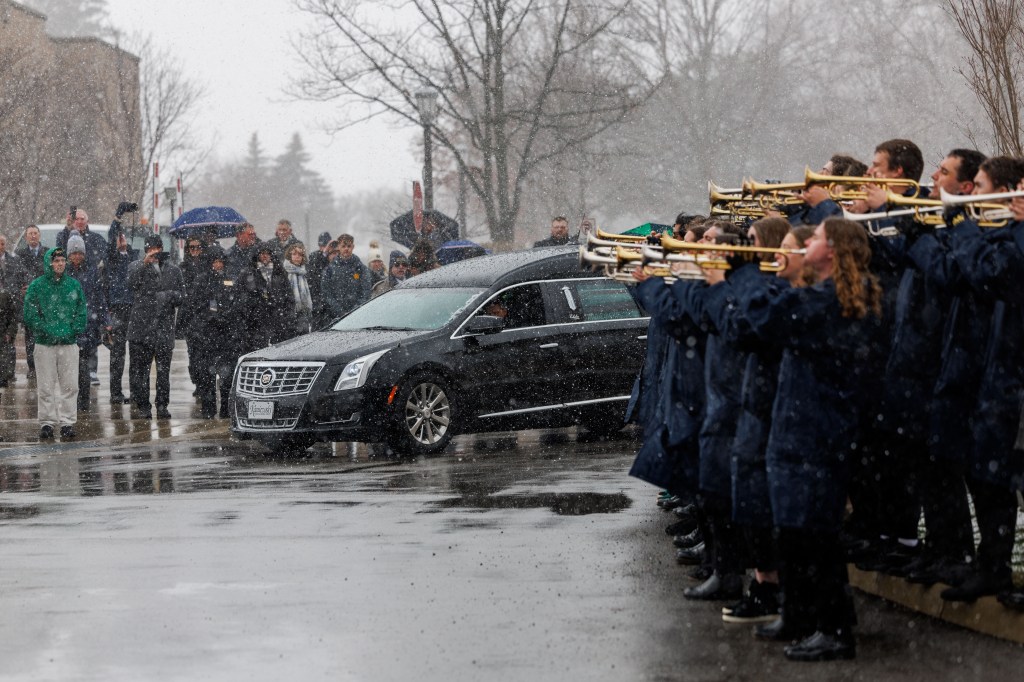
SOUTH BEND, Ind. — The night before Lou Holtz’s funeral, one of his old Notre Dame walk-ons spontaneously tended bar at the Linebacker Lounge, just across the street from campus. Over his generous pours of cheap beer and dive-bar cocktails, aging All-Americans and national champions told stories about their old coach, mixing in laughs with the occasional Holtz imitation.
Holtz’s Catholic funeral Mass on Monday at the Basilica of the Sacred Heart, the spiritual center of the campus he won over as the Fighting Irish football coach throughout the 1980s and 90s, was for the formalities. It was for the suits and ties and hymns and Communion, and the solemn remembrances about “a complicated man,” as Holtz’s son, Skip, described his father.
Sunday, though, and especially the impromptu late-night gathering at the Linebacker Lounge after a public visitation for Holtz, was about something else. It was for the fellowship and the memories. For graying football players, once the big men on campus, to honor the leader who’d taught them how to win, on the field as college kids and off of it as men.
Their most memorable collective triumph came in the fall of 1988, when a perfect 12-0 season rekindled the glory and delivered the University of Notre Dame its 11th national championship in football. While Holtz’s players celebrated that accomplishment, they savored the smaller victories more. The ones in their personal lives, the ones that may not have happened if not for their old coach.
“There wasn’t any crying,” Steve Beuerlein, Holtz’s first Notre Dame quarterback, said of the gathering that steadily grew to fill most of the Linebacker Lounge’s main room. And indeed, Beuerlein, who thought his days as a quarterback were over until Holtz arrived and restored his faith and self-confidence, had already worked through his own emotions in the nearly two weeks since Holtz’s death.
This, then, at the lounge — around since 1962 and where Holtz’s teams delivered so many fond memories (whether they can be recalled or not) to blue-and-gold clad patrons — was less about the sadness of a goodbye than it was “all about the great memories,” Beuerlein said.
“The gratitude that we all had for the experience, just to be a part of it.”
Holtz, who died March 4 at age 89, arrived at Notre Dame in late 1985, at a time of discontent and disillusionment in South Bend. The Fighting Irish had slipped into seemingly perpetual mediocrity and unfulfilled expectations. Its place in college football, which for so long had been assured and taken for granted, was in question.
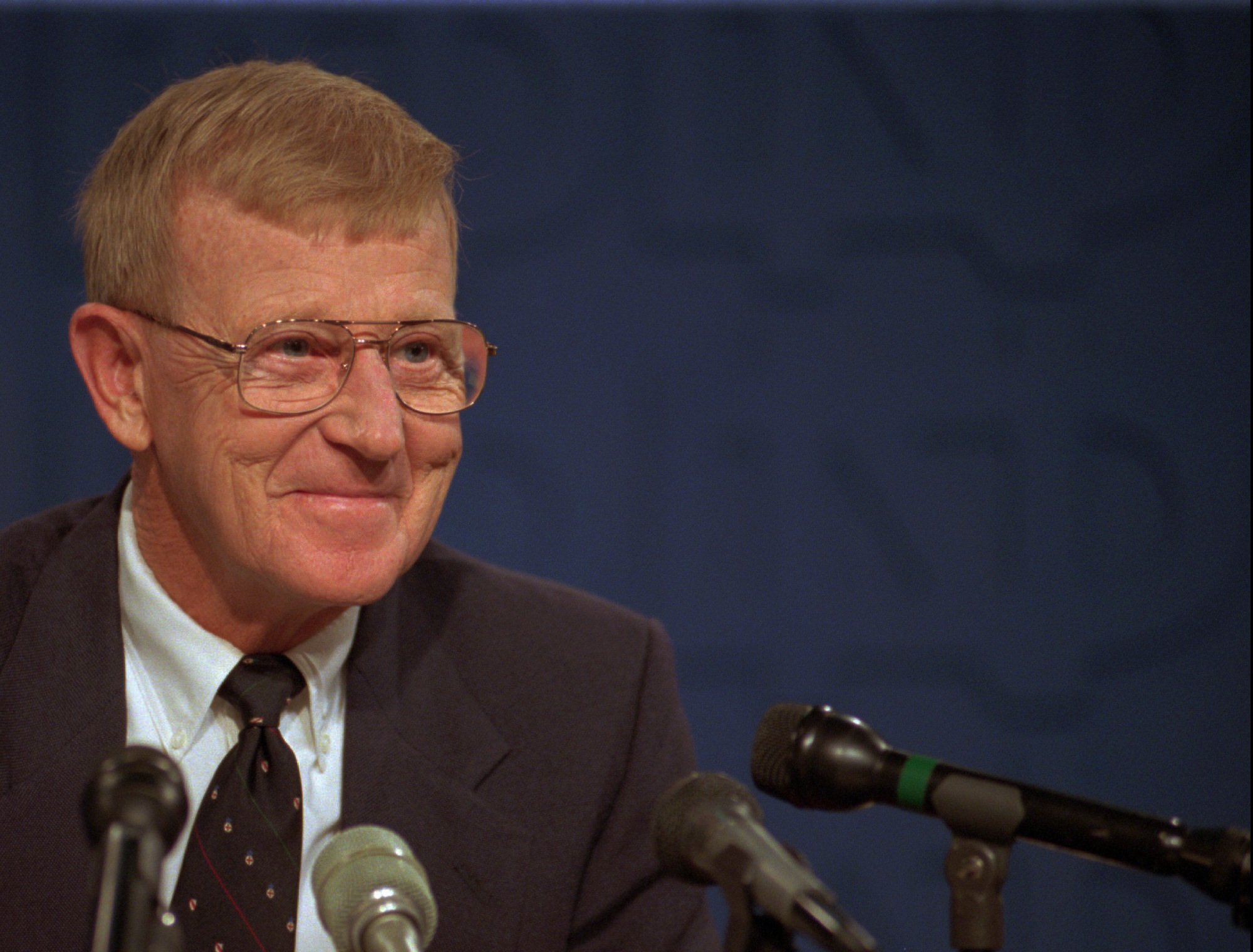
Lou Holtz announces he is stepping down as the head football coach at Notre Dame at a press conference in South Bend Indiana on Nov. 19, 1996. (John Kringas/Chicago Tribune)
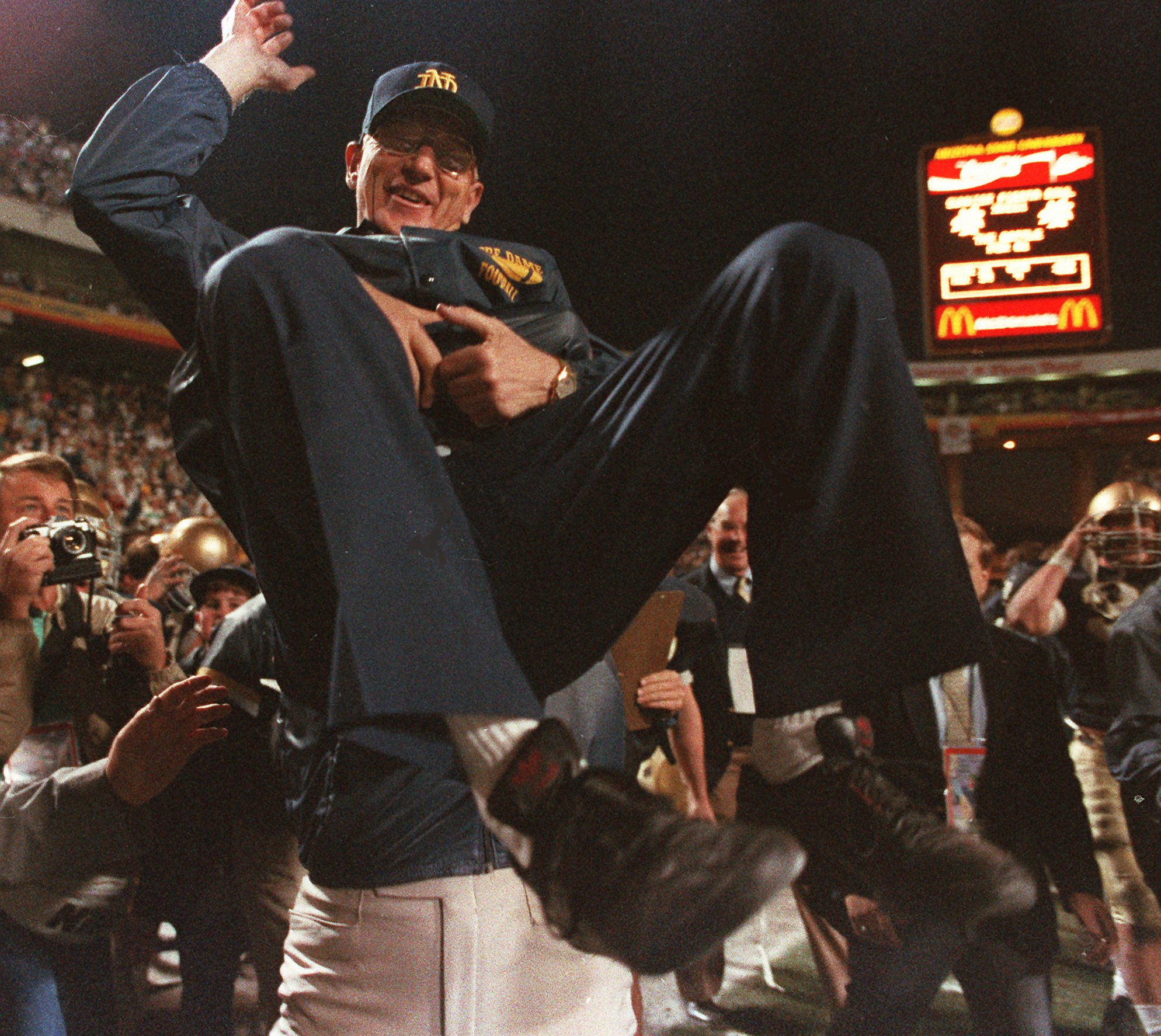
Notre Dame coach Lou Holtz is carried off the field on Jan. 2, 1989, in Tempe, Arizona, after the Fighting Irish defeated West Virginia in the Fiesta Bowl to win the national national championship. (Rob Schumacher/AP)
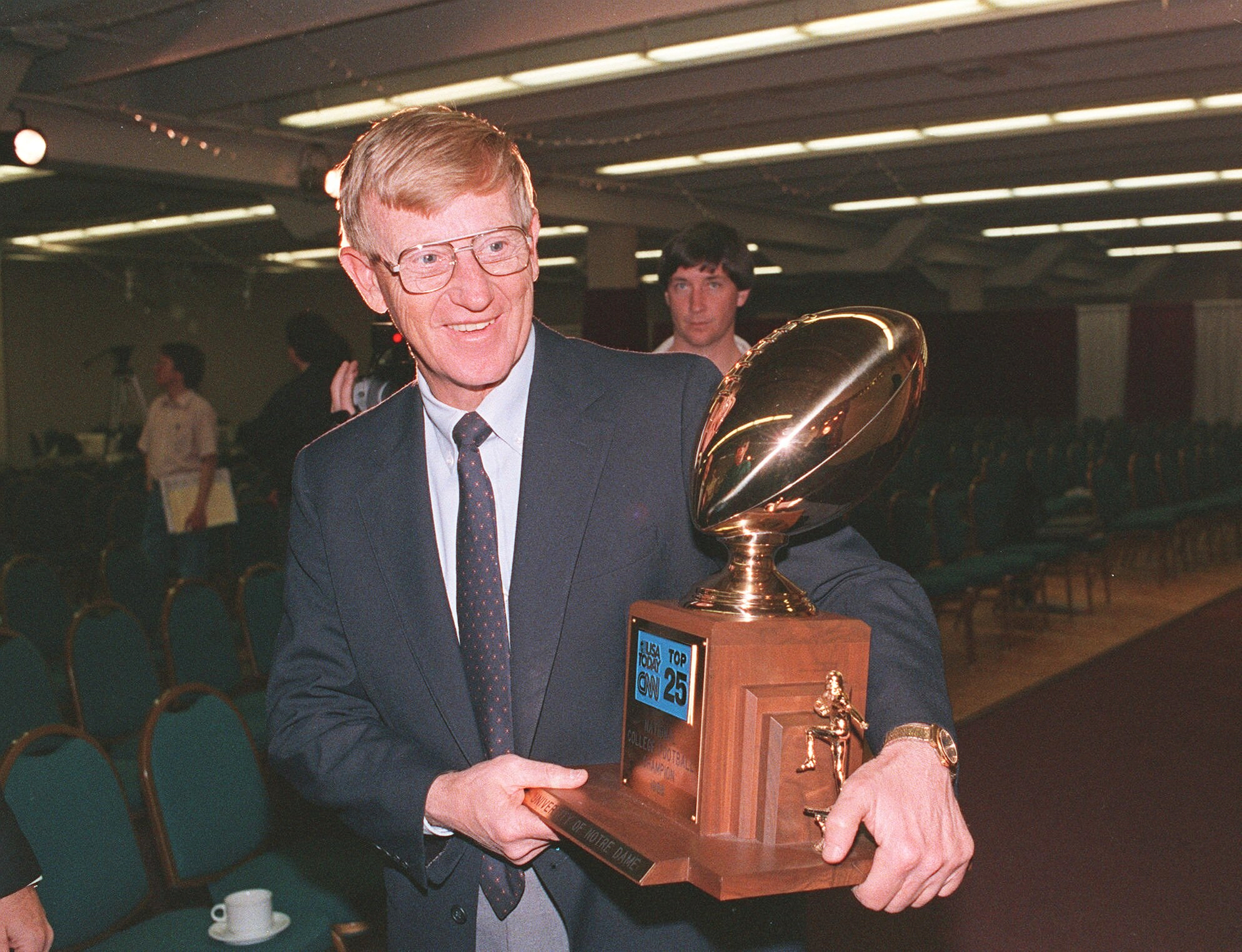
Notre Dame coach Lou Holtz carries away the national championship trophy after a news conference on Jan. 3, 1989, in Tempe, Arizona. (Rob Schmacher/AP)
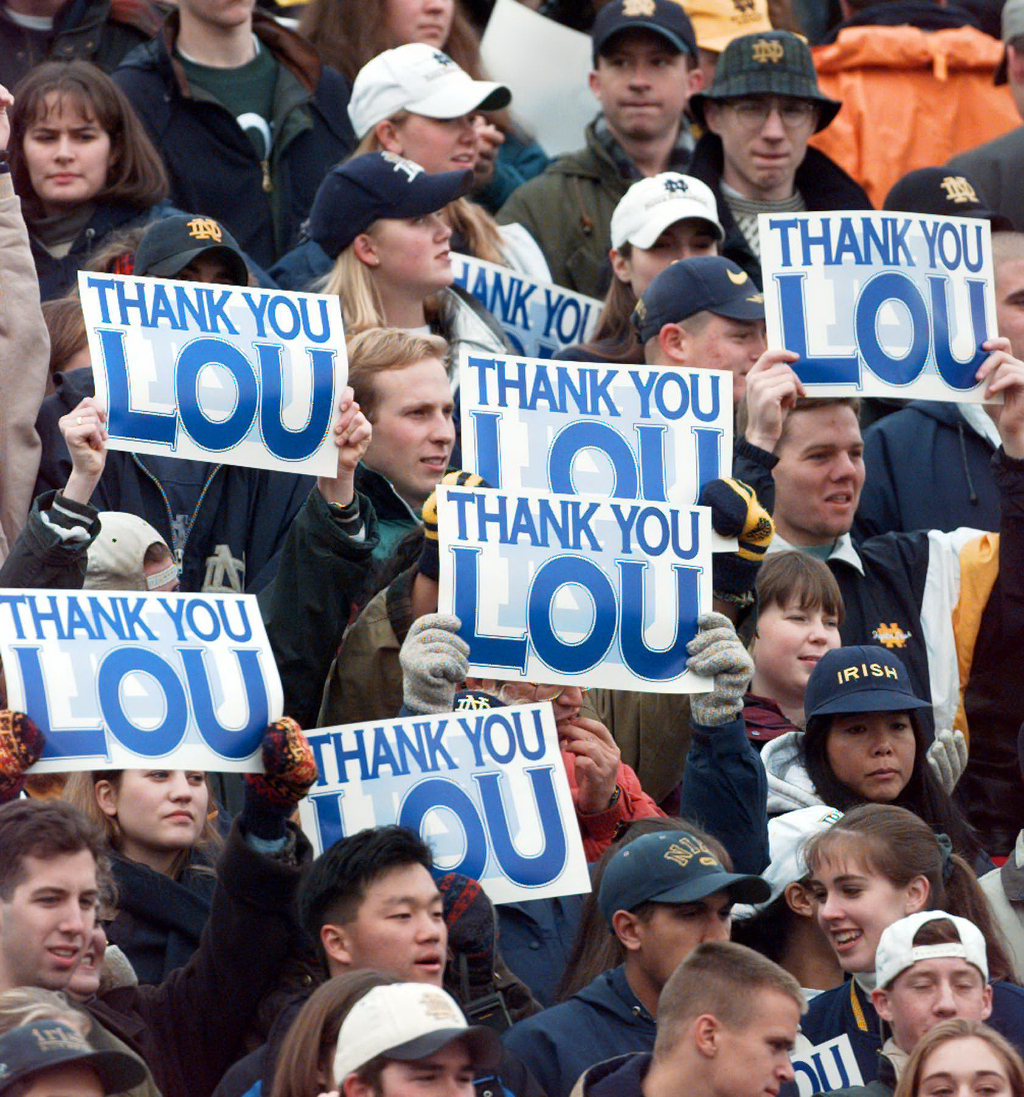
Notre Dame students show their support for coach Lou Holtz during the game against Rutgers on Nov. 23, 1996, in South Bend, Indiana. It was Holtz’s last home game as the Fighting Irish’s coach. (Beth A. Keiser/AP)
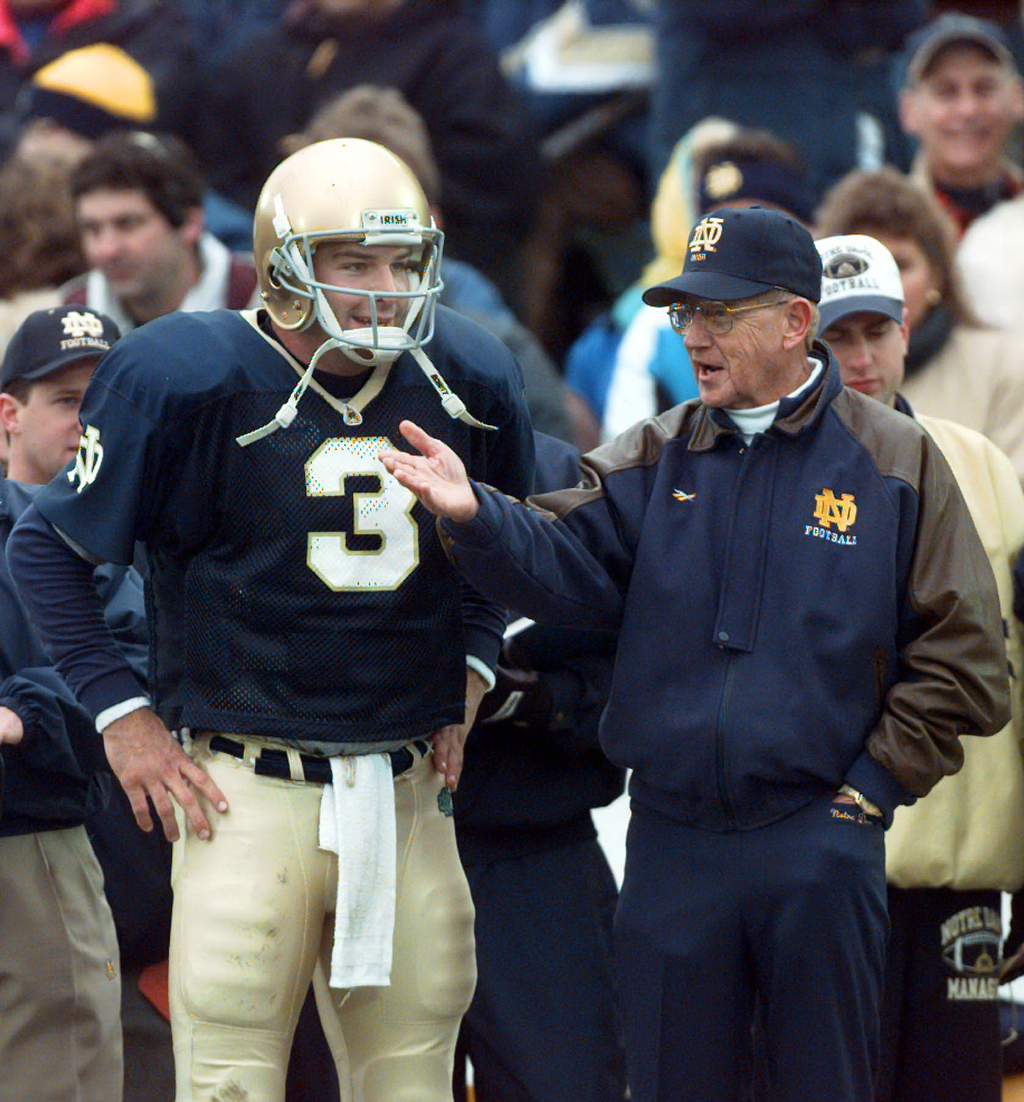
Notre Dame coach Lou Holtz shares a light moment with quarterback Ron Powlus during a game against Rutgers on Nov. 23, 1996, in South Bend, Indiana. It was Holtz’s last home game as coach. (Beth A. Keiser/AP)
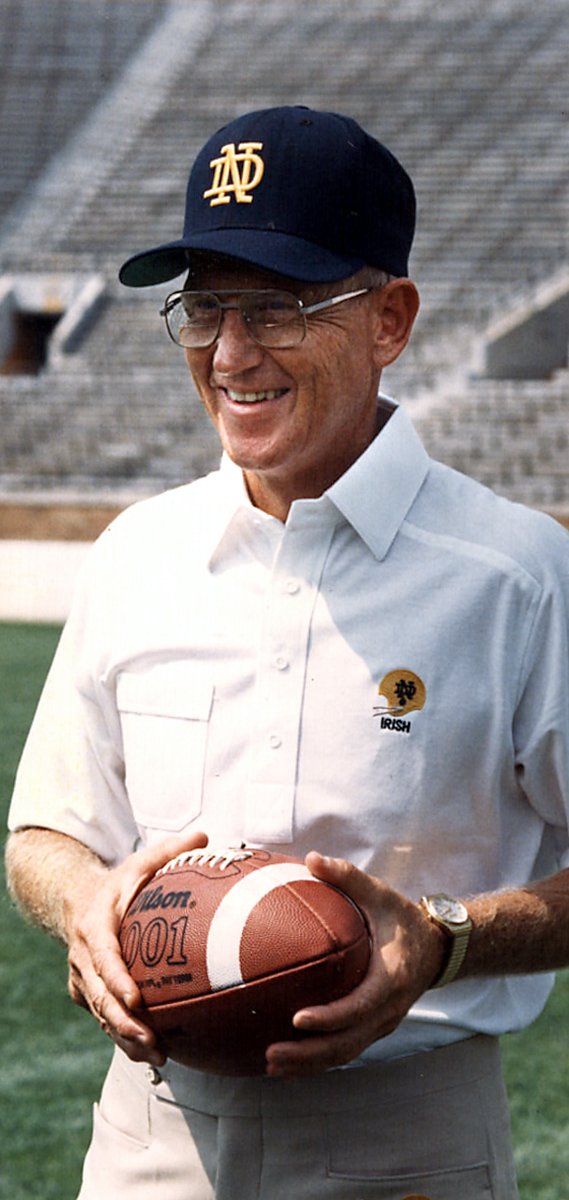
Lou Holtz in September 1988. (Ovie Carter/Chicago Tribune)
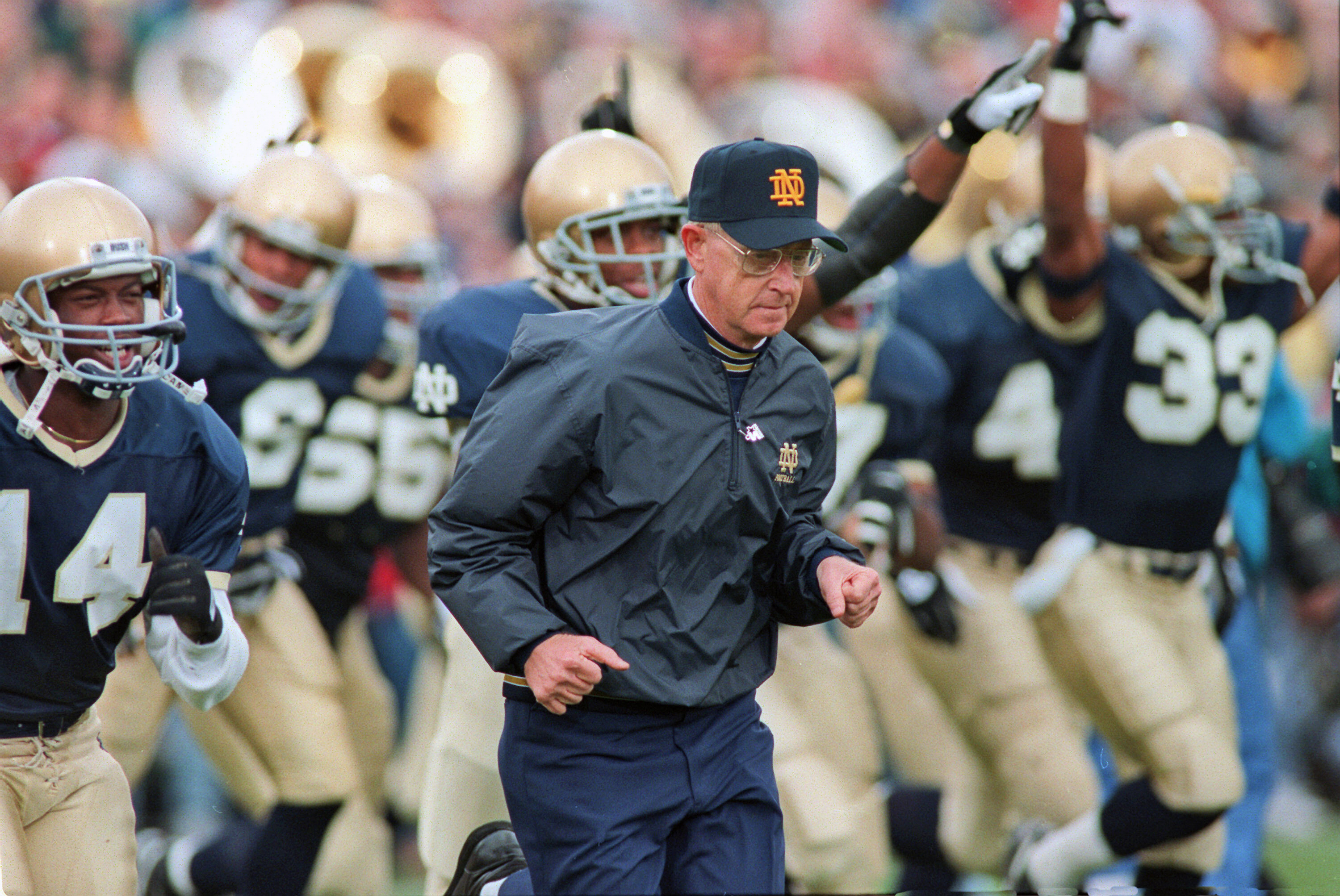
Notre Dame coach Lou Holtz runs onto the field with his team before a game against Florida State in South Bend, Indiana on Nov. 13, 1993. (Joe Raymond/AP)
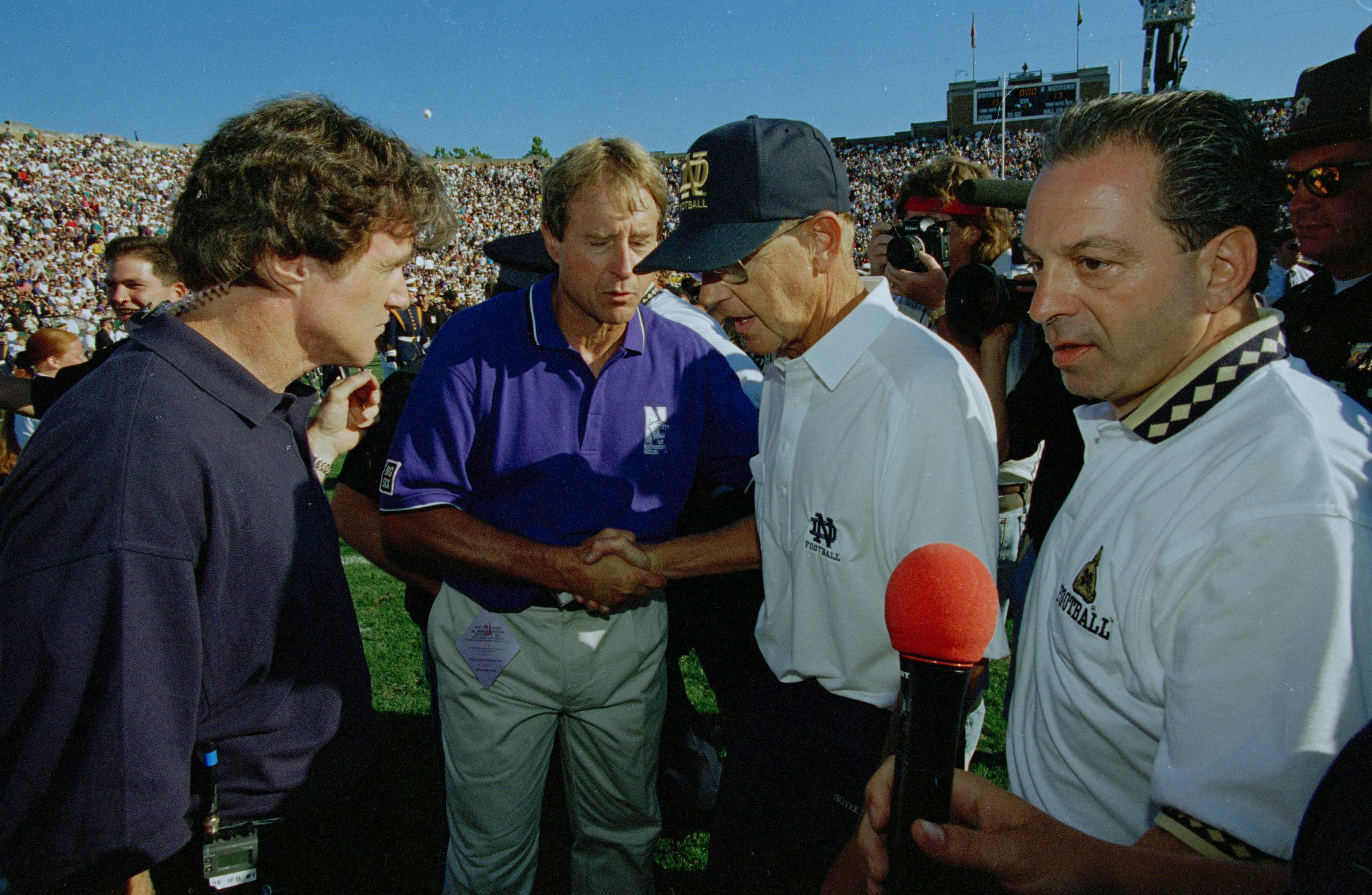
Northwestern coach Gary Barnett and Notre Dame coach Lou Holtz shake hands after Northwestern’s upset on Sept. 2, 1995, in South Bend. (Phil Greer/Chicago Tribune)
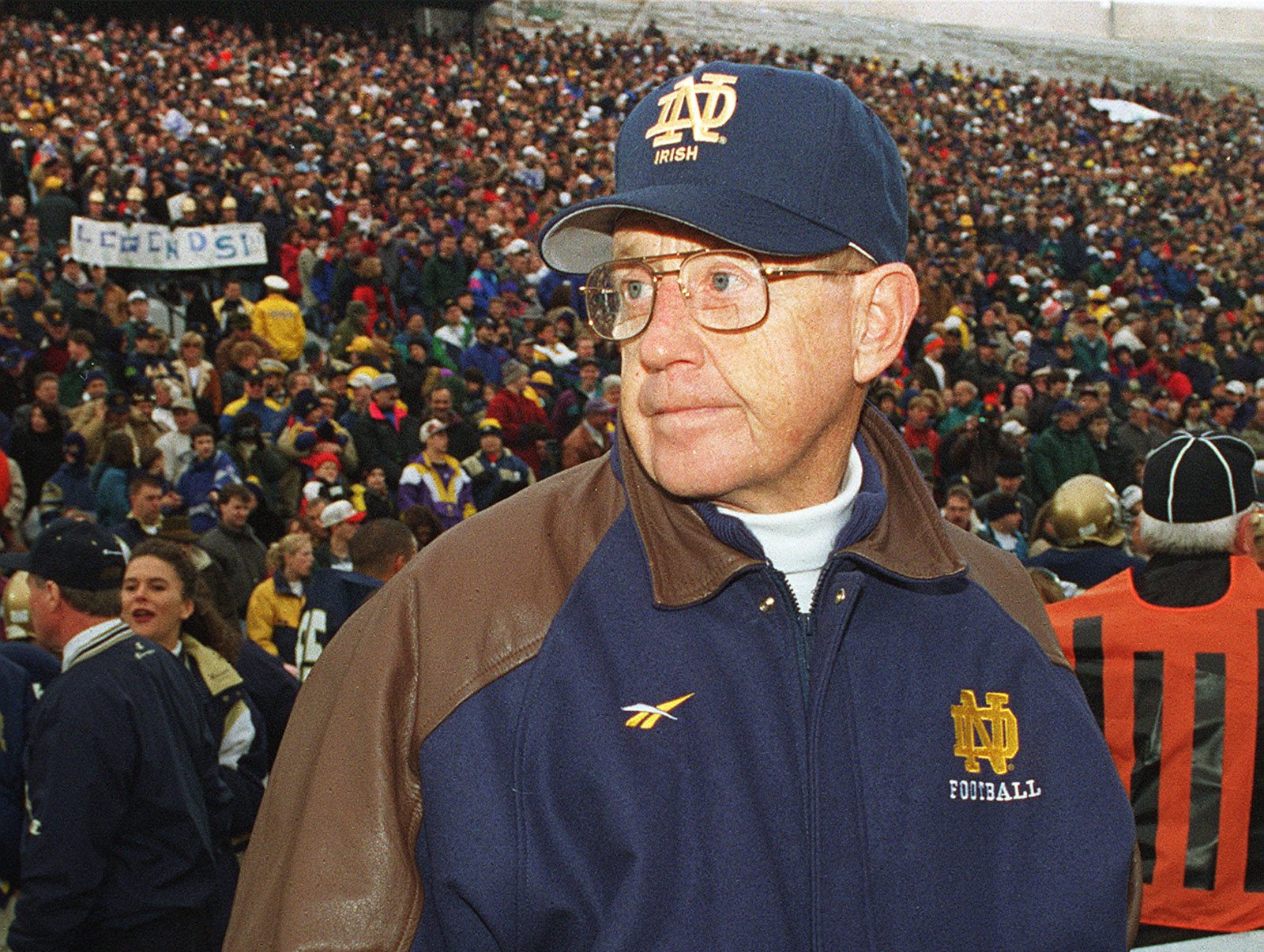
Former Notre Dame coach Lou Holtz, pictured in November 1996. (Joe Raymond/AP)
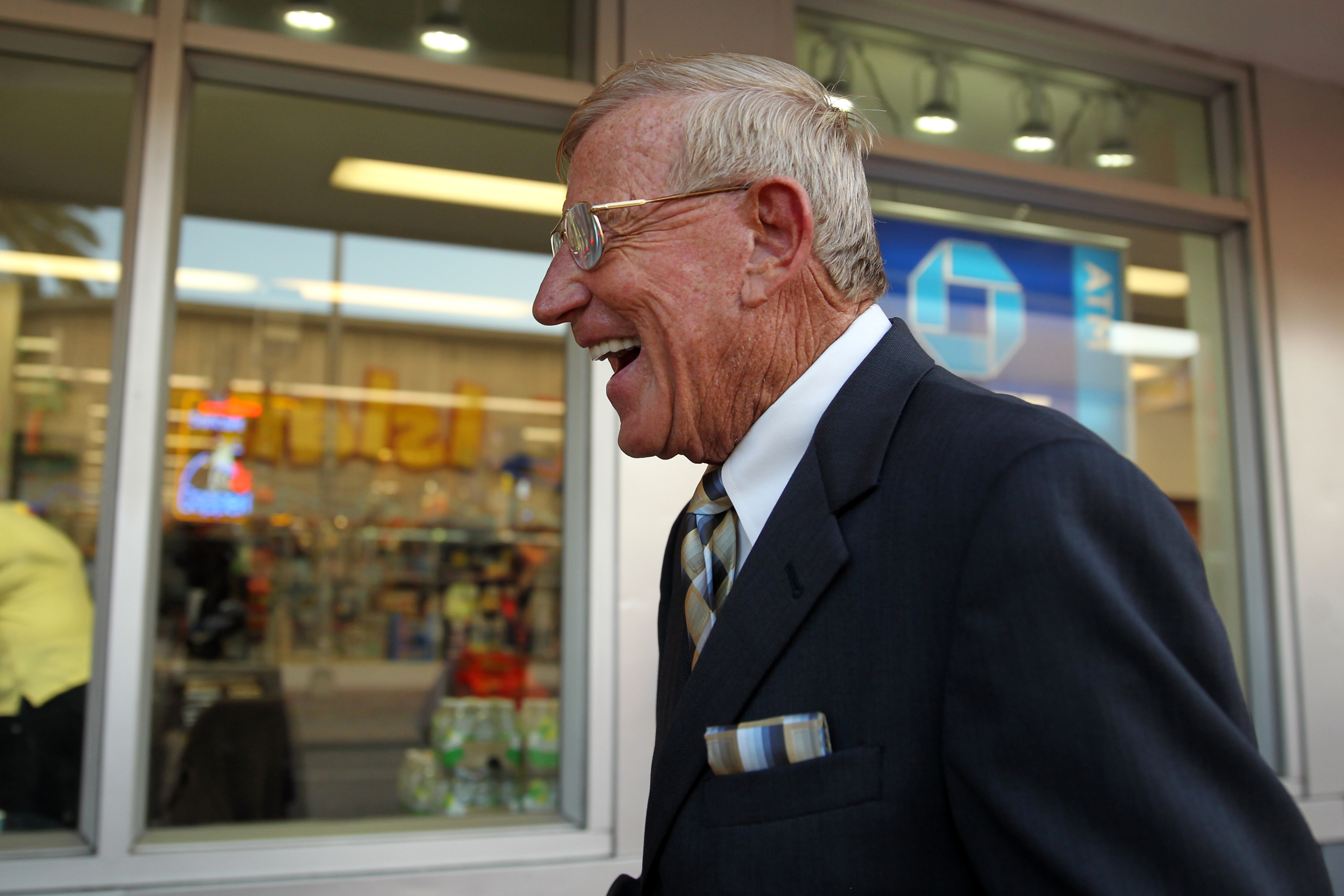
Former Notre Dame head coach Lou Holtz reacts to a fan’s comment while walking down Collins Avenue in Miami, Florida on Jan. 5, 2013. (Scott Strazzante/Chicago Tribune)
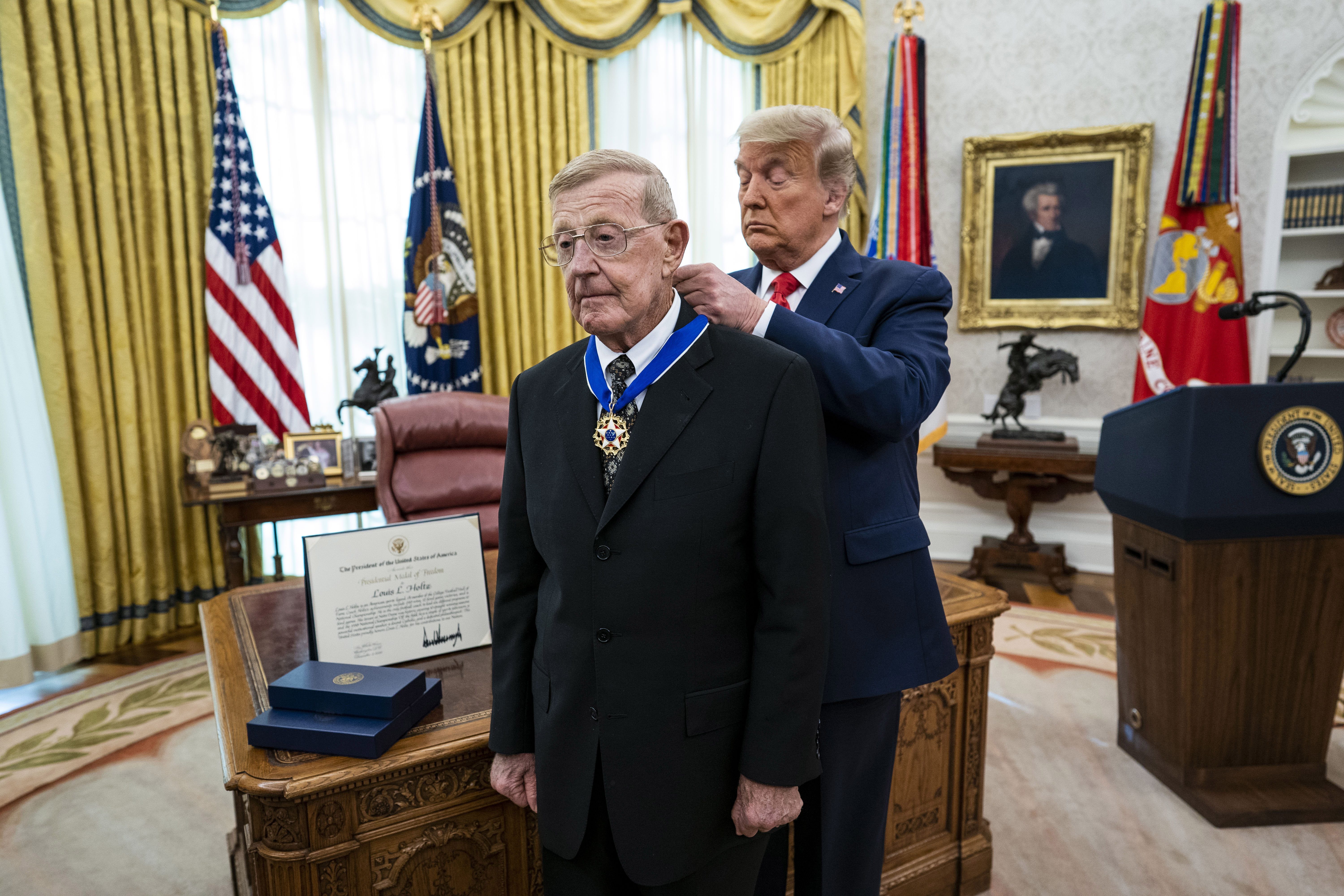
Lou Holtz, the famed college football coach, is presented with the Presidential Medal of Freedom by President Donald Trump in the Oval Office on Dec. 3, 2020, in Washington. Holtz coached six major colleges to bowl games and revived a floundering Notre Dame program, taking the Irish to an unbeaten national championship season in 1988. (Doug Mills/New York Times)
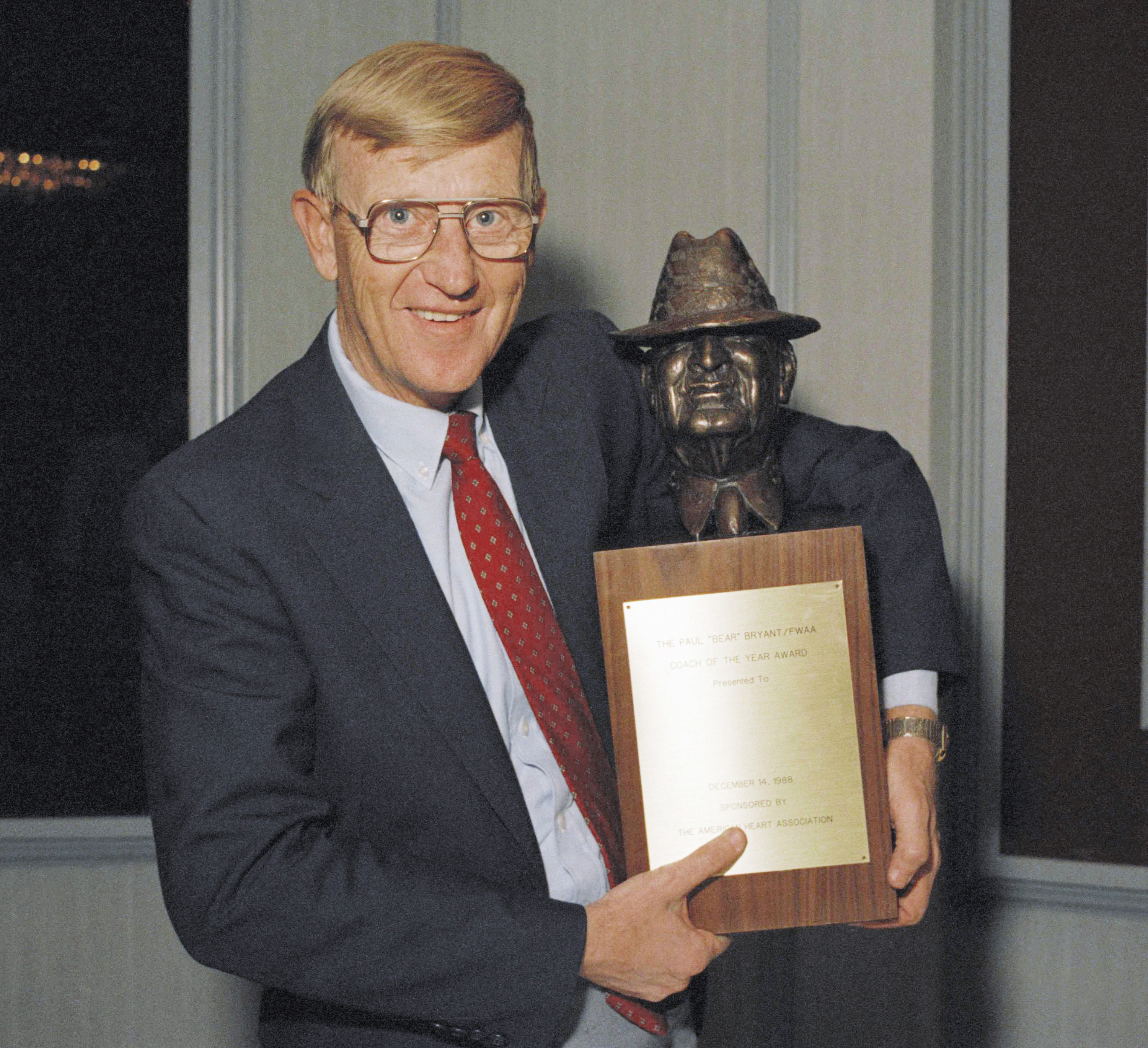
Notre Dame coach Lou Holtz holds the Paul “Bear” Bryant Coach of the Year award on Dec. 14, 1988, in Houston. (Pam MacDonald/AP)
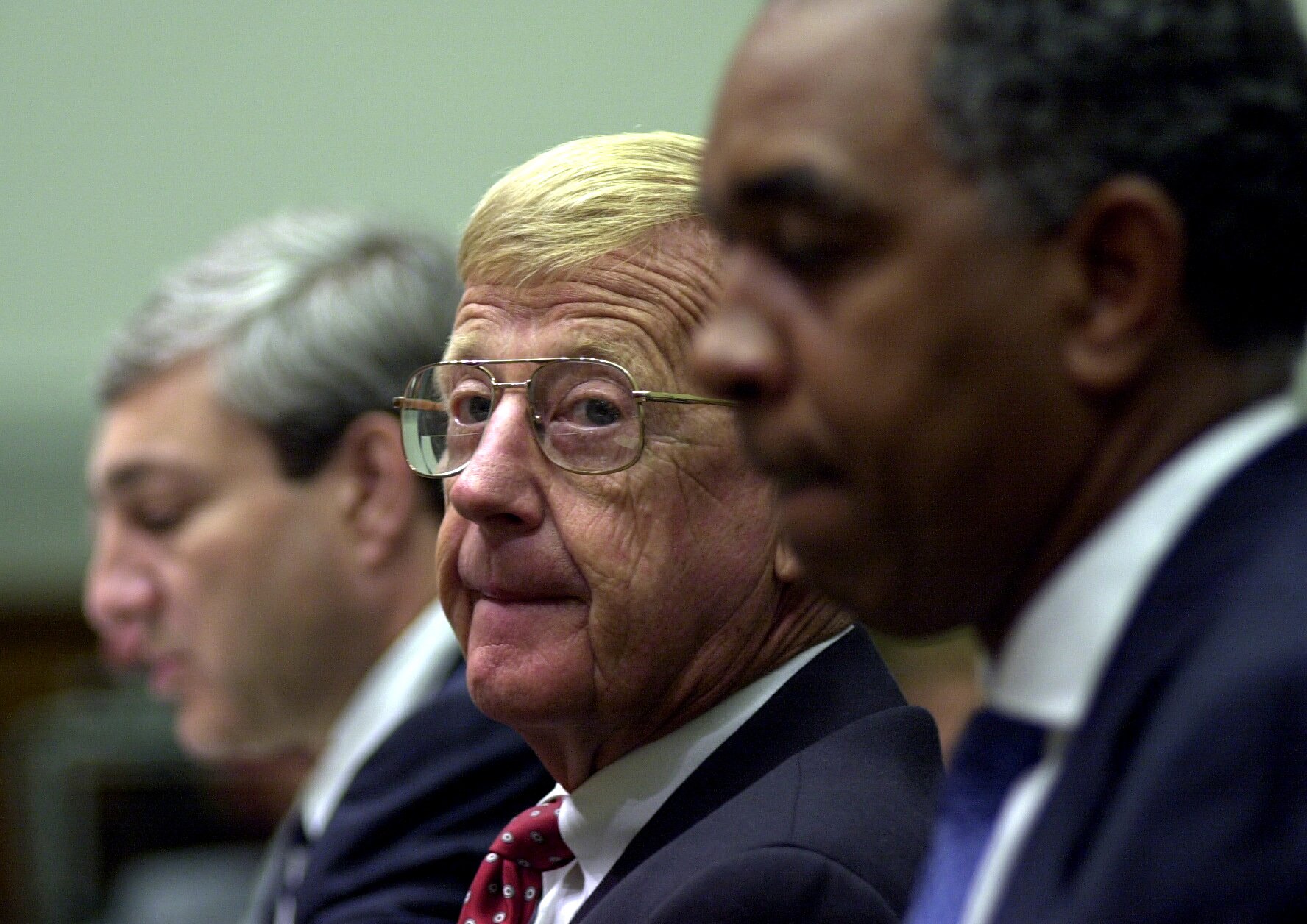
Tubby Smith, right, head basketball coach for Kentucky University, Lou Holtz, center, head football coach at Notre Dame and Dr. Graham Spanier, Chairman of NCAA Division I Board of Directors, were among the witnesses at a hearing on Capitol Hill looking into sports gambling on June 13, 2000. (Pete Souza/Chicago Tribune)
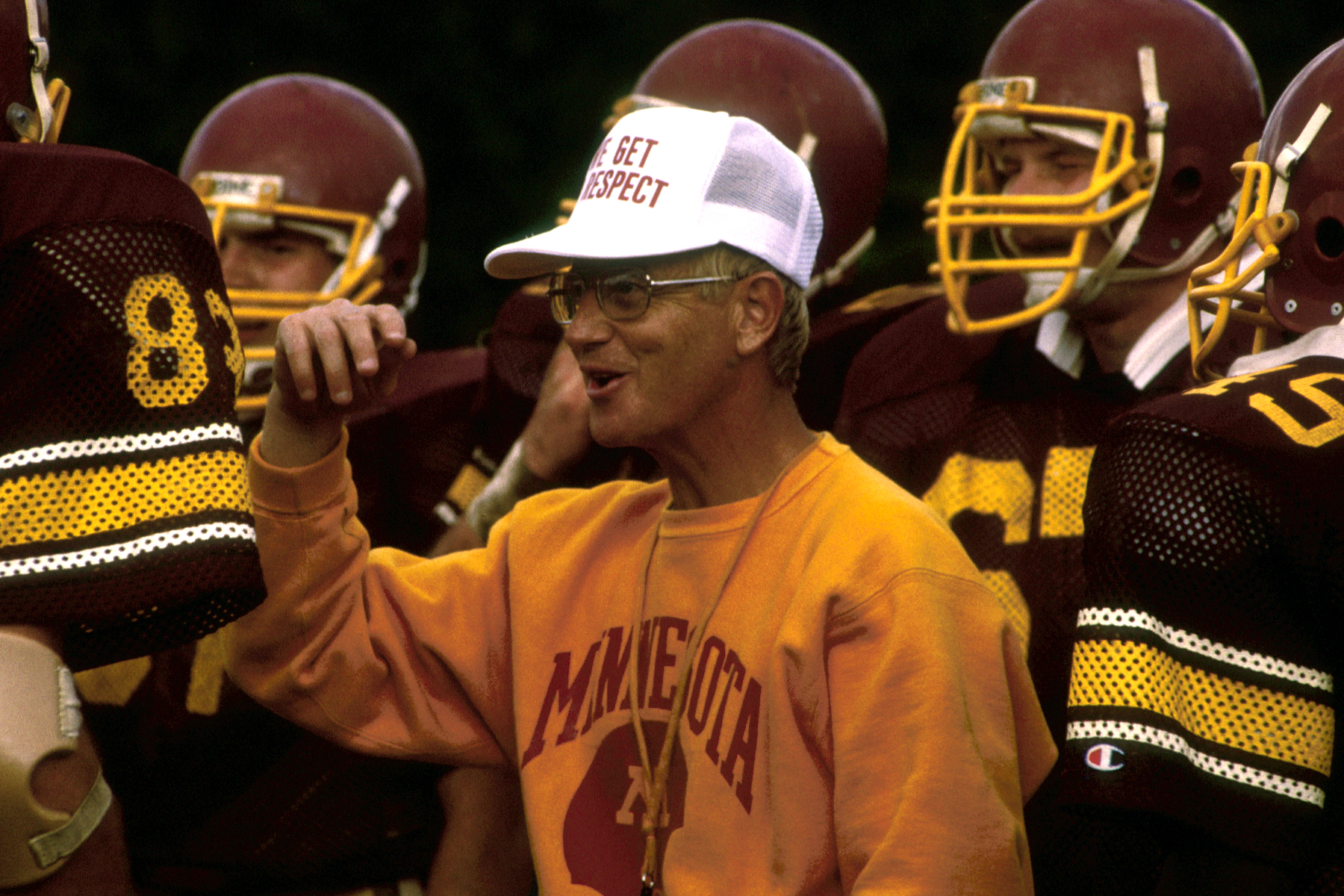
Lou Holtz was the Minnesota coach from 1983 to 1985. (University of Minnesota Athletics)
Show Caption
1 of 14
Lou Holtz announces he is stepping down as the head football coach at Notre Dame at a press conference in South Bend Indiana on Nov. 19, 1996. (John Kringas/Chicago Tribune)
Few of the players Holtz inherited had any idea who he was and their immediate impression — that of a smaller, slight man who talked a little funny with a distinct lisp — only raised more questions. But then he walked into his first team meeting and singled out the “biggest, strongest, meanest offensive lineman,” Corny Southall, a defensive back who was on that team, said Monday.
The lineman happened to be Chuck Lanza, the starting center. And Lanza on that particular day more than 40 years ago happened to be sitting in the front row, with his feet propped up on a ledge as Holtz walked in to address his new team. Lanza might’ve looked relaxed. He might’ve appeared confident or in control. That is, until Holtz walked past and kicked Lanza’s feet down.
“Get your feet off my stage,” Southall said, recalling the moment in Holtz’s tone. “And we all went, ‘Oh, my goodness. Who’s this 145-pound guy giving direction to all of us?’ He immediately took over the room. He said, ‘Everybody sit up!’ And all 101 players sat at attention in their chairs.
“I don’t think we breathed for probably 10 minutes.”
Holtz in his later years became something of a caricature, like an actor who leans into the over-the-top quirks of his role. Younger people might’ve known him best for his work as a commentator on ESPN, or for his commercials, or as the older guy who sometimes said questionable things in questionable ways about football, and then about social issues and politics.
At Notre Dame in the mid-1980s, though, he was all business. And those quirks that became trademarks later in life — the way of speech, the Yogi Berra-like malapropisms — belied a sense of competitiveness and a will to win he carried into coaching after growing up a child of the Great Depression in the coal-mining country along the Ohio and West Virginia border.
“He was old school,” his son, Skip, said Monday. “And from very humble beginnings. … He was a Depression baby. They didn’t have a lot of money. His dad drove a bus. His mom was a nurse.” And young Lou helped support the family in those years through his meager earnings delivering newspapers.
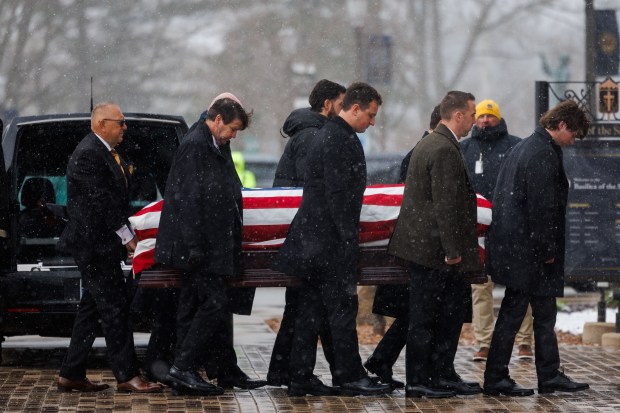 A flag drapes over the casket of former Notre Dame football coach Lou Holtz as it’s carried into the Basilica of the Sacred Heart at Notre Dame in South Bend, Indiana, on March 16, 2026. (Armando L. Sanchez/Chicago Tribune)
Growing up like that taught him resilience and strengthened his faith, Skip said.
“He believed circumstances don’t define who you are,” Skip said. “Choices do.”
When Lou Holtz first arrived at Notre Dame, the circumstances were unenviable. The history and tradition of a storied past offered constant reminders of present-day letdowns. The national TV deal with NBC was still more than four years away. Burgeoning national college football powers at Miami and elsewhere threatened Notre Dame’s place in the national hierarchy.
A proud program had become accustomed to losing. Part of Notre Dame’s identity was fading.
And then, after a modest five victories in Holtz’s first season, and a promising eight in his second, came 1988. It was a season that began with a narrow two-point victory over Michigan and one that included an even narrower 31-30 triumph over Miami in the notorious game dubbed “Catholics vs. Convicts.” And then, six more victories later, Notre Dame was 12-0 and national champions for the first time since 1977.
It had been more than a decade without such elation. And it has been almost 40 years since.
“So we feel a bond together,” Ned Bolcar, a former linebacker who was captain of that ’88 team, said Monday. “Like, hey, we brought Notre Dame back from the ashes to national prominence, (and to a) national championship.”
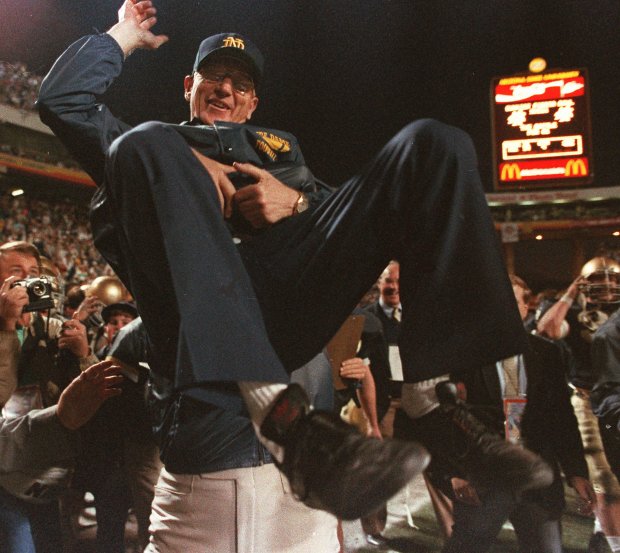 Notre Dame coach Lou Holtz is carried off the field on Jan. 2, 1989, in Tempe, Arizona, after the Fighting Irish defeated West Virginia in the Fiesta Bowl to win the national national championship. (Rob Schumacher/AP)
Bolcar was sitting Monday morning in a posh lounge, just inside the Knute Rockne Gate at Notre Dame Stadium, that did not exist when he was a player there almost four decades ago. A lot of things had changed. The TV money is a big part of the reason why, as is the general eruption in cash flow throughout major college athletics.
But without Holtz leading the turnaround in the mid- to late ’80s, and without Notre Dame reestablishing itself among the elite of a sport in which it has taken much pride over the past 100 years — well, who knows how things might’ve turned out. As it is, Notre Dame Stadium has grown into an 80,000-seat palace. Everything is shiny now, and state of the art.
And there are a great many players who were transformed, too, because of Holtz. Sitting across the room from Bolcar on Monday morning, Chris Zorich, the former defensive tackle who grew up in Chicago and later played for the Chicago Bears, became emotional at the thought of how Holtz had helped him.
This particular story, as Zorich recounted it, had little to do with football but it began there. It began with a team Mass before a road game his freshman season, long before he became an All-American and a coveted NFL prospect, back when nobody knew if he’d turn out to be a good football player or not. At the Mass, Holtz called on Zorich to read Scripture.
Zorich’s heart sank. He’d come to college with a stutter. Reading aloud terrified him.
He no longer remembers the verse he attempted to read. Only that it took him about three minutes to recite two sentences. Holtz stood by, watching. Not long after, Holtz asked to see him. He handed Zorich a slip of paper with details for an appointment with a speech therapist. Holtz had set it up himself, after wrangling with the NCAA to make sure it wasn’t a violation.
“That point changed my life,” Zorich said, growing emotional, and what has stayed with him all these years is that, at the time, he was an unknown. A relative nobody blending into the crowd of a large team. “I wasn’t a starter. Like, I’m not Tim Brown. I didn’t just win the Heisman. I’m a freshman, holding bags.”
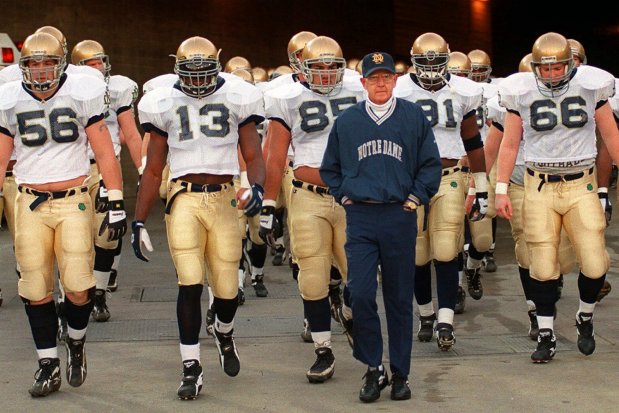 Coach Lou Holtz leads his Notre Dame team onto the field for a game against USC at the Los Angeles Coliseum in Los Angeles on Nov. 30, 1996. (Kevork Djansezian/AP file)
Zorich was hardly the only one who shared that kind of story in the hours before his old coach’s funeral. For Beuerlein, who spent 14 seasons in the NFL, Holtz reignited his self-confidence after he labored through a 14-interception season the year before Holtz’s arrival — a season after which Beuerlein honestly believed he’d never play quarterback at Notre Dame again.
It was a different time then, though. One before NIL. Before the transfer portal.
Southall, the starting free safety on the ‘88 national championship team, who went on to a lengthy career with the Secret Service, laughed Monday upon the thought of an alternative universe with a transfer portal in the mid-1980s. He figures it would’ve been crowded with Notre Dame players after Holtz’s first team meeting.
“That first day that we met Coach Holtz, and we went through what we did, and then the next morning, we had 5:30 workouts outside,” Southall said. “I believe we all would have transferred. If the transfer portal was there 37 years ago, we all would have transferred.
“Because we were like, ‘This guy’s crazy.’”
There was a touch of crazy, to be sure. Perhaps more than a touch.
During his eulogy on Monday, the Rev. John Jenkins, the former president of Notre Dame, alluded to some of Holtz’s quirks. And not those related to his manner of speech, or his small stature that always made him appear comically out of place on a football sideline. While Jenkins described Holtz as a “a man of love who showed that love to everybody encountered,” he spoke of the other side.
“My intention today is not to paint a halo around his head and gloss over his faults,” Jenkins said. “Those for whom he worked, those who worked for him, knew that he could be volatile, hardheaded. His players can tell you that he was often impossibly, maddeningly demanding.
“He could be hard to manage, hard to work for, hard to play for. … Lou would be the first to admit these things,” the priest said.
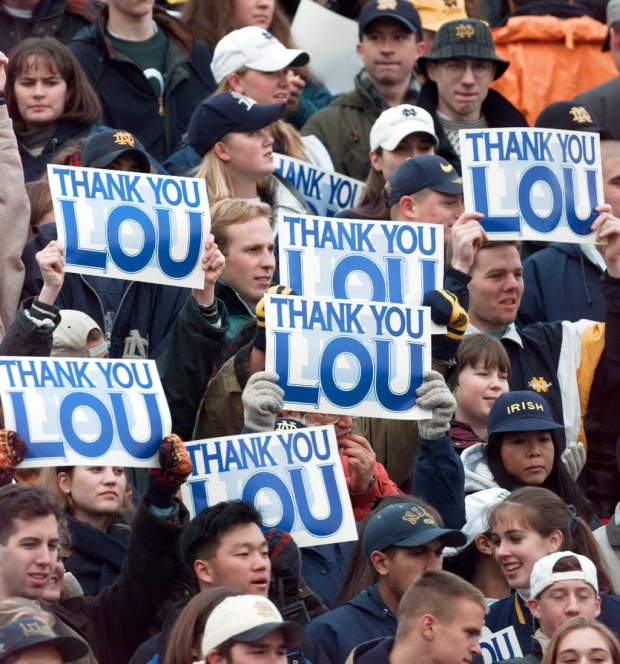 Notre Dame students show their support for coach Lou Holtz during the game against Rutgers on Nov. 23, 1996, in South Bend, Indiana. It was Holtz’s last home game as the Fighting Irish’s coach. (Beth A. Keiser/AP)
It was in part because of those traits that Holtz reestablished Notre Dame as national champions. And it was because he made room for another side — the one that drove him to help a freshman overcome his stutter, and allowed a broken quarterback to rebuild himself — that so many of those he coached gathered in the pews on Monday and along the railing of a bar the night before.
Inside the Linebacker Lounge on Sunday night, Tom MacDonald took orders and reunited with old teammates. He doesn’t work there, but he said he had his bartender’s license and no one seemed to mind. A former walk-on from 1991 through ’94, he played in a total of eight games and made no memorable plays. Even the most ardent of Notre Dame football fans would not be able to pick him out of a lineup, or name him.
But he carries memories from his time in South Bend as deep as any All-American’s. He can see himself like yesterday somehow getting into a trash-talking scrum with Florida State players before the 1993 “Game of the Century” — the game Bob Costas introduced on NBC with an essay about Main Street and boyhood dreams — but what MacDonald remembers most isn’t football.
It’s Holtz gathering all the freshmen after preseason camp in 1991 and leaving them with an order.
“He told us all to go home and to write a letter to our moms thanking them for everything they’ve done,” MacDonald said. “And for us to tell our moms how much we love them.”
Thirty-five years later, it sticks out as much as any game. Stories like that one circulated often Sunday and Monday, first inside an old campus bar and then inside the church.
When the funeral concluded after about 75 minutes Monday, the procession ended at Cedar Grove Cemetery, on the edge of campus. Knute Rockne and other Notre Dame luminaries are buried there and so is Holtz’s wife, Beth, who died in 2020 after 59 years of marriage. They’d been waiting to be reunited.