
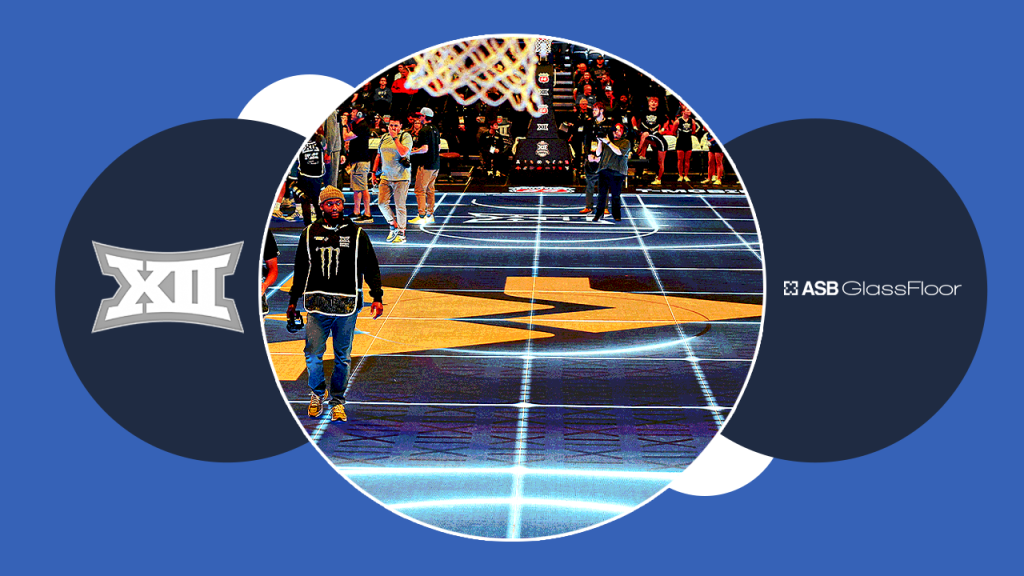
ASB GlassFloor, the Swiss manufacturer behind the controversial glass basketball court installed—and then ultimately removed—during last week’s Big 12 basketball tournament, has since defended itself by citing a study of the surface commissioned by the NBA ahead of the 2024 All-Star weekend.
ASB’s LumiFlex flooring contains LED panels sealed beneath tempered safety glass, which are covered in ceramic dots that are designed to improve friction to prevent slipping.
But its high-profile collegiate debut at the T-Mobile Center in Kansas City, Mo., proved rocky—or, critics say, too slick—after Texas Tech star guard Christian Anderson strained a muscle while slipping on the surface during a quarterfinal loss to Iowa State. Following Anderson’s injury and complaints from other players and coaches, Big 12 commissioner Brett Yormark announced that a traditional wooden court would replace the glass for the tournament’s final two rounds.
In an interview last week with CBS Sports, Benedikt von Dohnanyi, ASB’s CEO, touted the NBA’s study of his product, saying it scientifically concluded the glass court “plays the same as a wooden court,” including “from a grip perspective.”
However, the 50-page report by engineering consulting firm Rimkus—reviewed by Sportico—suggests a more nuanced conclusion.
While Rimkus concluded that its research and the available data did not suggest “increased risk of injury” for NBA’s intended use, it also acknowledged the significant limits of the analysis.
In the aftermath of the Big 12 tournament, an ASB spokesperson said company had launched “an active investigation” that included engaging an “independent scientific institution.”
“This process is our highest priority at this point to ensure we continue to meet the 100% satisfaction rate we have achieved at other high-profile venues,” a company spokesperson said in a statement.
Despite von Dohnanyi’s public comments last week, the ASB spokesperson declined to specifically address questions about Rimkus’ report, saying, “We generally do not comment on specific details in external studies not commissioned by us.”
The spokesperson added that the company has worked with “various independent test institutes globally,” and that its floors, including the one used in Kansas City, have undergone “strict, independent testing” as part of their certification for use by FIBA.
The Big 12 declined to comment, and a spokesperson for Rimkus did not immediately respond to an email inquiry.
The NBA retained Rimkus in 2024 to evaluate the safety of the court for limited use during All-Star Weekend events, including the skills challenge, 3-point contest and slam dunk contest. The firm assessed performance metrics such as force reduction, vertical deformation, ball rebound, surface friction, flatness and surface temperature—but only in the context of non-game use.
“It was beyond the scope of the assignment to address all possible sources of injury from the playing surface … so we are unable to opine on the overall safety of the court for full game use,” the study said. “Additional considerations, such as risk of skin abrasion, fall injury risk, and court-shoe traction may warrant additional tests if the floor is to be used on a frequent basis for training or competition.”
The study also noted the testing was not conducted on a full court. Instead, Rimkus examined four panels—each measuring roughly 6.5 feet by 5 feet—that were placed atop a ceramic-tiled floor in the atrium of the NBA’s headquarters in Secaucus, N.J. The tests were conducted in an environment with an air temperature of 72 degrees and relative humidity of 20%.
Due to the small sample size, the study’s researchers said they lacked the ability to assess the “uniformity of a larger set of panels.” A more thorough examination would have included linear and rotational traction testing on the floor using a standard basketball shoe.
Rimkus noted that the rubber of the test foot it used was “rapidly worn down by” the ceramic dots on the floor.
“This resulted in rubber residue being left on the court, which may reduce the surface frictions,” the report said. “It would also be expected to wear down the shoe outsole and potentially reduce shoe-surface traction.”
According to Rimkus, the NBA lacked its own formal standard for assessing court performance, so the firm based its testing methodologies on guidelines from FIBA, ASTM International (formerly the American Society for Testing and Materials) and the Maple Flooring Manufacturers Association. The LumiFlex floors’ results were compared against practice and game courts used by the Atlanta Hawks, Cleveland Cavaliers, Detroit Pistons, Houston Rockets and Milwaukee Bucks.
To measure surface friction, Rimkus used two methods: the ASTM standard (ASTM E303-22) and the British Pendulum Tester, also known as the XL Variably Incident Tribometer.
In dry testing conditions, the ASB glass court registered lower surface friction—meaning the court was more slippery—than any of the NBA hardwood courts under the ASTM standard, though it was still within the range considered slip-resistant. The glass court produced higher friction readings when measured using the British Pendulum Tester. The report noted the contradictions of these findings are “not typically seen for standard flooring and was not apparent among the NBA courts tested.”
When the surfaces were wet, Rimkus found the ASB glass court’s slip resistance held up better than that of the NBA hardwood floors.
When it came to force reduction, the level of shock absorption provided by the floor, and vertical deformation, or how much the surface deflects underfoot, Rimkus found that that the ASB floor “appears to be slightly stiffer/less shock absorbent” than the average NBA courts, but “within or very close” to their range.
“This would not be expected to pose an issue for the NBA All-Star Skills Challenge since players are not spending an extended time on the court,” the report stated. “However, should the court be used for training or game play on a frequent basis, additional considerations may be warranted.”
About a month prior to the conference’s public announcement on Feb. 12, the league briefed basketball coaches about its interest in using the surface in Kansas City and encouraged teams to check out a full-court model the company had set up at a court testing facility in Orlando while they were in the area to play UCF.
While the NBA-commissioned study was not the only factor, one Big 12 school official told Sportico that was among the materials discussed.
Beyond the 2024 NBA All-Star Weekend, the court has been used for the 2023 FIBA Under-19 Women’s World Cup in Madrid, and it has also been employed by European clubs FC Bayern Basketball and Panathinaikos BC. The University of Kentucky used the floor for its “Big Blue Madness” event ahead of the 2024-25 basketball season, though no NCAA college game had been played on it until last week.