
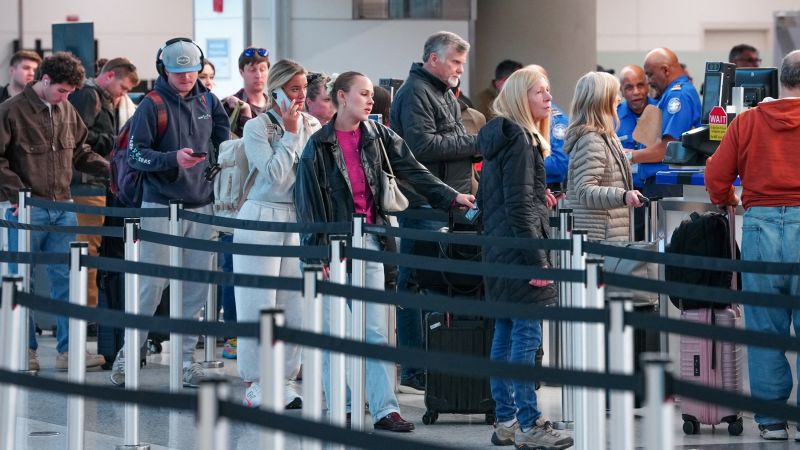

Long waits at airport security checkpoints can be caused by a variety of personnel factors and can change suddenly, making it hard for travelers to predict.
“When we flew here, it wasn’t like this at all. So this is just crazy,” Kennedy Taylor told CNN as she waited in line yesterday at Hartsfield-Jackson Atlanta International Airport.
Transportation Security Administration screeners have been working without pay as the Department of Homeland Security remains unfunded due to a stalemate in Congress over immigration enforcement.
Some TSA officers have quit and others are calling out to take unscheduled time off. Government employees are not allowed to strike, so the actions are not organized, union leaders say, but rather reflect personal situations.
“Officers are not just not showing up, they have reasons for not showing up. Whether it is ‘I can’t put gas in my car, I have to take care of my children,’” Aaron Barker, an American Federation of Government Employees union leader in Atlanta, said Monday.
And just because an airport has long lines on one day does not mean it will still be bad a few days later.
A little more than a week ago Houston Hobby airport saw TSA lines reach nearly three hours long, but this week they’ve been shorter, at times clocking in at less than 10 minutes.
The flow of passengers through airport checkpoints also varies throughout the day with airports reporting busy checkpoints before 9 a.m. then again in the late afternoon.
The specific checkpoint a traveler uses can also impact their wait time.
Atlanta saw peak lines of nearly two hours Tuesday at the main checkpoint. As the day continued, more domestic passengers went to the usually quick international checkpoint on the other side of the airport. The line there quickly swelled to more than an hour while the domestic wait times dwindled to just a few minutes before rapidly growing again.
CNN’s Alexandra Skores, Ryan Young, Jason Morris and Chris Youd contributed to this report.