
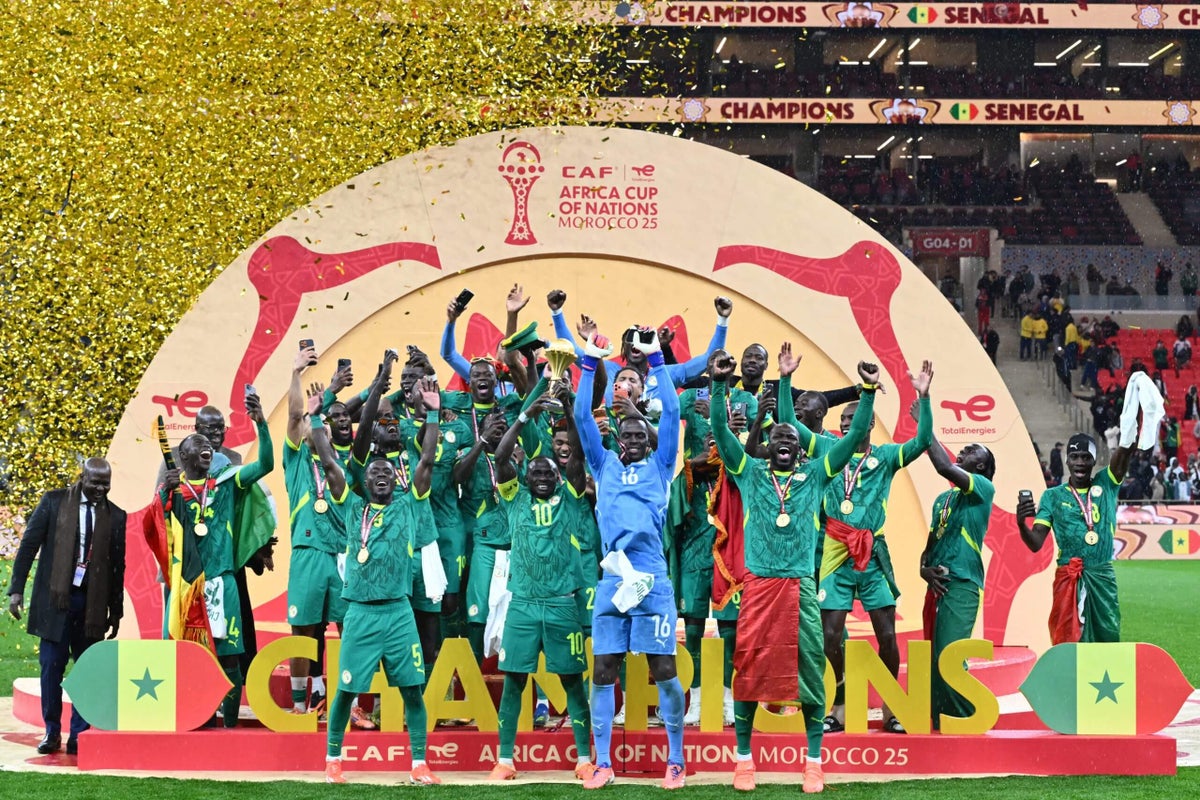
The result of the 2025 Africa Cup of Nations final has been reversed, with hosts Morocco now standing as 3-0 winners after a stunning decision from the competition organisers.
The Confederation of African Football released a statement on Tuesday evening, 57 days after the final, saying that its appeal board had declared that Senegal have now forfeited the game, which they had won 1-0 on January 18.
CAF said the decision came after an appeal from the Royal Moroccan Football Federation (FRMF) following that match, which Senegal won in extra time after the team walked off the field during normal time in protest at a refereeing decision.
FIFA president Gianni Infantino, who attended the final, had said it was “unacceptable” that Senegal players had left the pitch, causing a delay of more than 15 minutes.
Morocco announced their intention to raise legal proceedings the day after the game, with CAF also saying it was reviewing what had occurred.
What happened in the game?
Play was delayed by around 16 minutes after Morocco were awarded a penalty in second-half stoppage time, with Senegal having seen a potential match-winning goal disallowed only minutes before. Senegal head coach Pape Thiaw encouraged his players to leave the pitch, with captain Sadio Mane the only one remaining.
After Senegal’s players had returned, Morocco’s Brahim Diaz missed his penalty. Senegal’s Pape Gueye then scored the game’s only goal in the 94th minute.
The final was further marred by fighting in the stands at the Stade Prince Moulay Abdallah, with clashes between Senegal and Morocco fans, as well as stadium security staff, occurring during the delay in proceedings.
Why the result was overturned
In CAF’s statement on Tuesday, the governing body said that its appeal board found that Senegal’s actions were “within the scope of articles 82 and 84″. It said that Senegal “infringed article 82” of the AFCON regulations, which state that a team will forfeit the game if it “leaves the ground before the regular end of the match without the authorisation of the referee.”
Article 84 subsequently states that the forfeiting team will be ruled to have lost the match 3-0, unless the opponent was leading by a more advantageous scoreline.
‘Crybabies’ – How Senegal’s players reacted to the decision
The Senegalese Football Federation (FSF) is yet to comment officially on the decision, though shortly after the decision was made public, it posted a video on its social media channels showing the open-top bus celebrations in the country following the final. Several members of the squad also posted their reaction on social media.
Crystal Palace winger Ismaila Sarr posted an Instagram story with several laughing emoji, while West Ham United’s El Hadji Malick Diouf wrote: “Champions, speak up!”
Lyon’s Moussa Niakhate said: “Come and get them (the medals). They are crazy.” Goalkeeper Yehvann Diouf reposted an image of Senegal’s trophy celebrations, with the caption: “In the eyes of the whole world.”
“You can add three more goals in favour of the crybabies,” Rayo Vallecano midfielder Pathe Cis wrote, with a laughing emoji. “Champions of Africa!”
— Equipe du Sénégal (@GaindeYi) March 17, 2026
The FRMF acknowledged the decision, saying: “The FRMF wishes to emphasise that its approach has never been intended to challenge the sporting performance of the teams taking part in this competition, but merely to call for the enforcement of the competition rules.”
“The federation reaffirms its commitment to compliance with the rules, to a clear competitive framework and to the stability of African competitions.”
It added that it would issue an official statement on Wednesday.
Can Senegal appeal?
CAF’s statement twice said that “all other motions or prayers for relief are dismissed” following the decision of its appeals board.
Senegal, who previously won AFCON in 2021, could though take the case to the Court of Arbitration for Sport, the Swiss-based independent court which resolves sporting disputes across the globe.
‘Shameful and disgraceful’ – What Morocco said of the final
Speaking in a news conference immediately after the final, then-Morocco coach Regragui said the incident around the penalty gave a “shameful and disgraceful” image of African football. “The coach (Thiaw) asked his players to leave the pitch,” Regragui added. “I have always said that in the end, you must always stay in place in defeat and victory alike.”
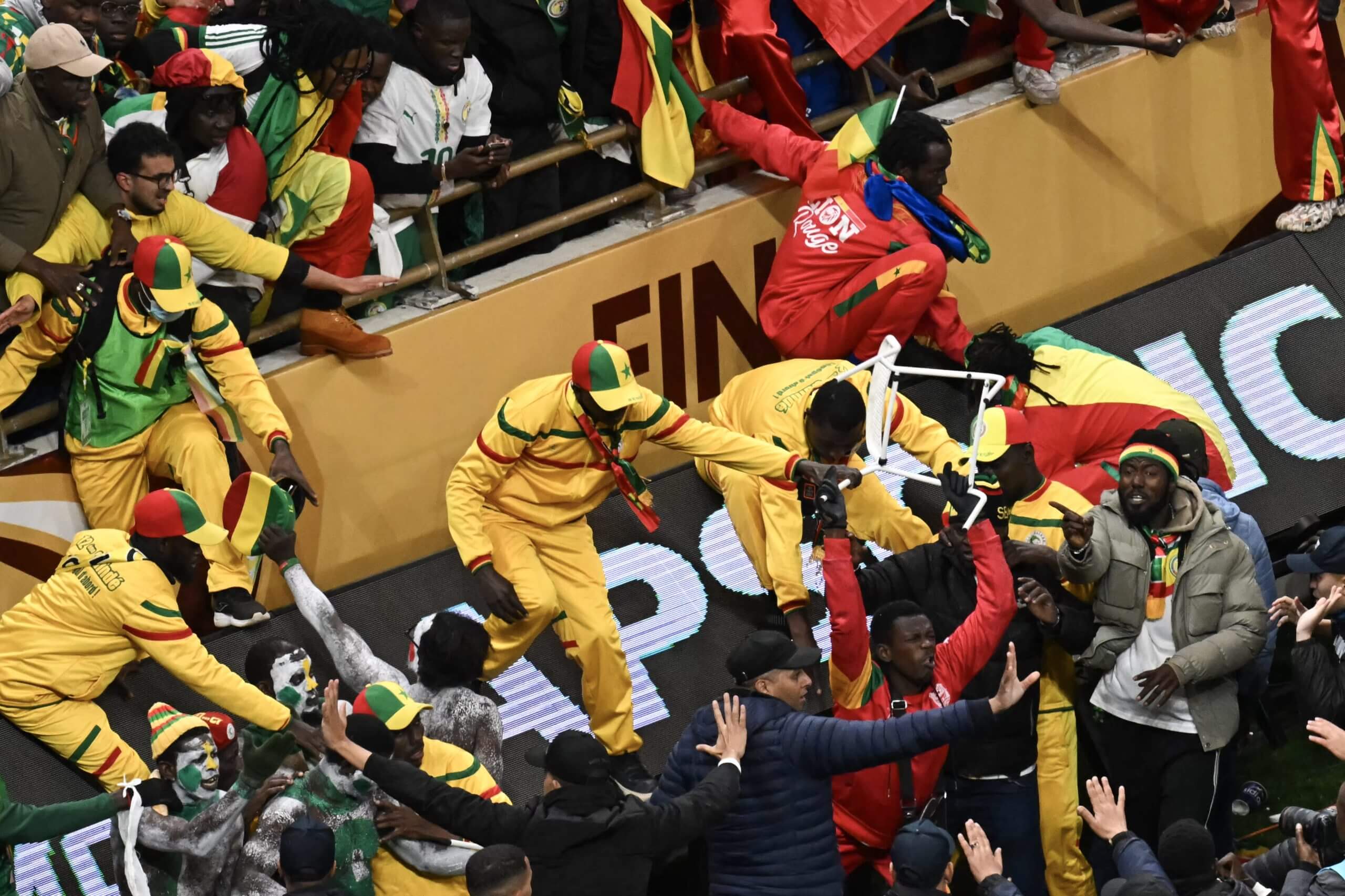
Supporters clashed with each other and security personnel during January’s final (Paul Ellis / AFP via Getty Images)
More reaction came in the day after the game, with the FMRF lodging its formal complaint within 24 hours. It said in a statement it would “resort to legal procedures with CAF and FIFA” after Senegal’s protests “significantly impacted the normal flow of the match and the players’ performance”.
Similarly, CAF described Senegal’s actions as “unacceptable” and “inappropriate”, adding that it was “examining all the images”.
Infantino also posted his reaction on Instagram the day after the final. “We must always respect the decisions taken by the match officials on and off the field of play,” he wrote. “Teams must compete on the pitch and within the Laws of the Game, because anything less puts the very essence of football at risk.”
In the days after the final, Thiaw was fined $100,000 (£72,000) by CAF, who said the 44-year-old was guilty of “unsporting conduct” and “bringing the game into disrepute”.
Senegal forwards Iliman Ndiaye and Sarr each received two-match bans for “unsporting behaviour towards the referee”.
CAF also distributed fines totalling more than $1m. The FSF was fined $615k for breaches of CAF’s disciplinary code, while the FRMF was fined $200k for the “inappropriate behaviour” of ball boys — which was halved on Tuesday.
The FRMF’s $100k fine for the “improper conduct of players and staff, who invaded the VAR review area” has been upheld, but the $15k fine “for the use of lasers by supporters” was reduced to $10k.
Tensions between Morocco and Senegal
After the fighting in the stands at the AFCON final, some Senegal fans were detained in Morocco and 18 were eventually jailed for hooliganism offences, per BBC Sport.
The FSF issued a statement on the ruling, saying that it was closely monitoring the situation and that the Senegalese government was “fully committed to this cause” of ensuring “respect for their fundamental rights and to provide them with appropriate legal assistance”.
In quotes carried by the BBC, Senegal president Ousmane Sonko said that the matter had gone “beyond the realm of sport”. “For two countries that call each other friends, like Morocco and Senegal, things should not have gone this far,” he said.
After the sentences were handed out, protestors marched through the Senegalese capital of Dakar in late February, demonstrating against the convictions.
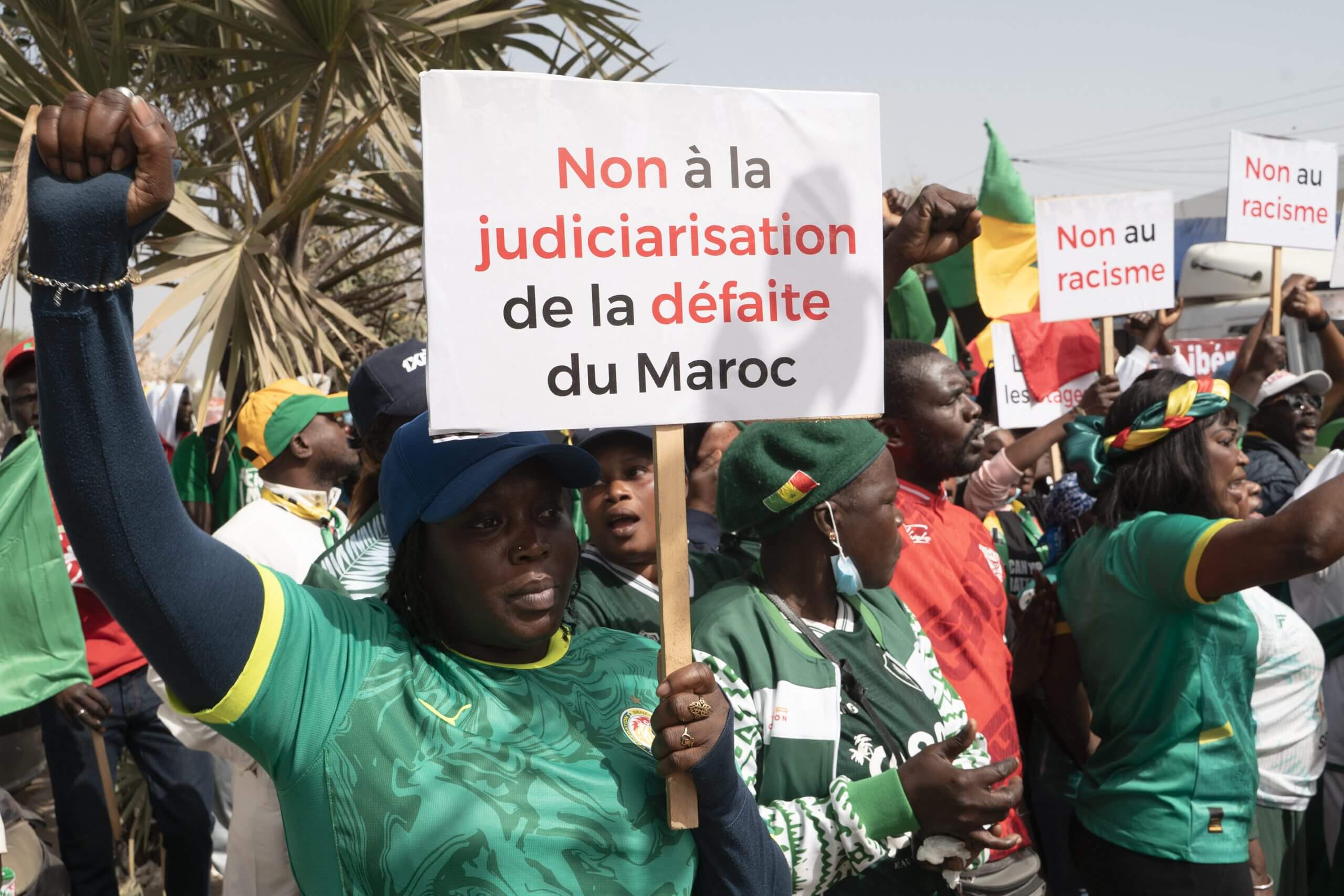
Protests against the Moroccan judicial sentences (Seyllou / AFP via Getty Images)
Tensions between the two nations had begun to rise even before the final, with the FSF releasing a statement complaining about the Senegalese ticket allocation at the Prince Moulay Abdellah Stadium and the standard of accommodation.
Senegal coach Thiaw also criticised the security operation for the players after the squad was forced to move through a large crowd at Rabat station two days before the final.
“The players were in danger,” he said. “Anything could have happened if there were people with bad intentions. And this, this should not happen, especially between our two countries, like we have always said.”
During the match, tensions also broke out between members of the media, with skirmishes occurring in the press box between reporters from the two countries.
Awkward questions for CAF over Morocco treatment
Analysis from football writer Jay Harris
This is a wild sequence of events and there is a lot to unpack.
Senegal clearly violated CAF’s rules when they walked off in stoppage time after Morocco were awarded a penalty for Diouf’s challenge on Diaz, but the wider context is crucial.
There was a feeling throughout the tournament from many observers that the hosts Morocco benefited from favourable refereeing decisions.
There were a few questionable incidents in their victory over Cameroon in the quarter-finals, including Adam Masina escaping any punishment for an elbow on Karl Etta Eyong and a separate tackle on Bryan Mbeumo in the penalty box. Nigeria’s full-back Bright Osayi-Samuel criticised the officiating following their defeat by Morocco in the semi-finals. Senegal had a goal wrongly disallowed in the final moments before Morocco were awarded a penalty. This is why Senegal reacted angrily and their fans protested in the stands.
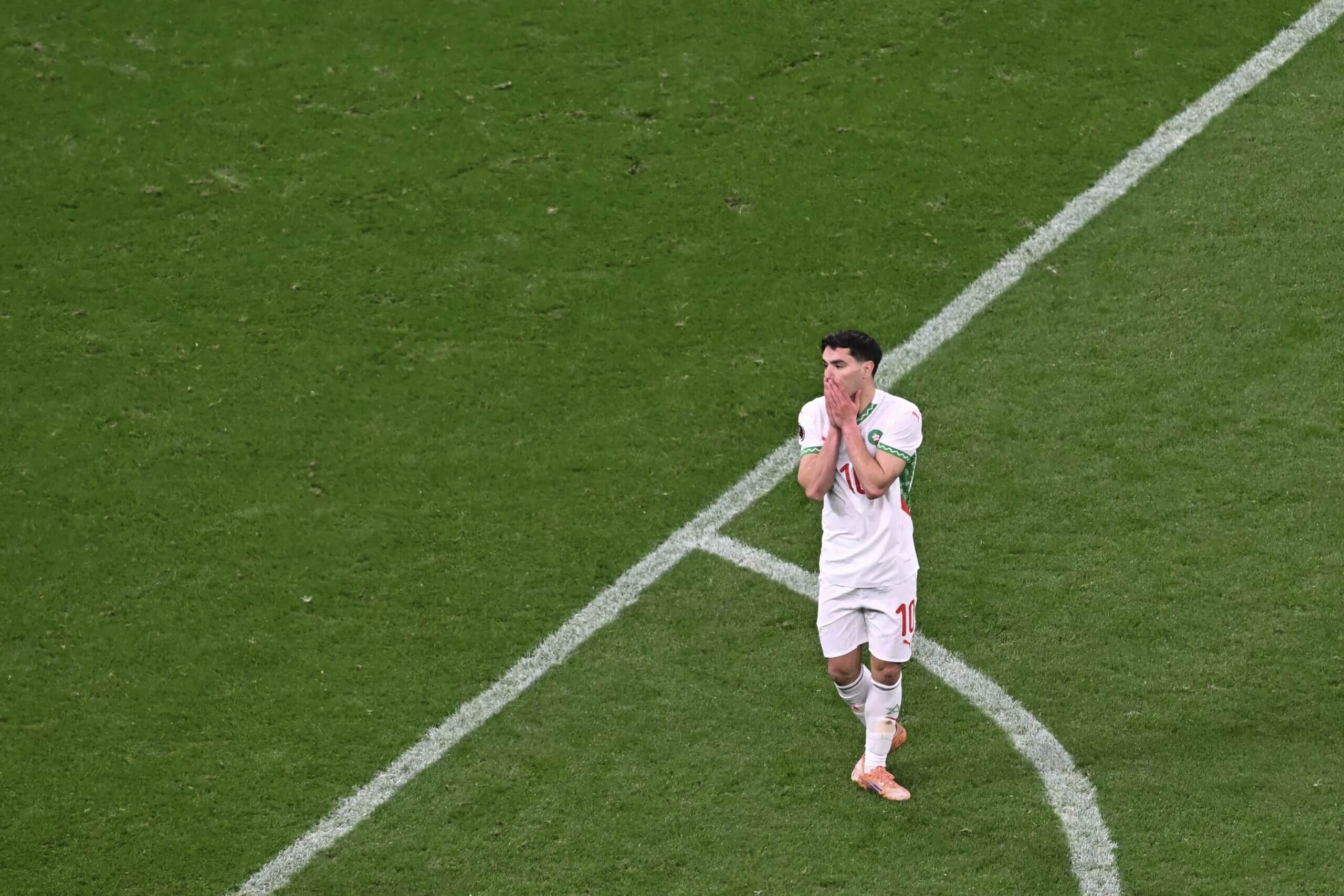
Morocco’s Diaz missed the crucial penalty on the night (Paul Ellis / AFP via Getty Images)
The CAF appeal board’s decision will sting because it will be seen by many people like Morocco have kicked up a fuss and managed to get their own way. It fuels a criticism from some observers that Morocco holds too much political sway with CAF.
It also raises a lot of awkward questions for CAF about what happens next. Are they going to strip the Senegal squad of the trophy and their medals? Will anybody outside of Morocco actually recognise this victory? And how must Walid Regragui be feeling after he resigned as Morocco’s head coach in the aftermath?
CAF will receive a lot of criticism for this decision and to further stoke the flames, Morocco’s punishments for their behaviour during the final have been reduced. Ismael Saibari and several Moroccan ball boys tried to steal the towel of Senegal’s goalkeeper Edouard Mendy. Saibari’s three-match ban has been reduced to two games, with one of them suspended, while his $100,000 fine has been wiped.