
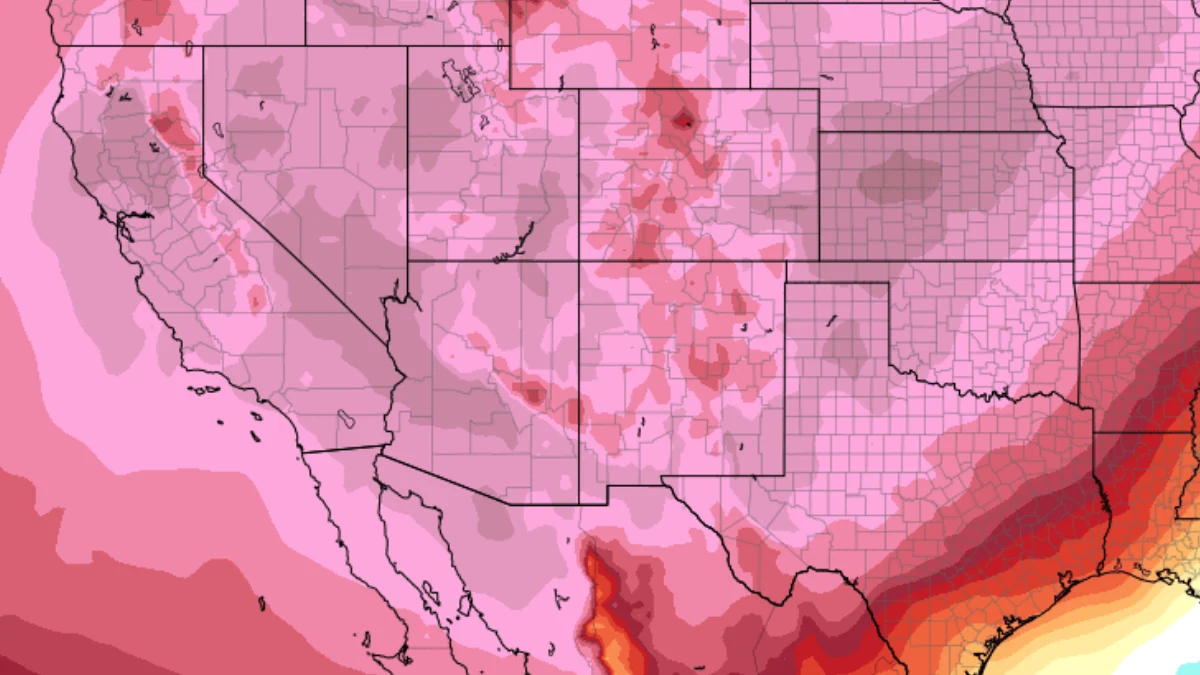
A strong and persistent high-pressure system has stalled over the Desert Southwest on March 18 and will bring a widespread and potentially record-breaking early-season heatwave across the western United States.
The stalled system is forecast to expand, allowing the heat to spread eastward from California and the Great Basin into the Rockies and Great Plains by March 20. This configuration suppresses cloud formation and enhances solar heating, supporting continued temperature increases across a broad region.
Forecast high temperatures are expected to reach 40–44°C (104–112°F) across the Desert Southwest, particularly in southeastern California, southern Nevada, and Arizona. More broadly, temperatures in the 26–38°C (80–100°F) range are forecast across California and the Great Basin, indicating widespread summer-like conditions for mid-March.
Multiple daily and monthly temperature records for March are likely to be tied or broken across multiple states. Several locations in the Desert Southwest are also likely to record their earliest occurrence of temperatures reaching over 37.8°C (100°F).
Video credit: Tropical Tidbits
Extreme Heat Warnings have been issued by the National Weather Service (NWS) for large portions of southeastern California, southern Nevada, and Arizona. In the Coachella Valley and San Diego County Deserts, maximum temperatures of 40–44°C (104–112°F) are forecast through March 22, with peak intensity expected around March 20.
In southern Nevada and parts of northwest Arizona, including the Las Vegas Valley and Lake Mead region, temperatures are forecast to rise to near 17°C (30°F) above seasonal averages. These anomalies highlight the magnitude of the event and its deviation from typical March conditions.
Across central and southern Arizona, including the Phoenix metropolitan area, afternoon temperatures are forecast to reach 35–42°C (95–107°F) through March 23. In lower elevations of the Grand Canyon region, temperatures between 36–40°C (96–104°F) are expected, with conditions described as more typical of summer.
Additional Heat Advisories are in effect across inland portions of Southern California, including the Inland Empire and adjacent valleys, where temperatures in the upper 30s to near 40°C (upper 90s to 104°F) are expected through March 21.
NWS warns that heat-related illnesses, including heat exhaustion and heat stroke, may increase significantly during this event, particularly among vulnerable groups such as the elderly, children, outdoor workers, and individuals without access to adequate cooling. High tourism activity in desert regions further elevates the risk for individuals not acclimated to extreme heat conditions.
The heatwave is forecast to persist through the weekend, with conditions expected to gradually return closer to seasonal averages early next week as the upper-level pattern weakens and shifts.
References:
1 Short Range Forecast Discussion – NWS – March 18, 2026