
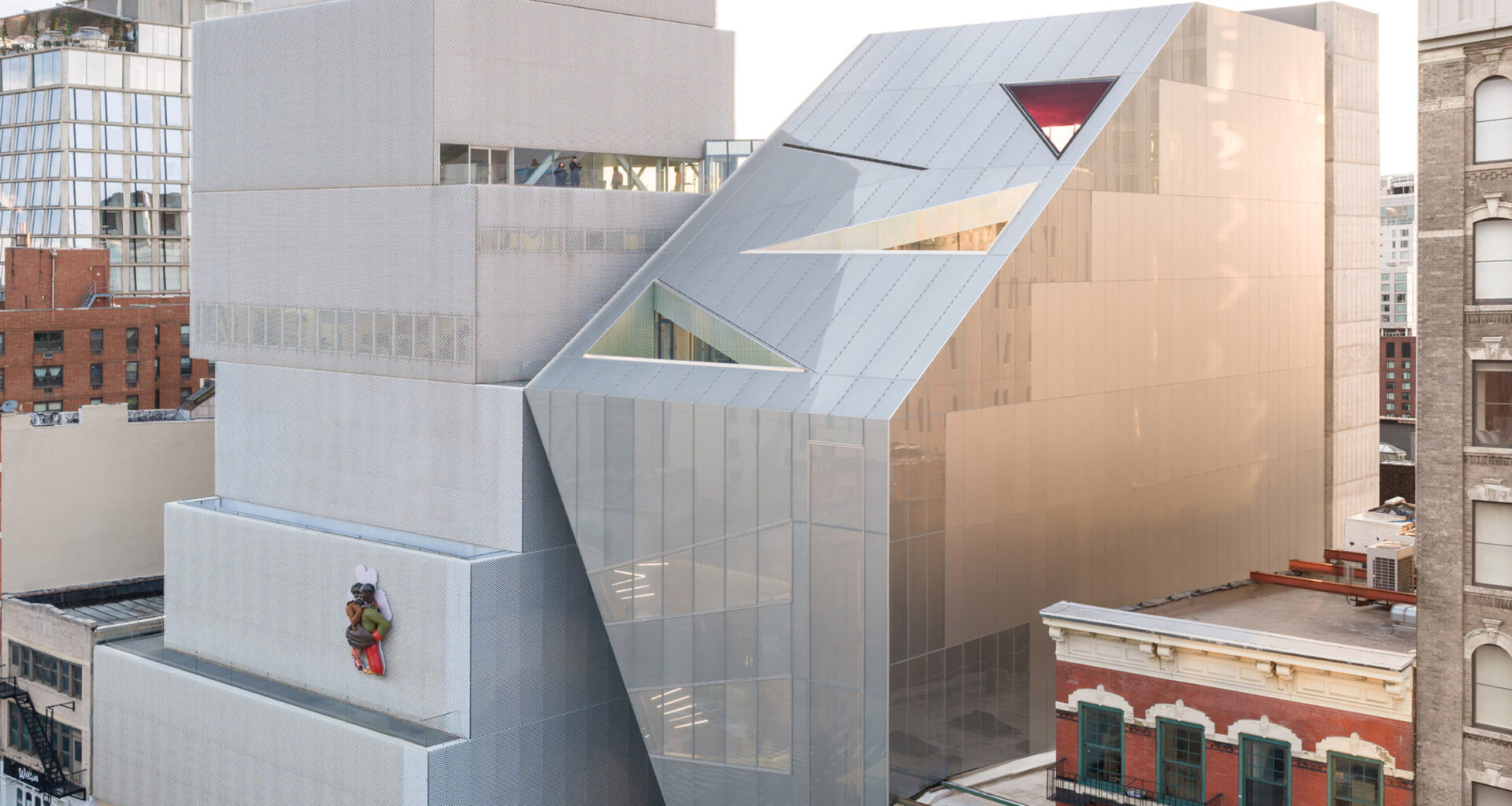
Architecture studio OMA has mirrored the programme of the SANAA-designed New Museum in Manhattan with an extension that has a unique profile and facade treatment.
Led by OMA‘s New York office, the New Museum expansion features a ground-up build abutting the structure Japanese architecture studio SANAA designed for the institution in 2007.
OMA’s project, its first public building in the city, doubles the footprint of the contemporary art museum to 120,000 square feet (11,000 square metres), adding much-needed social and gallery space and additional egress for the expanding number of visitors.
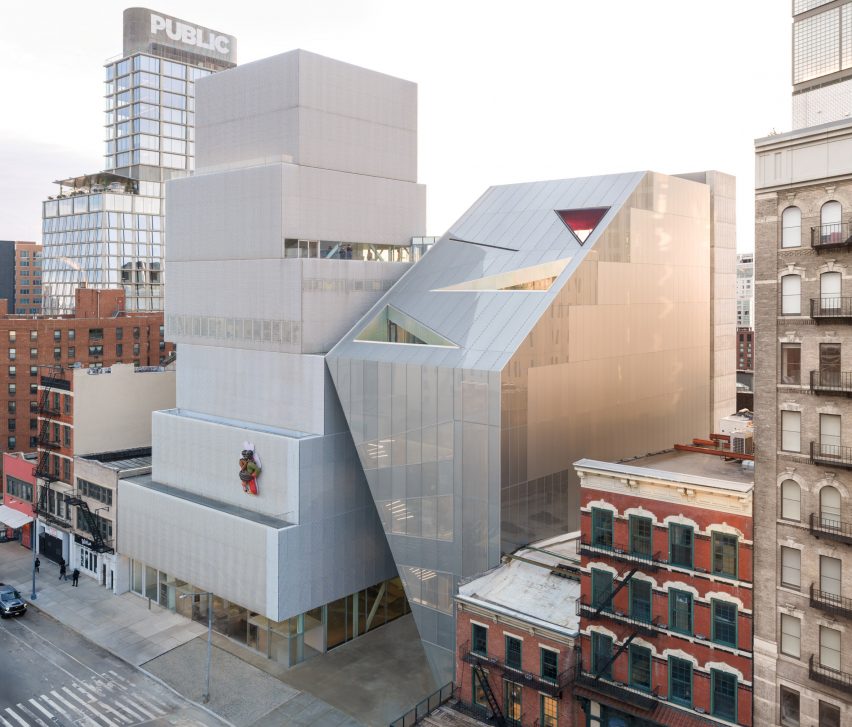 OMA has designed an extension for the New Museum in New York. Above photo and top by Jason O’Rear
OMA New York principal Shohei Shigematsu said the conditions for the expansion were unusual, given the relative contemporaneity of the SANAA building and referenced the idea of a “twin or pair” in his studio’s design.
“We were very careful in actually understanding what it means to build contemporary against contemporary,” Shigematsu told Dezeen.
“We actually looked at the idea of the pairs, or that notion of the pair.”
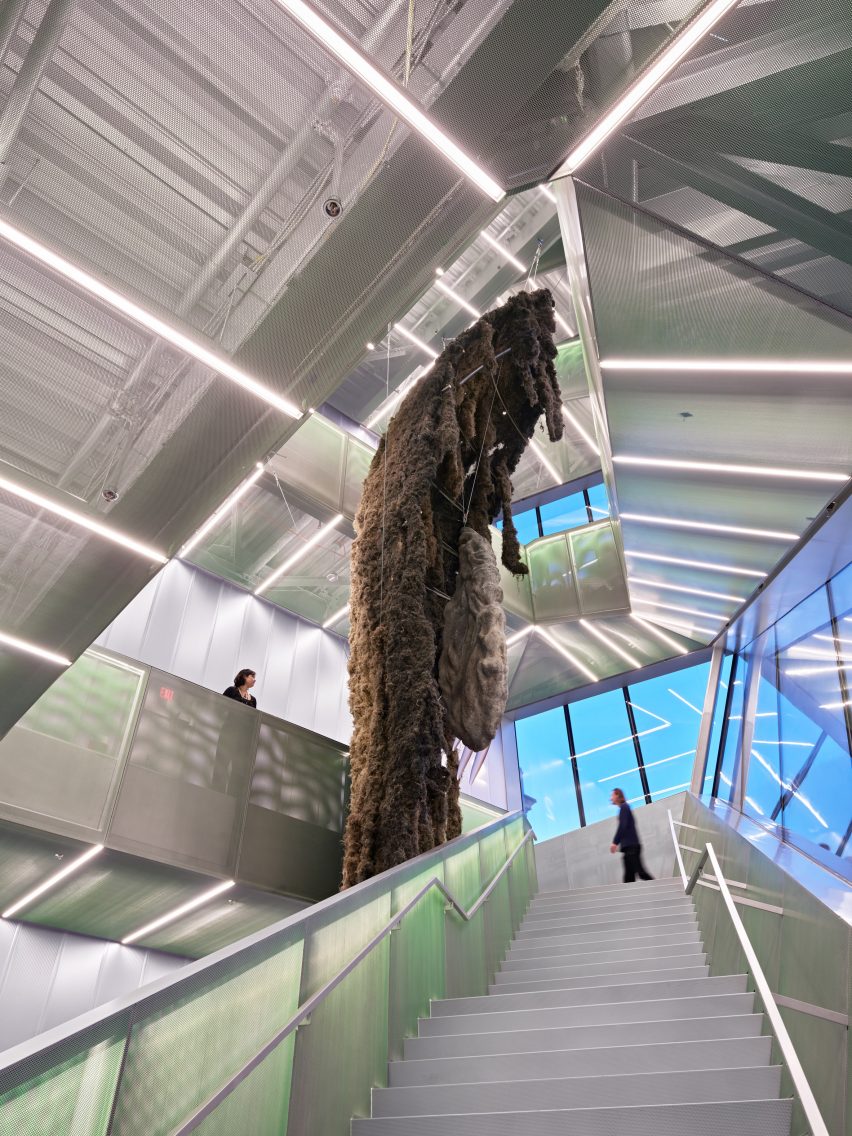 A massive staircase fills the atrium at the front of the building. Photo by Jason Keen
He recalled a set of reference images, such as that of a performance of Marina Abramovic and her then-husband Ulay standing naked facing each other in a doorway for in 1977 and of the fixed-service structures that support an orbital rocket pre-launch.
“I often joked, when I had to present this to the board members, that finding the love of your life is one of the most difficult things, right?” he said. “So this is what we were doing here.”
“It’s highly connected, but highly individual too,” he continued.
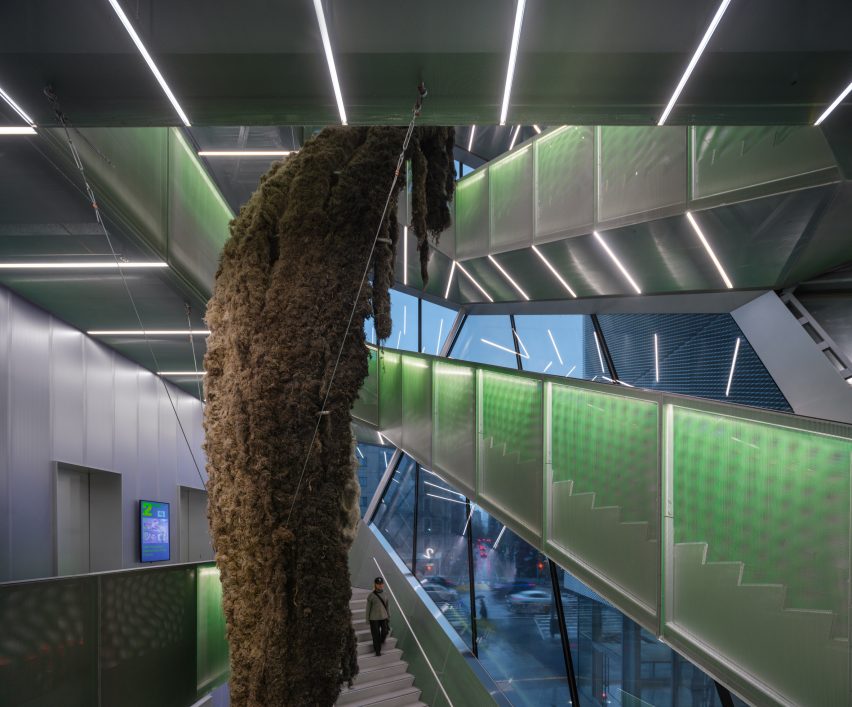 The metal-mesh staircase was painted on the inside to produce a moire effect. Photo by Jason O’Rear.
Scrapping the initial notion of maintaining the facade of the pre-existing, mid-rise industrial building, OMA designed a building that resembles a pentagon in section. It has a steep recess at ground level and a deep setback above tapering towards a central point, where it “kisses” the facade of the SANAA building.
From the north, the structure is mostly obscured by the taller SANAA building, but it extends deeper into the block.
“It’s actually quite surprising, because from outside, it’s not so screaming for presence, but as you enter, you feel the depth,” said Shigematsu.
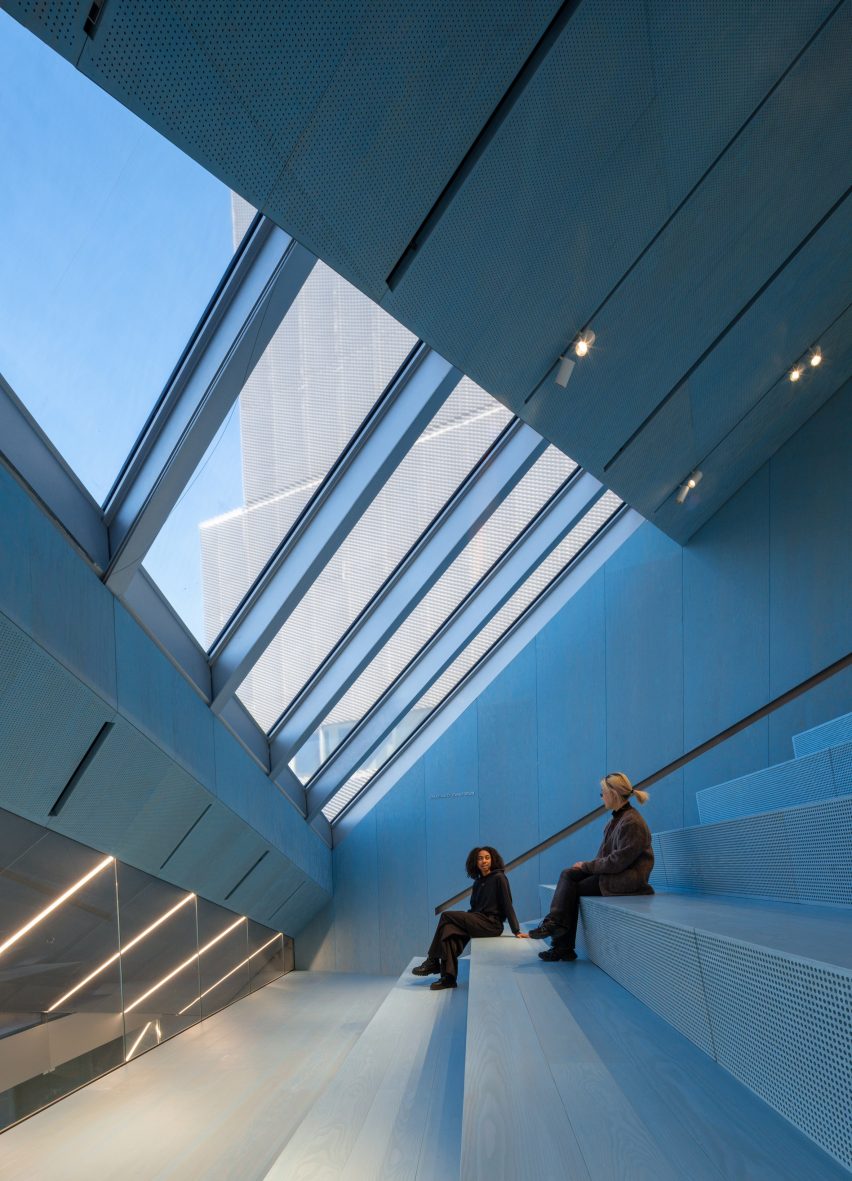 Gaps in the facade near the top allow views out and up. Photo by Jason O’Rear.
The faceted facade was clad in laminated glass with metal mesh that recalls the aluminium mesh of the SANAA building, while remaining distinct.
Immediately inside the street-facing walls, an atrium between the galleries and the facade allowed for a winding staircase that connects at each landing to the levels of both buildings.
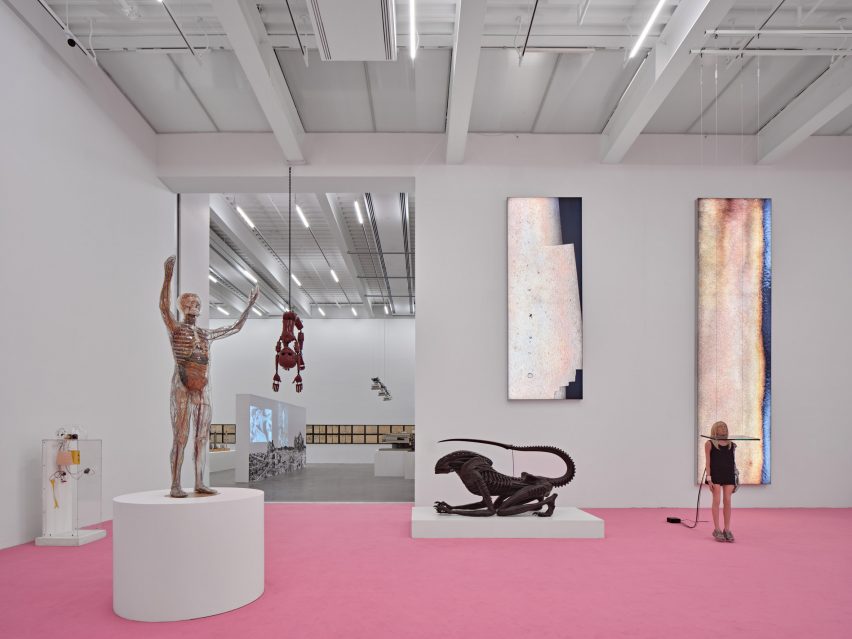 It nearly doubles the gallery, programming and office space for the New Museum. Photo by Jason Keen
At the fourth level, there is a soaring columnless space with an auditorium that faces a glass-filled void in the facade, which has views out into the Bowery.
Shigematsu referred to the staircase atrium as a “social and visible condenser” that allows the whole museum complex to become more “open and communicative”.
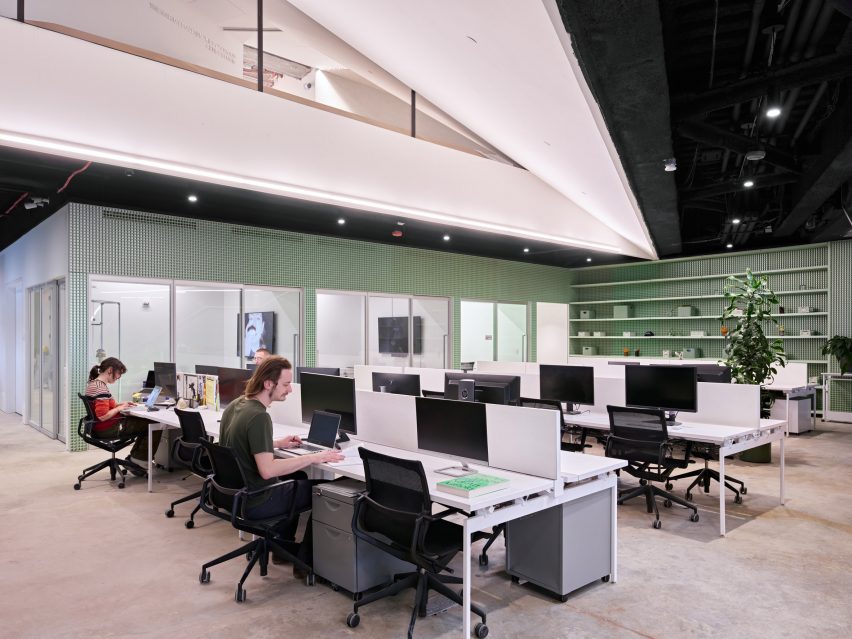 The office space at the top of the building was referred to as its “brain” by OMA. Photo by Jason Keen
Shigematsu said the vernacular front-facade fire escape played into the articulation of the stair.
Further voids in the facade hold balconies and additional panes of glass without the metal mesh form stripes running down the side of the building, giving the building a sense of publicness and transparency.
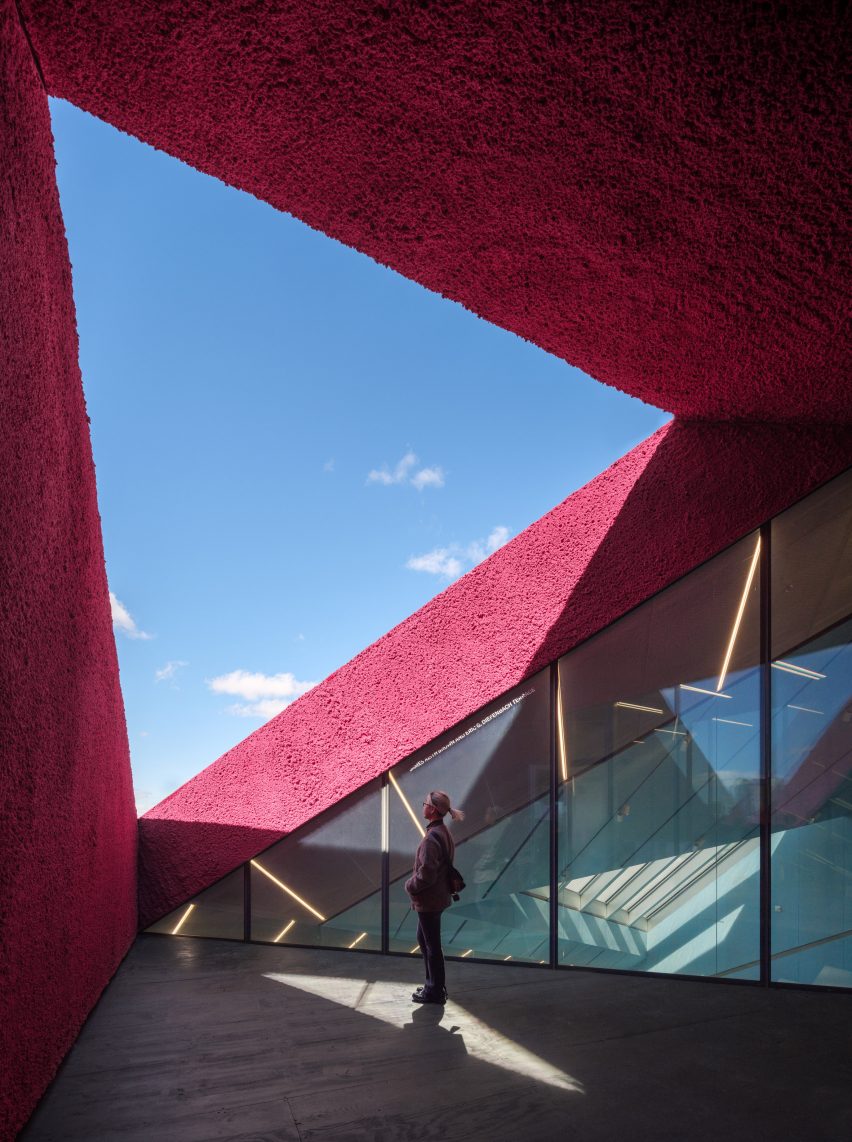 Outdoor balconies feature along the building’s upper slope. photo by Jason O’Rear.
OMA’s building sits at the junction of a three-way intersection and faces Prince Street, acting as a terminus. The entry into the newly programmed entrance extends the street into the building and upwards, up the new staircase.
At ground level, the slope of the OMA facade was articulated again at the north side, folding inwards. This exposed more of the SANAA building, leading the team to bring in additional material to extend the original facade.
OMA wraps Jomoo headquarters in white ceramic stripes
This double fold created a triangular exterior courtyard. Next to it, the primary entrance into the museum leads into a lobby that includes the unticketed ground floors of both structures.
A massive portal door leads from the original lobby into the ground floor of the extension, which centres around a concealed restaurant, clad in expanded cork painted with silver leaf, blending it into the metal ceilings and polycarbonate-clad elevator core.
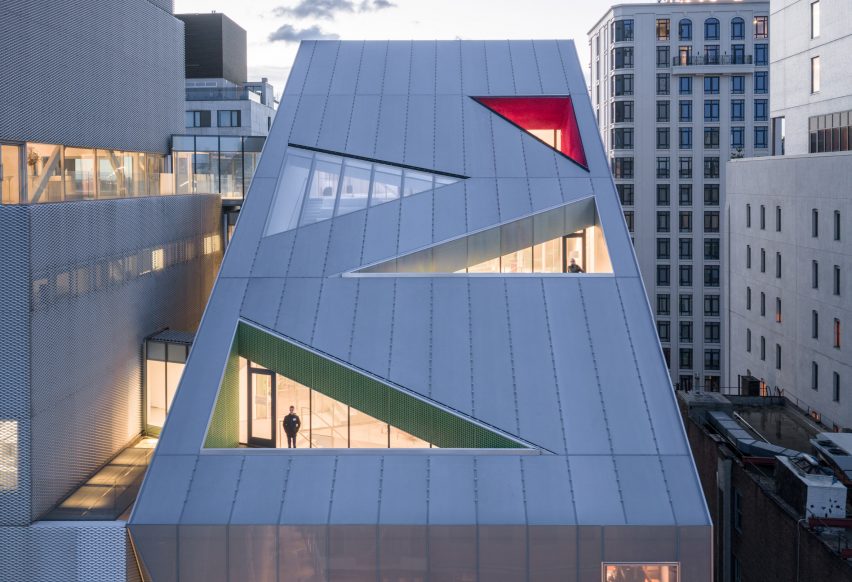 It sits deeper in the block but also lower than the neighbouring SANAA building. Photo by Jason O’Rear
The restaurant acts as an enclosed courtyard within the lobby, and the plan is for it to be accessible via the lobby as well as via Freeman Alley at the back of the structure after the museum has closed. Inside, it features walls and ceiling also clad in cork, this time left unpainted.
It has textured glass that obscures the interior of the restaurant from the lobby, but allows restaurant goers to look out.
In order to allow for free movement on the ground level, the ticketing was pushed to the stairwells at the front of the building.
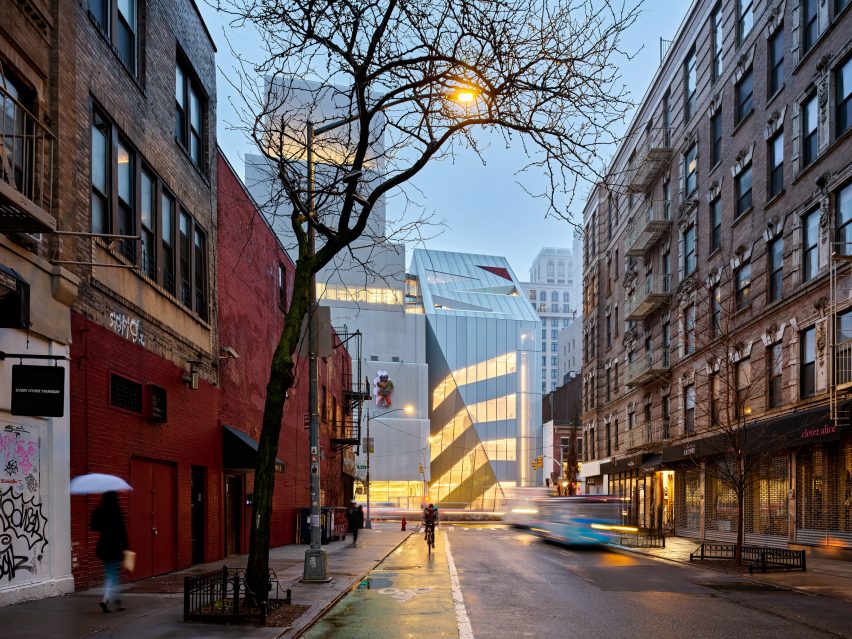 The extension terminates a street. Photo by Jason Keen
The winding stairway crisscrosses the atrium at severe angles and is clad with more mesh, painted green on the inside to create a moire effect. Exposed I-beams and highly polished meshed floors create a collage of industrial materials.
New galleries echo the relatively simple format of the original, with high ceilings and white walls.
The gallery spaces run for the first three storeys, while above level four, incubator spaces and offices form what the studio called the “brain” of the building, conceptually and formally.
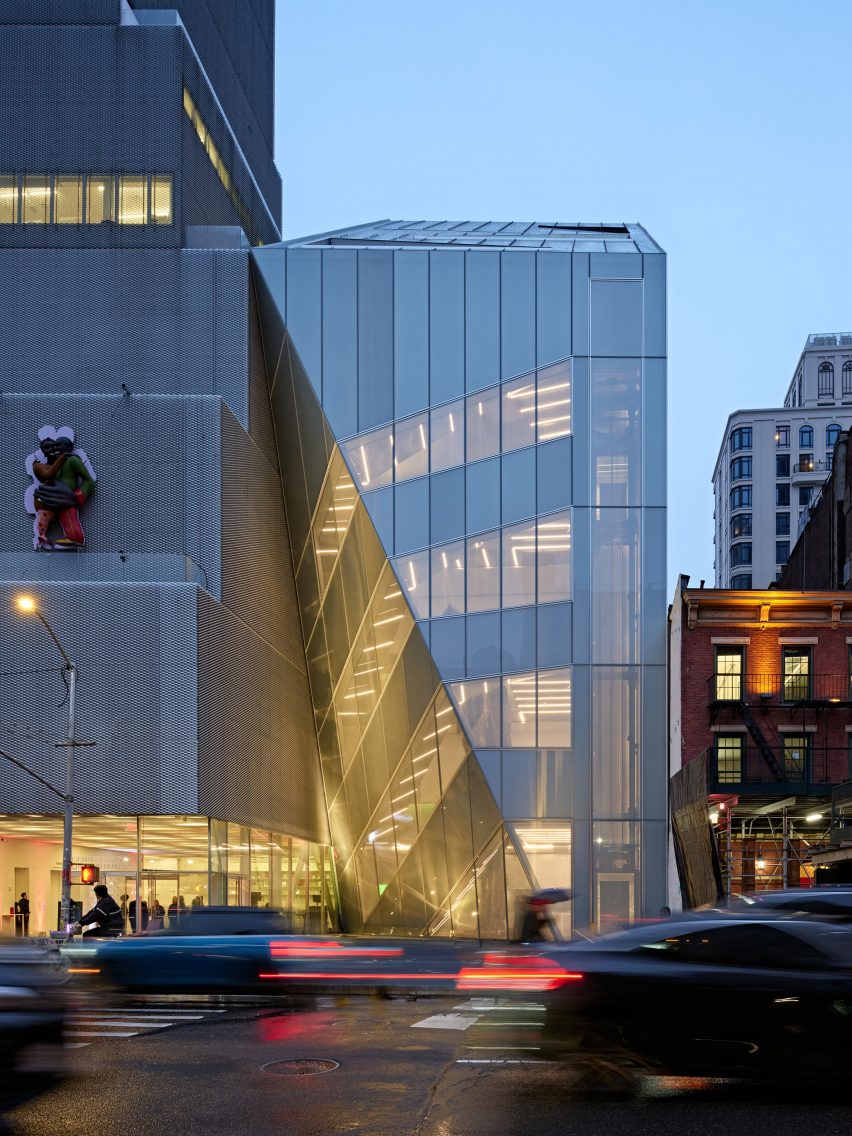 The faceted facade creates a triangular exterior courtyard. Photo by Jason Keen
New Museum artistic director Massimo Gioni referred to the prismatic quality of the new building, saying it reflects the non-collecting museum’s mission to “refract” artistic messages from all over the world.
For Shigematsu, the build represents a culmination of arts and culture work in New York for OMA and recalls the studio’s other recent museum, the faceted glass extension for Buffalo AKG Art Museum. He was also part of the failed bid for a Whitney Museum extension in 2001.
“It took 20 years, but gave me the kind of holistic understanding of the ecosystem of art,” he said.
“It’s a once-in-a-lifetime chance to be able to do a building of this calibre in Manhattan. So we are very blessed.”
OMA’s founder, Rem Koolhaas has long theorised about New York, with his 1979 book Delirious New York being a significant work of architectural theory.
Other recent museum projects by OMA include the aluminium-clad Gallery of the Kings at the Museo Egizio in Italy
The photography is by Jason O’Rear and Jason Keen.
Project credits:
Design Architects: OMA: Shohei Shigematsu, partner in charge; Rem Koolhaas, partner in collaboration; Jake Forster, associate/project architect; Jackie Woon Bae, design lead; Ninoslav Krgovic, technical lead
architect of record: Cooper Robertson (now Corgan), Erin Flynn, principal; Andrew Barwick, senior associate; Isil Akgul, project architect
New Museum Building Project Coordinator: New Museum, Dennis Szakacs
Project and cost management: Gardiner and Theobald
Construction Manager: FJ Sciame Construction, Co
Structural engineer: Arup
Mechanical Systems: Arup
Facade: Front
Geotechnical: Langan
Signage: 2×4
Lighting: Dot Dash